
Every sign and symptom can be triggered by either a mental fear or a physical strain. This time, it was no imagined fear, but a real underwater struggle during my first open water diving session. It was the last of my strength to hold on underwater. What remained was my intuition to survive, to clamp my mouth onto the regulator and wrestle back control of my breathing while being 5m below the surface of the sea water. I managed a few seconds of calm midway, trying to mouth-breathe with control, but it felt impossible after unintentionally aspirating saltwater. The disturbance to my parasympathetic system was enough to cloud my rational thinking in that second to disrupt underwater and diving regulations. Alongside my diving instructor, I forcefully swam to the surface to gasp oxygen through my lungs. Uncontrollably, I began coughing, followed by streams of vomit.
The formidability and pain I then sustained weren't something temporary. It was firstly accompanied by a sensation that my lungs were filled with saltwater, reinforced when I vomited constantly with what looked like '白沫'. I tried as hard as I could to breathe but that felt strenuous and nearly impossible. The worst was not the pain but the mental storm: thoughts of decompression sickness (DCS), pneumothorax, pleural effusion spiralled through my mind. They all sounded like some horrible complications for a recreational diver, certainly not the outcomes I had planned.
The progression from reaching the water surface, crawling into the boat, and finally catching sight of land became one of the most agonising waits, as quoted due to my physical symptoms. There were some blurred moments on the boat, where I was given mild oxygen therapy at (possibly) 5L/min, my diving buddy guided me to practice conscious abdominal breathing and to hydrate with water. Altogether, I felt dizzy, dyspnoeic and exerted. I couldn't control it and vomited non-stop. I even lowkey peed myself during this process TT. It was a wrestle in my head if oxygen therapy is what I needed at that point, I knew I wasn't unconscious or hypoxic. It was a mechanism failure of respiration, rather than an oxygen deficit.
It is at that moment that I was reminded of the legendary tale of a cardiothoracic surgeon who, while enduring a STEMI (a medical term of heart attack), diagnosed his own condition. He was able to pinpoint the site of cardiac infarction and steered himself towards care. He was a master-grade physician, who knew illness not only in theory, but in flesh. Truly, I had yet to master such a knack.
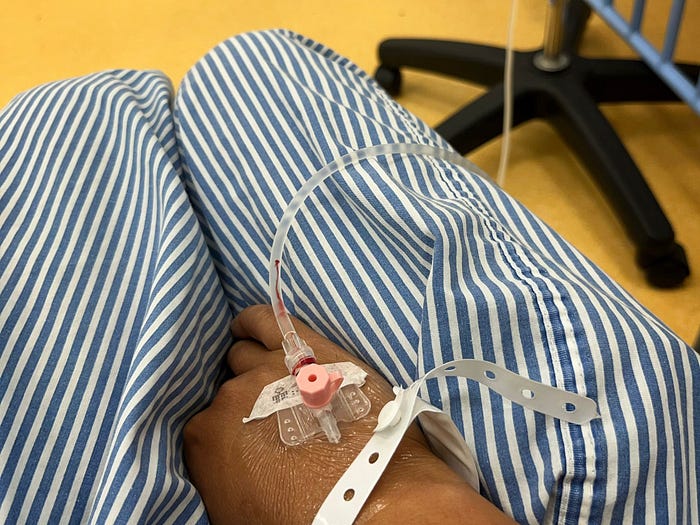
An exciting side quest while in my hometown is to deliberately experience Malaysia's national healthcare system by being a patient myself. Indeed a rather exciting one, although not what I intended to. I was impressed actually, by their effectiveness, the language versatility, the professional enquiries and the hospital facilities. Some incompleteness included the lack of a full respiratory physical examination or a complete medical history being taken. Technically, they had ONE job which is to rule out the possible diving complications such as decompression sickness and pneumothorax — which they did.
I wasn't complaining because physically, I couldn't even speak. Every movement or step I took would either cause me to lose control in breathing or literally this sharp pleuritic pain would cut through with every attempt to inhale. I find myself describing this in a dramatic manner. I normally classify myself to tolerate pain well, but this pain felt like breathing against vacuum-sealed walls. It was claustrophobic and made me more conscious of each breath. Oxygen is such a gift. Never before had I realised how much it sustains every moment of life, until, at 23, I found myself fighting for each breath.
Getting my urine collection was a pain. Squatting to sit down felt like I was going to pass out, but I can manage, I told myself. One unique thing about the hospital was the freezing cold temperature, with air-conditioning on full blast so that no sweat could be seen or smelled. It was only afterwards that I realised why the hospital looked so impressive, the emergency department had been the first to undergo renovation, which explained its fresh appearance and polished facility. I hadn't had the chance to comment on other departments' facilities and I probably rather not at this point.
I sat on the wheelchair and was pushed to the radiology centre to get my X-ray done. I was genuinely terrified by the fact when breathing became so painful and difficult. I was convinced that I may have a pneumothorax, basically a tear of the lung tissue through massive lung expansion, commonly seen as a pulmonary complication of an unregulated ascent underwater. It literally means the lung has broken. But what else can I be more thankful for because I in fact did not suffer a ruptured or collapsed lung. The chest x-ray showed haziness and horizontal lines across the lung fields, indicating alveolar fluid accumulation, which are the saltwater I aspirated. I was adamant about interpreting my own X-ray and they actually allowed me to. I even cheekily took a picture. Initially, the peripheral shadows on the x-ray looked like signs of pneumothorax, but the doctor reassured and showed the presence of some lung markings despite the shadow — disputing a pneumothorax. PHEW, that was what I needed to hear.
I rested and slept on the hospital bed. Little did I know that the degree of exhaustion I was in was enough to put me into a state that my physical body was unmoved and my mind slowed down. I still wanted to know why I was exhausted, my diving instructor was direct enough to validate my exhaustion: I had just experienced a panic attack! Anyways, he shamelessly took a group selfie while I was struggling on the hospital bed?!?! It became a funny story to tell (even giggling while writing this down)….
Reassurance came after, he told me that I can still dive after. No amount of happiness can be expressed when I heard that and no fear shall stop me. I am entirely blessed by people around me who are kind with their words.
Recovery is a process, the struggle to breathe was imminent and will take some time to heal. I inhale and exhale, continuously. Every step felt lighter, especially after the dispersion of my mental whirlwind. I was discharged and drove myself back home. Every easy daily activities humbled me, because driving felt like my lungs needed time to rest, although nothing was supposed to exert my lungs when I was sat in a car. So here I am, resting and breathing.
I made a promise to return stronger, with courage and humility. My heart and lungs are ready to learn from mistakes and to see joy where fear once lived.