
How bombing three different SDE‑2 interviews — at a Big Tech giant, a FAANG rival, and a scrappy startup — finally taught me how to level up.
The night before attempt #3, I promised myself I wouldn't scroll LeetCode "easy"s to feel better.
I'd done that before both of my previous interviews. It's like eating cotton candy before a marathon — sweet and useless. At 1:00 a.m., staring at the ceiling, I admitted something I had avoided for months: I didn't have a skill problem. I had a proof problem. I couldn't prove my skills under pressure.
The truth is unsexy. I knew the patterns. I had notebooks, flashcards, and a wall of sticky notes. Yet in the moment, my brain froze at precisely the time clarity mattered most. Failing the third time — this time at a startup that should've felt "friendly" — forced me to re‑engineer my approach from the ground up. This is the story of those three interviews, what broke, how I rebuilt, and seven lessons you can use right now.
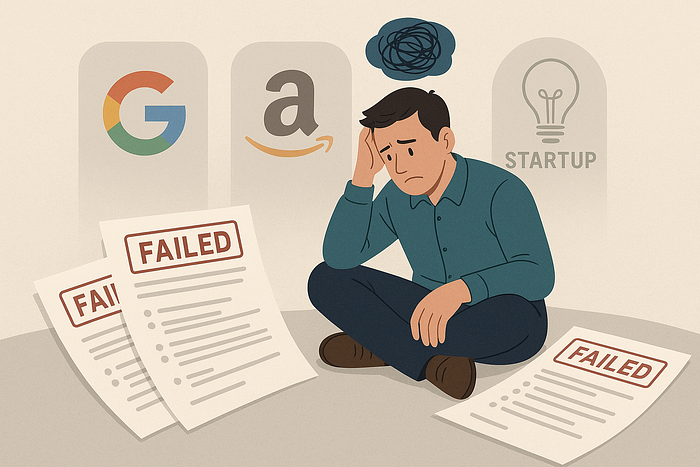
The Three Interviews (and where I tripped)
1) Google: The hidden cost of late correctness
Format: 2 x 45‑minute rounds (DSA + systems), virtual.
What happened: I solved the core DSA question… with 8 minutes left. I narrated too little, optimized too late, and got stuck proving correctness under edge cases. I also never labeled time/space complexity aloud. The interviewer wasn't grading my final code; they were grading my signal. Mine arrived at the station after the train had left.
Post‑mortem
- I didn't time‑box exploration vs. execution.
- I skipped a deliberate complexity statement (T: O(n log n), S: O(1) etc.) and didn't test systematically.
- I thought "working code" was enough. It wasn't.
2) Amazon: The behavioral trap I didn't see coming
Format: 1 coding, 1 system design, 1 behavioral (Leadership Principles).
What happened: I under‑indexed on behavioral. When asked about disagreement with a peer, I rambled into a nice‑sounding story that didn't show ownership, frugality, or earning trust. My coding round was fine; my LP round sunk me.
Post‑mortem
- My STAR stories weren't "bar‑raising" — they were "feel‑good."
- I didn't quantify impact or tradeoffs.
- I avoided the word "I" to seem humble and erased my own agency.
3) Startup: The speed illusion
Format: 1 take‑home (4 hours), 1 live code review, 1 founder chat.
What happened: I shipped fast but ragged. The reviewer opened my PR and I watched them scroll through duplicated logic, no tests, and zero docstrings. When they asked about extensibility, I had a clever answer and fragile code.
Post‑mortem
- I optimized for demo‑ability, not maintainability.
- I didn't treat the repo like something other people would live with.
- My take‑home lacked a README that told a compelling story.
The Seven Lessons (that finally moved the needle)
1) Narrate like a reviewer is listening
Don't code in silence. Use a rhythm: Frame → Explore → Decide → Execute → Verify. Say the invariants out loud, state complexity early, and keep a running test list ("empty input, all duplicates, already sorted, adversarial"). You're not showing off — you're giving the interviewer handles to grab.
2) Time‑box the ambiguity
Set explicit mini‑deadlines: 5 minutes for brute force, 5 for patterns, 5 for decision, then build. Announce them. If you're still exploring at minute 15, you're not stuck — you're late.
3) Make correctness cheap
Write scaffolding first: helper to print state, quick local tests, a tiny harness. Micro‑tests are insurance. People remember how confidently you verify, not just whether your first attempt compiled.
4) STAR isn't a script; it's a ledger
For behavioral, keep a ledger of Situation/Task/Action/Result but also add Lessons and Next Step. Numbers beat adjectives: "reduced p95 latency from 920ms → 410ms" crushes "made things smoother."
5) Design with edges first
In systems rounds, draw the bottleneck before the boxes. "Our QPS doubles during sales; cache churn spikes; how do we shed load?" If you lead with constraints (SLA, consistency, back‑pressure), your architecture looks inevitable, not improvised.
6) Ship like someone else inherits it tomorrow
Take‑homes: prioritize a clean README, tests that prove behavior, and a tiny ADR (Architecture Decision Record) explaining why you didn't build the spaceship. Reviewers hire people who reduce future risk.
7) Practice the transfer, not the trick
Patterns transfer across unseen problems; tricks don't. Drill recognizing when to pivot: two‑pointer vs. sliding window, heap vs. bucket, DFS with memo vs. topo sort. Score yourself on switch cost — how fast you abandon a dead end.
A Concrete Example: Turning a messy story into a bar‑raising one
Original (weak): "We had a caching issue. I helped fix it and users were happier."
Refactored (bar‑raising)
- S: Incident: cache stampede during campaign; p95 latency 900ms; 3x 500s.
- T: Reduce errors <0.1% and p95 <450ms before next campaign (10 days).
- A: Introduced request coalescing with singleflight keys; added circuit breaker for dependency X; raised TTL jitter 15–35%; synthesized load test with production keys; dashboarded hit rate & errors.
- R: p95 410ms, 500s down 92%, infra spend −14% from origin offload.
- L: We were blind to "thundering herd" until we graphed collapse time vs. TTL.
- Next: Wrote a runbook; added canary and autoscaling guardrails.
This version shows ownership, constraints, trade‑offs, and measurable impact. It sells judgment, not just activity.
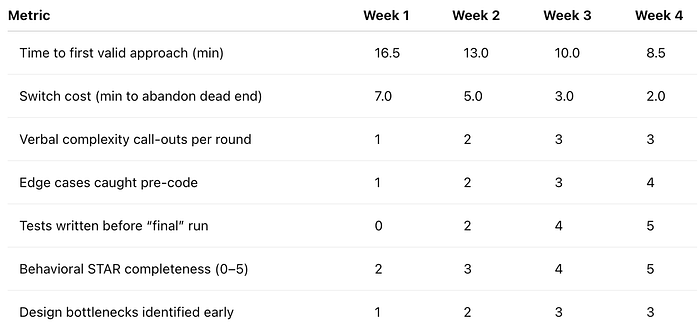
Micro‑Benchmarks: What actually improved when I applied the seven lessons
Self‑run, 4‑week experiment with 10 mock sessions (2/wk coding, 1/wk design, 1/wk behavioral). Same partner, new problems each time.
What it helped with
- Faster convergence (less flailing).
- Clearer signal for interviewers (they can advocate for you).
- Fewer last‑minute corrections (confidence up, cortisol down).
- Reusable habits at work: incident response, design docs, code reviews.
A Minimal Prep Plan (4 weeks) you can copy
- Daily (30–45 min): 1 DSA problem by category (rotate arrays/graphs/greedy/DP). Narrate out loud. Always state complexity. Always list three edge cases first.
- 3x/week (45–60 min): Mock interview with a buddy. Record it. Score yourself on the table above.
- Weekly (90 min): One systems prompt (rate limiter, feed service, search autocomplete). Lead with constraints; draw bottlenecks first; compute back‑of‑envelope capacity.
- Weekly (45 min): Behavioral ledger upkeep — refresh two stories; add numbers; add a "failure" story that ends in a process fix.
- Take‑home practice (1 weekend): Build a tiny service with a README, tests, and an ADR. Ship something boring but durable.
If you only remember three things
- Don't perform code — explain decisions.
- Don't chase clever — chase transfer.
- Don't aim for perfect — aim for provably right, quickly.
Epilogue
Two months after the startup rejection, I redid the same kind of take‑home for another company. This time my README told the story, my tests proved the claims, and my interview narration sounded like I was pair‑programming, not auditioning. The offer came a week later. The difference wasn't a brand‑new algorithm — it was a brand‑new way of sending signal.
If this helped, share it with someone who needs a kinder, sharper plan. And if you fail again, good. Now you know where to look.