

No matter what your writing goals are, I believe you want to write interesting content that can be meaningful and have a considerable impact on both yourself and your readers.
I know because I do.
Once, a fellow writer Irfan Arif left this comment on my article:
Ahaa! You write so well. First of all, I will need a cat to practice. And you write so well. Definitely write something about your writing process. And secondly, I need to make jokes. These four steps are well to the point. And you are humorous, I did smile reading your article.
Who doesn't like a nice, meaningful comment like that? Plus, he mentioned "you write so well" twice. Reading it surely helped my ego skyrocket.
As he requested me to write something about how I write, I thought to myself, sure, why not?
Besides, as a writer with 6 years of experience in blogging and having been in the content creation world for a while, I think there is a thing or two that I can share. So let me share my writing process along with what I've learned on how to create interesting content for yourself and your lovely audience.
What Is the Formula for Interesting Content?
Before we get into my writing process, let's identify what is "interesting content".
Interesting content is the content that people "want" to read. Emphasize on the want.
But want is such a relative word. The big question is, how do I get people to want to read my stuff?
While there is no definite answer to that, I found that all kinds of interesting content — regardless of the genre — have common patterns that we can identify. I've learned that the formula for interesting content is:
Readable & Engaging & Quality = Interesting Content
Or you can shorten it to R.E.Q.
Let's break it down one by one.
- Readable means that it is enjoyable and easy to read. No matter how heavy the subject, readers can read and understand the writing clearly and easily. If your idea is amazing but you can't convey it in readable content, it will confuse your readers and possibly drive them off halfway.
- Engaging articles offer something new, helpful, or inspiring. It gives the readers a peek at something they haven't seen before but can relate to. The story makes sense to them and keeps them engaged till the end.
- Quality prefers a well-written piece that has a purpose. The article gives solid knowledge or wisdom based on actual experiences. The readers will see your content as valuable, meaningful, or relevant.
Josh Bernoff, author of Groundswell and Writing Without Bullshit, put it this way:
Quality content is useful, based on actual statistics or experience, and unique — not available anywhere else. If people need something and you make it easy for them to find it, they'll come.
A Deep Look of My Writing Process
After knowing the formula for interesting content, here I will present the steps for how I write an article. It's important to note that in each step, I always keep the R.E.Q. formula in mind as it helps me write better.
My writing process goes like this:
Topic → Framework → Research → First draft → "Hardcore editing" → Revise → Proofread/Final editing → Done/Publish.
Here is a detailed look at how I write a single Medium article in 7 steps:
1. Choose the writing topic.
First, I pick an idea for my writing topic. It could be from the writing ideas I already had or from getting a new one.
I jot down many writing ideas every day in my notes. Sometimes I save them in my Medium drafts as ideas for later. I currently have 40 drafts, but I prioritize finishing and publishing them one by one depending on time and urgency.
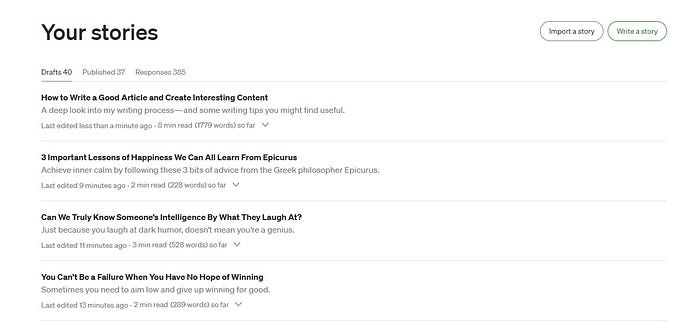
If you want to generate infinite writing ideas, I wrote some tips that you can read in this article.
2. Create the framework.
To create a framework, I ask myself: What do I want to say here? What points do I want to convey in my writing? And the killer question: Why does it matter?
Knowing the 'why' of my article is a must. I write a lot of things on a whim. But I only share what's truly valuable (at least for me).
Pro-tip: start the framework with the why/what and then follow up with the how. For example, for this article, my key points were: (1) why do writers want to create interesting content, (2) what is interesting content, (3) a deep look at my writing process (the how).
3. Perform deep research on the chosen topic.
Next, I look for case studies, theories, or gather more pieces of information relevant to the ideas I've collected.
Some writers only write personal stories so they rarely need a lot of research (or don't do research at all). I'm not against that. But for me, I have my own rules: don't treat Medium as a 'diary'. If you want to tell the entire world about how amazing your day was, do it on your blog. Or make a thread on Twitter. Just don't do that here.
For these reasons, I always research to gain a deeper understanding of the topic. Even for personal stories, I always try to draw general conclusions that others can learn.
Pro-tip: provide some interesting facts or random (but relevant) trivia about your topics. If you don't know what to look for, just type on Google "interesting fact about [insert your writing topic here]". For example, when I wrote this article, I gave facts about how Google is a big success but actually fails 36% of the time — did you know that?
Another interesting fact: that article mentioning Google above was my first article to get a 100% engagement read ratio.
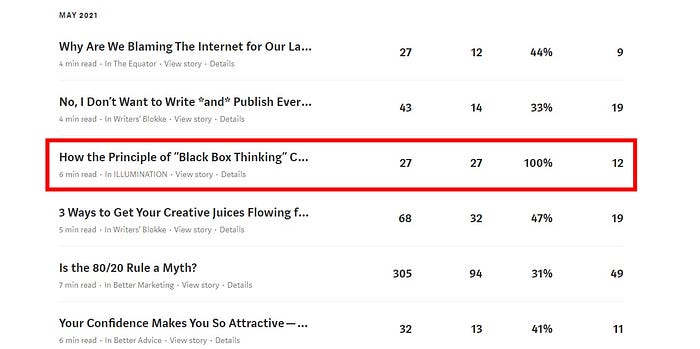
Even though it doesn't get as many views compared to my other articles, I'm so happy that (all) the readers read it to the end (thank you so much!).
4. Write the first draft.
Now, it's time for the actual writing. I write my first draft from the ideas I've collected and the knowledge I've gathered. When writing the first draft, I avoid any kind of distraction — such as a phone or a cat — and just write for about 1–2 hours.
Pro-tip: while writing the first draft, choose your own unique perspective or tell your story from a different angle by asking unexpected questions. For example, I wrote this self-improvement article about attitude from a simple question of "how is the life of a balloon salesman?"
5. Do hardcore editing.
Editing, editing, editing. I edit my article like my life depends on it.
In this process, I fix grammatical or spelling errors (like everyone else; I use Grammarly and ProWritingAid to help with this), rewrite better sentences, choose clearer words, blend words and paragraphs, check sentence fluency, and make headings and subheadings.
I am aware of my perfectionist nature — which often does more harm than good — so I set a time limit to avoid going insane and focus on the things that matter.
Pro-tip: you can use the 'rule of three' — a writing principle because humans process information through pattern recognition — anywhere; to make effective phrases, lines, tricolon, sections, etc. For example: in this article, I use it to make the R.E.Q. theory and the sections of this writing — Introduction-Body-Takeaway.
6. Repair the piece for a better craft.
This is where I clean up and revise my piece. I add some relevant quotes, add or check backup links, rewrite (or delete) fluffy paragraphs, and delete a LOT of unnecessary sentences.
My rule of thumb while revising is this quote from my favorite human entrepreneur:
"Why waste a sentence saying nothing?" — Seth Godin
Pro-tip: make your content actionable — create a clear takeaway, conclusion, or final thoughts at the end of your article. Conclusions are important because they wrap up the story and comfortably tell the readers that they've reached the end.
7. Proofread/Final editing.
In this step, I read my writing out loud (not too loud to piss my neighbor off). If I hear something is off — I edit, change or cut it until it feels natural.
This way, I can articulate the writing more clearly and compellingly.
Pro-tip: imagine presenting a YouTube video while proofreading your writing.
What to Do After Final Editing
From the 7 steps above, we are ready. The article is ready to be published.
But here are extra details for you about what I usually do after the final editing:
- Decide the title. This is the most important part of the article. Readers won't read your article if they don't click it. Interesting content has a strong, attention-grabbing headline — but not clickbait. I'm also still struggling with headlines but I've been using Headline Analyzer to make better headlines, it's totally free and super helpful for writers.
- Choose an image and relevant tags. I often use images from Unsplash, Pexels, or Pixabay and properly cite each source. I always use the maximum number of tags which is five. For inspiration, I usually look at some tag ideas with Top Writer status that can be found here.
- Done? Read my entire article again. If there's no big problem, I don't publish it right away. I take a break or do something else for 2 hours or more, or check it out the next day.
- 2 hours later or the next day: check out my article with a fresh mind. Not satisfied? Edit again, think about how I can improve my craft.
- Satisfied? Okay, publish!
Finished!
Seems like a long process, doesn't it? But that's how I did it. This entire writing process can take 3 hours or 3 days — it depends on the topic. Like this article, I finished it in 3 days.
It's important to note that the writing process is not linear. It's very much recursive — I jump from one step to another and then back again. It goes forward, backward, sideways, here and there.
For example, when I already in editing, I go back to research to find more evidence to support my point. Or when I write my first draft, I start with the main body of the text, saving the introduction for later once I have clearer ideas for the introduction.
The Bottom Line
Writing interesting content is not about making your writing "sounds fun" or more likely to attract audiences — even though these are nice perks. Rather, it's about making your article more relatable and telling a story that conveys value to the readers.
I believe your readers deserve quality content. So always remember the R.E.Q. formula = Readable, Engaging, Quality.
In the end, only "writing" is not enough, we need to keep honing our craft until it can make a lasting impression on the minds of the readers.
"Either write something worth reading or do something worth writing about." — Benjamin Franklin