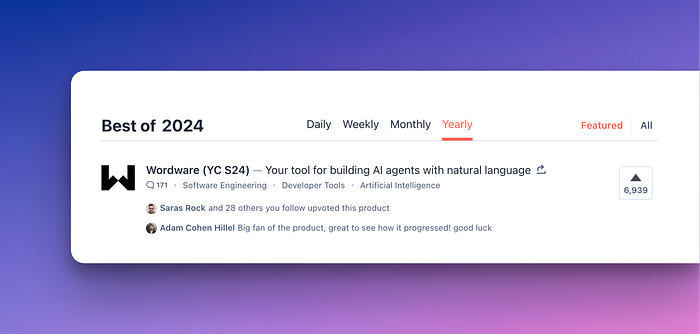


On August 2nd, Wordware AI officially launched on ProductHunt, and the overwhelming number of upvotes sparked massive debates in both domestic and international founder communities🤯🤯
Were they buying fake votes?
Was it the support of the YC community? (Yes, ProductHunt is also a YC S14 alumnus)
Or was it perhaps a product launched with an existing fanbase?
These are all reasonable speculations, but let's uncover the truth step by step👇
After looking at the entire launch operation, one thing is clear: the marketing head behind this is nothing short of a genius.
Speculation 1: The Product Already Had a Fanbase
In July, Wordware's Twitter posts were receiving only 1k-4k views on average. Before this, the official account mainly shared information and comparisons of various models, with very few examples of templates actually created with Wordware AI.
However, looking at Similarweb data, there's a noticeable spike in traffic starting in July.

On July 31st, Wordware released an AI Agency for Twitter personality analysis tool, which suddenly went viral, garnering 195K views and 371 likes. This tool analyzes your Twitter posts and gives you a snarky one-liner description — paid features allow you to unlock insights about your health, fortune, and even past lives. It's a perfect blend of snarky AI and mystical fortune-telling. Given the previous success of Grok's snarky tone, it's clear this was a tailor-made operation for Twitter. The founding team knew exactly what Twitter users wanted.
🔥A Flawless Marketing Campaign: No Risk, No Reward
Sure, we've seen plenty of GPT tools like this, but this time it was different:
- Zero cost: Users don't have to input anything, just paste a Twitter link.
- Built-in virality: Not only can users analyze their own accounts for free, but they can also analyze others'. Much like the popular 16-personality tests, everyone is curious about themselves and the people they follow.
- Perfect result: The snark was just too good — hard to believe this level of wit came from AI!
- Most importantly — it was just an appetizer.
If we were to build such a "real" product, we'd focus on monetization, user scenarios, and retention, but right now, this is purely a fun product aimed at virality. Anyone can use it, without even logging in — the cost is simply treated as promotional expenditure.
When things are simplified, and the goal is singular and clear — just make the product spread as far as possible at any cost — the chances of success increase by 50%.

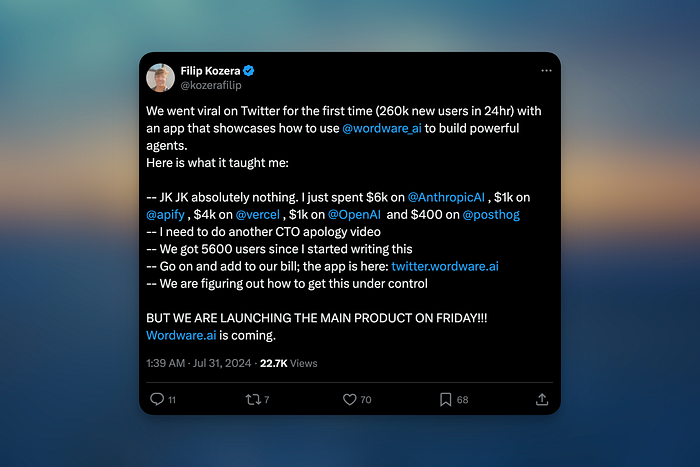
The Twitter accounts of Wordware's CEO and marketing head also exploded on July 31st. CEO Filip openly admitted that this was their first time going viral on Twitter (260,000 new users within 24 hours), and the numbers kept growing. He kept sharing the results of this successful case study on Twitter, truly building in public, attracting founders like us to spread the word further.
Never hesitate to share your success story — it can easily 10X or even 20X your current traffic. Everyone loves a good story, and often, if your product itself doesn't have strong viral attributes (users are less likely to promote it on their own), remember there's a whole community out there (founders) whose daily task is to figure out how to sell their product & others' success stories. Break into one circle, even if it's full of entrepreneurs who might replicate your success.
Fake Votes?
Let's do some simple math:
After reaching 1k votes in the first 6 hours, their position at the top of the PH leaderboard and their astonishing vote count attracted a large number of PH veterans to join the fun. So, let's focus on how they achieved the first 1k votes👇
Based on the actual voting growth curve, we can deduce:
- Asian Users: Active between 12:00 AM — 6:00 AM Pacific Time, contributed to the early votes.
- European Users: Active between 6:00 AM — 12:00 PM Pacific Time, accelerated the vote growth.
- North American Users: Active between 12:00 PM — 6:00 PM Pacific Time, brought the largest vote increases.
The first surge in growth actually started between 3:00 AM — 5:00 AM Pacific Time. During this time window:
- Eastern U.S.: Users were just waking up, starting their day.
- Asia: Users were finishing work or studies, possibly engaging in leisure activities.
- Europe: Users might have been checking social media or voting during lunch breaks or work breaks.
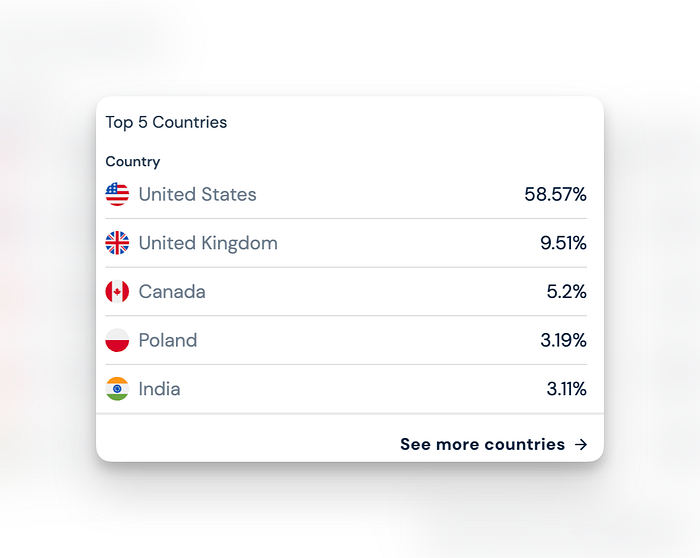
According to Similarweb data, the UK contributed 9.51% of traffic, Poland contributed 3%, and India contributed 3%, so it's likely that the first surge of votes came from Asian and European regions.
The secret to such an astonishing number of votes is time zone differences. Achieving 1k votes within the first 6 hours — before most Americans were even awake — meant that when they did wake up, the top spot was already secured (Note: ProductHunt does not show rankings for the first 4 hours of a launch — the order is random).
Now, let's consider the possibility of fake votes:
Wordware's total votes on the day = 4151
They hit 1k votes between 6:00 AM and 8:00 AM Pacific Time.
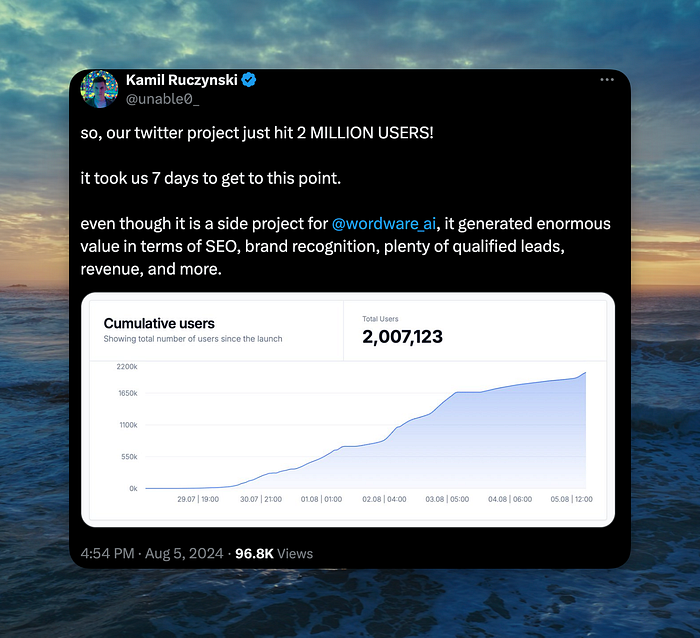
Wordware AI Agency for Twitter personality analysis gained approximately 800,000 to 1,000,000 new users that day.
1,000,000 users * 10% click-through rate to PH * 1% voting rate = 1000 votes (a very conservative estimate)
A 1% voting rate could easily be higher, depending on whether the product was prominently exposed on PH or offered incentives. Generally, a founder can gather 100 votes from friends and family. It seems their team had two active members — the CEO and MKT head — so 200 votes. In the first hour, they quickly boosted traffic, and with Asian and European Twitter personality analysis users, getting 400–500 votes seems plausible. Add YC alumni votes and natural PH traffic, reaching 1k votes in the first 6 hours is not impossible.
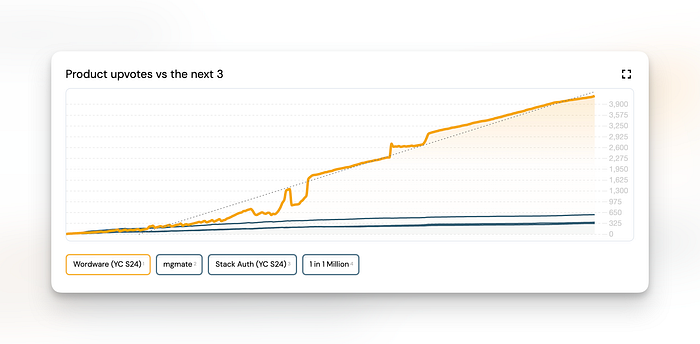
I remember posting a tweet that day asking why everyone launching products now adds "YC S24" to the product name. It turns out it really works😅😅. The #buildinpublic community was stunned by their rapid vote growth. Moreover, you could see the founding team quickly responding to every tweet mentioning their product — truly putting in the effort🥲.

Speculation 3: YC Community Support
This is hard to determine, but I suspect not👇. Their product did experience a sharp drop, which usually happens when PH's algorithm detects irregular voting patterns and makes automatic adjustments. However, their numbers were so astounding that everyone was drawn in to see what was going on, and of course, once they saw it, they cast their votes, so the numbers continued to rise steadily ⏫.
The Wordware founder also shared chat logs with the PH founder, showing that they had nothing to hide. This was a typical win-win situation for both the product and PH — so does it even matter if they boosted a few votes?
As a side note: If you search for Wordware on Twitter now, most of the top posts are from Japan (Japanese traffic is amazing).
After the launch, the team conducted an online sharing event specifically targeting Japan within a week, attracting a total of 87k users. These 87k users account for approximately 0.41% of the 15–34 year-old population in Japan.

Conclusion: Brilliant Strategy
One thing is clear — Wordware's marketing team is incredibly smart. This wasn't a fluke — it was a meticulously crafted strategy.
They decided to release a purely viral social media tool three days before the launch, sparing no expense. You and I might think they were scrambling to deal with the traffic explosion, but maybe it was all part of the plan.
Anyway, the most impressive part is that the product they went viral with was just a small page built using their tool. Now that you've read this article, don't you also want to use Wordware to create your own viral social media tool to drive traffic to your next product? That's real product marketing — subtly making you buy in. (Of course, this only works if the product/idea is genuinely good.)
Thanks for reading. I'm Alex, Ex-Marketing Head of a startup, reached $10,000 MRR in 3 months, and now the founder of AutoAE. Follow me for more growth tips for SaaS.
Want more marketing tips and tricks? Subscribe to the Better Marketing newsletter The Marketing Memo here.