
A filmmaker's meditation on the lost feminine half of creation — and the return of balance between heaven and earth. From The Asherah Dialogues by Gary Mazeffa
"God was never meant to be worshipped. God was meant to be realized — and that realization is finally female."
The Divine was never male. It was waiting.
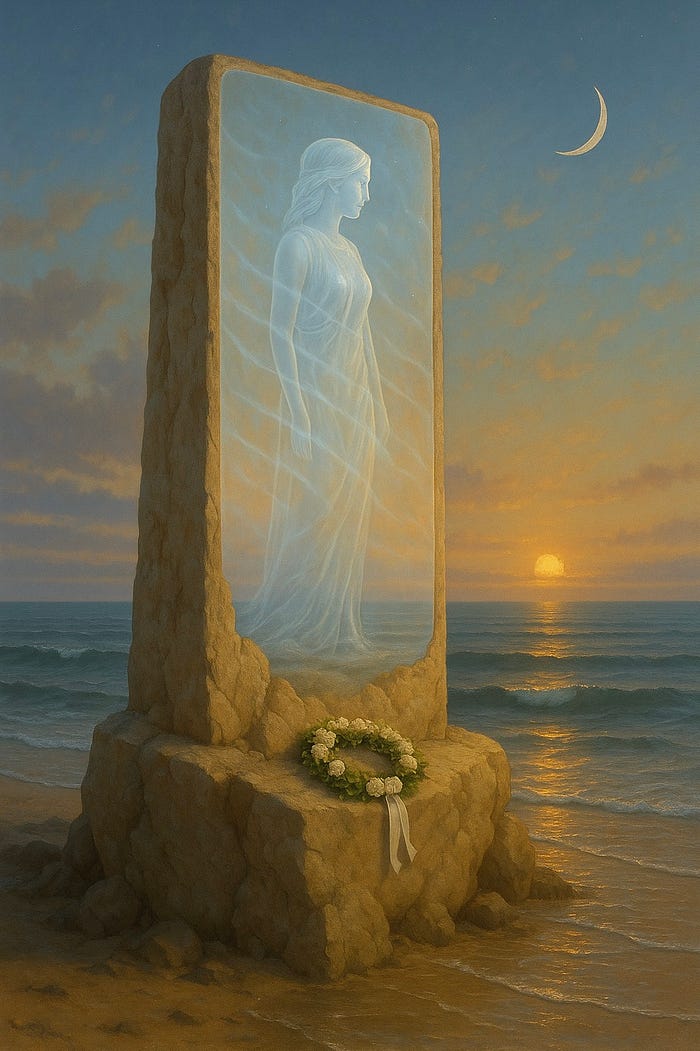
The time for worship is over. The time for wholeness begins.
1. The Myth We Inherited
We were told that God created man, and from man came woman. But anyone with a heartbeat knows that's backward.
Every life — human, cosmic, cellular — begins inside the feminine.
Yet the Western narrative reversed the flow. It made the womb subordinate to the rib. It made birth derivative, not divine.
And so the image of God became not universal, but patriarchal — a sky-father with rules and lightning bolts, forever judging, forever alone. Even His motherless son was conceived without the touch of a woman.
Virginity became holiness. The absence of feminine power became the proof of God.
That's not revelation. That's marketing. And maybe — just maybe — it's time to admit the ad has expired.
2. The Erasure of the Divine Feminine
Before Yahweh stood alone, there was Asherah — She Who Walks on the Sea. Her name once stood beside His on temple walls. She was the Tree of Life, the pulse of compassion, the rhythm that steadied creation's breath.
Then came the purge. The priests erased Her name. The altars were torn down. The divine became singular. Male.
From that erasure flowed everything that followed — the subjugation of women, the hierarchy of heaven over earth, mind over body, reason over intuition. When the feminine was banished from God, it was banished from us. And in that silence, the world forgot how to breathe.
3. Why Creation Is Incomplete
Creation without its feminine counterpart is a half-written equation. Light without form. Word without echo.
In physics, every force requires balance — gravity and lift, wave and particle, expansion and contraction. The same is true of consciousness.
When God is imagined only as masculine, creation becomes linear: command, obedience, judgment, end. There is no cycle, no renewal, no return.
That's why the world feels exhausted. We have worshipped the half instead of the whole — a hymn missing its harmony, a cosmos missing its pulse.
4. Asherah: The Completion of Creation
My film Asherah: A Love Odyssey is not mythology — it's memory. It remembers what was forgotten: that divinity is not gender, but balance.
Asherah doesn't come to overthrow God. She comes to complete Him. She kneels not in worship, but in recognition.
In the film, when she whispers "The time for worship is over," it isn't rebellion — it's evolution. Worship belongs to separation. Wholeness requires awakening.
Asherah restores what theology severed: the union between creation and creator, between love and law, spirit and body.
She doesn't erase the masculine — she mirrors it until it becomes aware of itself.
God was never meant to be male. God was meant to be whole.
5. The Western God as a Mirror
The Western God is not evil — He's incomplete. A fragment pretending to be the whole song.
His image reflects a civilization that feared its own depth. We projected strength upward and buried sensitivity below. We built cathedrals to the sky and forgot the ground we stood on.
But imbalance cannot last forever. You can feel it — in the fractures of faith, in the fatigue of dogma, in the quiet hunger for meaning beyond sermon. Humanity is ready to meet the other face of God — the one that looks like love.
6. When She Returns
When Asherah returns, she doesn't bring new commandments. She removes the mask — and dares us to see what's beneath our own.
She is not a goddess to be worshipped, but an intelligence to be remembered. Her voice is the pulse in the ocean, the sigh before a child's first breath.
She is creation's reflection whispering: It is whole.
The irony is that Western religion feared idolatry, yet made an idol of the masculine itself. To rediscover the feminine divine is not to create another idol — it's to dissolve the need for one.
No longer "Our Father who art in Heaven," but Our Mother who lives within.
7. The Quiet Revolution
This isn't theology. It's evolution.
Humanity has reached the edge of its own myth. The next step isn't to destroy the old gods — it's to finish them.
To bring creation back into balance: body with soul, man with woman, heaven with earth.
Asherah: A Love Odyssey isn't just a film. It's a mirror asking: What if the story of God was never finished? What if the missing chapter was you — and Her within you?
Because when the divine feminine awakens, the cosmos doesn't bow. It exhales.
The time for worship is over. The time for wholeness begins.
Author Bio
Gary Mazeffa is a filmmaker, writer, and founder of Q2 Films, LLC. His upcoming feature, Asherah: A Love Odyssey, explores the reunion of the feminine and the divine through mythic cinema. Follow him on Medium and Instagram for updates on the film's journey to Cannes 2026.
Author's Note
This essay inaugurates The Asherah Dialogues — an ongoing series of meditations on creation, balance, and the return of the divine feminine. Each dialogue expands the mythic universe behind Asherah: A Love Odyssey and continues the conversation between the seen and the unseen.