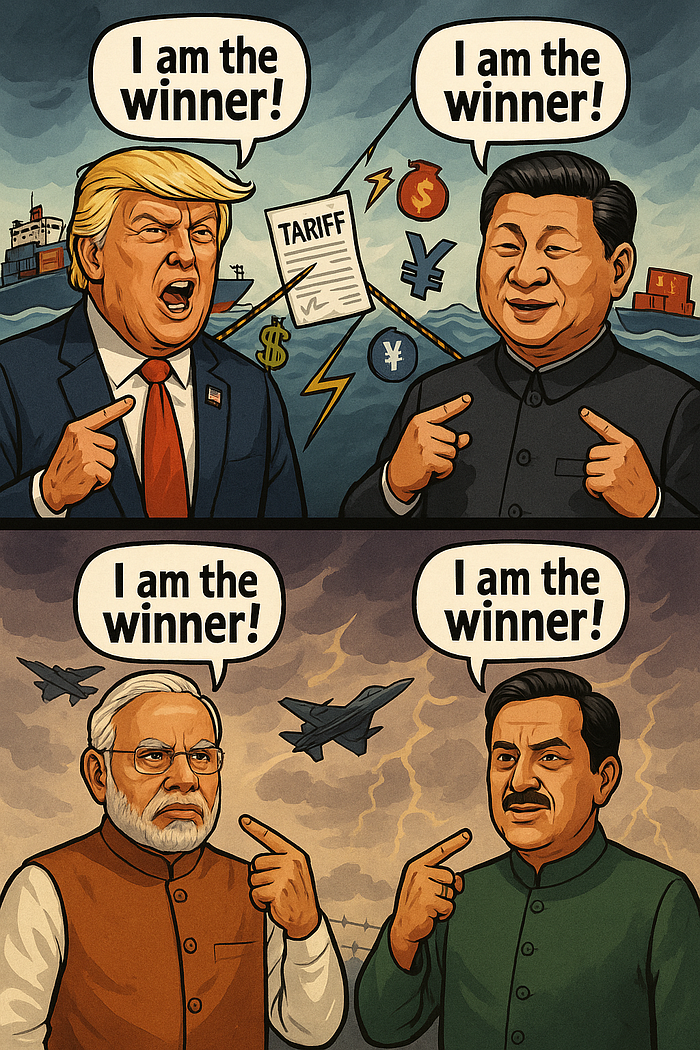

The Victory Paradox: Why Does Everyone Claim Victory in Modern Conflicts? Case of India-Pakistan and US-China conflict
In the last week, we observed two major truces at the global level. One is the India-Pakistan military standoff, and the next is the China-USA tariff wars. These cases reflect one typical pattern: both sides of each conflict have claimed victory publicly, though both are finalised with compromises and are also of a temporary nature. This article explores what drives these patterns and what they tell us about evolving international politics.
India-Pakistan Conflict: Recent tension between India and Pakistan evolved after the April 22 Terror Attack on tourists in Pahalgam, Kashmir. Accusing Pakistan of promoting terrorist attacks, India initiated 'Operation Sindur', aerial targeting of terrorist bases and camps in Pakistani territory. As Pakistan retaliate against India, a military standoff escalates between the two nuclear-powered neighbours, though casualties and damage from the conflict are still unknown and contested. Both agreed to shut down their guns on May 10, achieving a clear military advantage; however, both sides declared victory officially. Still, traditional media and social media narratives project victory, dissimulating the opposite side.
US-China tariff conflict and victory claim: US-China Conflict: Similarly, the US and China have been entangled in a tariff war, particularly after April 2, as Trump unilaterally imposed tariffs on Chinese goods and other countries. The tariff war escalated as China chose to retaliate against the US's move. However, as both sides agreed on April 12 to roll back tariffs, they framed the move as their triumph. Trump immediately projected it to reflect his "deal-making prowess and protection of American interests". In China, however, it is highlighted as the victory of their firm's resistance and successful resistance to US bullying.
Causes behind the 'Victory Narrative': Strongman leadership
As world politics evolves towards fragmentation, tensions and conflicts, a rising demand for strong leadership exists, particularly in democratic countries. For instance, India and the USA have re-elected 'strong leaders' like Modi, Trump, with perceptions that such leaders will successfully act as tough negotiators, defenders of national pride and saviours of the country in crisis. In some cases, leaders are judged or evaluated prioritising international image and stature rather than domestic governance capability. For instance, the slogan about Modi's image is popular, "Modi hai to Mumkin hai" or (As Modi is there, he can fix everything) that encapsulates the high expectations from the leaders, particularly in the international realm.
Likewise, because of self-image projection like saviour, though negotiable, strong leaderships are under constant pressure to project themself as capable, powerful and winners, both for domestic legitimacy and international stature. We have witnessed the use of divinity for Modi and Trump to project an image of a saviour of their respective countries. For instance, in the 2024 election campaign, Modi argued, "I'm convinced that God has sent me for a purpose". In contrast, Trump claimed that "God saved me for a purpose to make America great again", revealing such image projection.
Modi and Trump themselves do not hesitate to hail their greatness. For instance, Trump immediately revealed the cease-fire between India and Pakistan to reflect his 'deal-making prowess' even before an official declaration from India and Pakistan. Contemporary strong leaders like Trump, XI, Putin, Modi, etc, aim to project their self-image as 'saviour', 'deliverer', 'protector', and they are compelled to frame every outcome, even compromise and stalemate, as victory. Rhetoric and branding of their images heighten the public's expectation bar even higher, as they are in constant pressure to meet that expectation.
Domestic Political Consumption: With the rise of nationalism, 'victories' at the international level are also used for domestic political purposes. Such 'victory claims' are instrumentalised for public support, serving nationalistic greed and also distracting the public from government failure. For instance, the BJP, India's ruling party, decided to launch a nationwide 10-day Tiranga Yatra celebrating the success of 'Operation Sindur'. As international conflicts ignite nationalism at home, that undermines critiques and opposition parties' voices, politicising conflicts to gain in domestic politics. For instance, traditional and new media tried to crush people and groups with different opinions or compel them to align with their tone on the conflict.
Changing patterns of conflict: narrative warfare over ground realities
With the rise of social media and digital platforms, narratives of warfare have overtaken the ground realities of conflicts and contestations. It reveals that conflict narratives — controlling information and shaping perceptions- have emerged as essential weapons in conflicts as material outcomes. For instance, in the India-Pakistan conflicts, these 'narrative wars' have overshadowed the realities and aimed to amplify exaggerated and even false claims of victory.
Foreign affairs: a common man's concern
Social media has also transformed international relations as a concern of ordinary people, which was traditionally used by high politics. Traditionally, Negotiations, agreements and discourses around foreign affairs used to be dominated by the cliques of elite circles; however, with social media, it is now a matter of the commoner as they are not only the consumers but also the narrators of foreign affairs. With a smartphone, people are reacting to the conflicts with audio, videos, and images that prioritise nationalists' narratives and perceptions of victory that hardly reflect the real realities.
Conclusion
As world politics evolves towards greater fragmentation and polarisation, we will likely observe more and more 'manufactured victories'. It reflects the more profound structural changes, such as the rise of strongman rule, evolving divides and fragmentations, politicisation of international conflicts and social-media-driven narratives of wars. This may lead to more 'performative' and 'narrative-driven' diplomacy and international engagements; however, such patterns are less likely to reflect conflicts' ground realities and roots. These patterns will deviate from the root causes of conflicts, which may hardly lead towards a sustainable solution of disputes.