
Right now, a silent arms race is unfolding — one that isn't about oil, or even chips. It's about the minerals that make those chips possible… the metals behind every missile, EV, and AI server rack on the planet.
And the U.S. government is quietly pouring over $5 billion into two little-known companies to fight back. Because if the next global tech war is fought with magnets instead of missiles… these two could already be holding the keys.
Before we dive in — If you want more trade breakdowns and analysis check out https://optiontradingmastery.com/ as well as the YouTube channel at https://www.youtube.com/@darrensteves/videos. Our community is hitting record highs, and I appreciate every single one of you.
There is also a link to our FREE Options Workshop and complete option trading course if you are new to options and want to know how to utilize the strategies, or if you've been trading a while and just want to level up your game and increase your profits and consistency.
(Disclaimer: I'm not a financial planner and not recommending trades. Please do your own research and if your new or learning options please consult a financial planner and start small).
Advanced technology isn't built on software alone — it's built on elements. Rare earths like neodymium, dysprosium, and terbium are what make magnets powerful enough to spin an EV motor or guide a missile with pinpoint precision.
The problem? China controls nearly 85% of global refining. That means every iPhone, Tesla motor, and U.S. defense system relies — at some level — on materials refined in China.
Now, the U.S. is fighting back. Billions are being deployed to rebuild a domestic "mine-to-magnet" supply chain. And at the center of that mission — are two companies you've probably never heard of… yet.
Rare earth elements aren't actually "rare" — they're everywhere. What's rare is the ability to process them. And China cornered that market decades ago.
Over 80% of rare earths used in the U.S. are imported. That's a major national security risk. If China shuts the tap, America's defense and EV industries could freeze overnight.
That's why Washington just launched a $5 billion initiative — a moonshot to rebuild U.S. rare earth mining and magnet manufacturing from scratch.
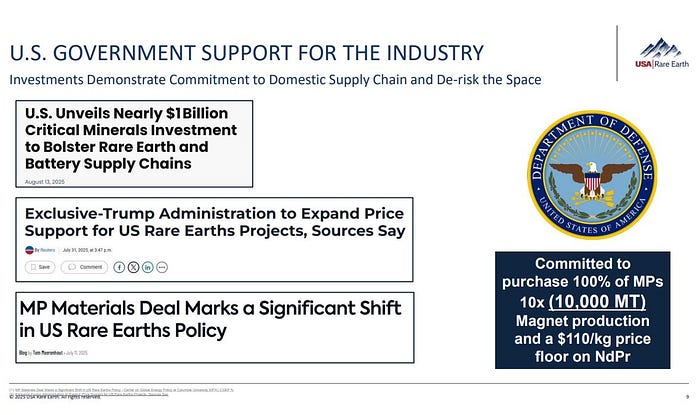
And at the center of it… are the two companies we're about to talk about.
Right now, China produces 90% of the world's rare earth magnets — the core of every advanced machine we rely on. But here's the turning point: The U.S. mines rare earths… it just doesn't process them. Until now.
In 2025, the government rolled out its new "Mine-to-Magnet" initiative — funded by $5 billion in defense and industrial grants. And two companies emerged as the backbone of that plan — one backed by the Pentagon itself… and another building the next magnet hub deep in Texas.

Meet MP Materials — ticker MP. It operates the legendary Mountain Pass Mine, the only active rare earth mine in the U.S.
This isn't a speculative play — It operates the legendary Mountain Pass Mine, the only active rare earth mine in the U.S.
But here's where things got interesting. In July 2025, the Department of Defense didn't just award MP a contract — it took an equity stake worth over $400 million, guaranteeing a price floor for ten years.
Then Apple signed a $500 million magnet deal to lock in U.S.-made materials for iPhones and EVs.
Now, MP is building a Texas magnet refinery to finish the loop — mining, refining, and producing magnets all on U.S. soil.
MP isn't just producing — it's replacing China's supply chain, step by step.
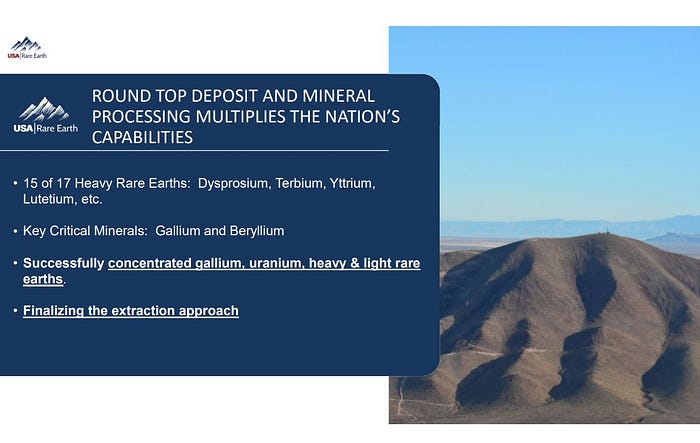
If MP is the proven player, USA Rare Earth, ticker USAR, is the upstart innovator. Based in Texas, their Round Top Mountain site holds heavy rare earths, lithium, and gallium — materials critical for EVs, semiconductors, and defense.
Their Stillwater, Oklahoma plant could produce 5,000 metric tons of magnets per year, meeting 17% of U.S. demand — and it's backed by Defense Production Act funding.
Of course, it's still early. Losses widened to $142 million last quarter, and scaling delays remain a concern.
But if USAR executes, it could become the first fully American magnet producer in decades — and possibly the next multibillion-dollar industrial success story.
Here's where things get big-picture. By 2030, global magnet demand is expected to double. And with federal funding locked in, MP and USAR could anchor an entirely domestic supply chain.
For MP: Their 10X Facility, funded by the Pentagon, could push U.S. capacity to 10,000 tons per year — enough for Apple, GM, and the DoD.
For USA Rare Earth: Their Texas Round Top site could make them the first heavy rare earth miner and magnet producer entirely within U.S. borders.
Together, these two companies could flip America's rare earth story — from dependence on China… to dominance in the next decade.
At the end of the day, this isn't just about mining. It's about control. Whoever controls rare earths — controls the future of technology, defense, and clean energy.
MP Materials and USA Rare Earth stand at the center of that race. MP has Pentagon backing, Apple and GM partnerships, and full-scale production. USAR is the bold newcomer — riskier, but positioned to capture massive upside.
By 2030, the U.S. could produce most of its own rare earths — ending decades of dependency. But make no mistake — this isn't just an economic story. It's a strategic one.
So — will these two U.S. companies become the backbone of a new tech superpower? Or will China tighten its grip again before the West catches up? Drop your thoughts in the comments — and make sure you're subscribed… because this story is just getting started.
If this resonates, consider implementing these strategies for your own portfolio. Also, please check out my website and FREE course as we dive deeper into options and other income strategies with full trade management details.
Please comment and ask questions. Join our free community to share ideas and grow your options skills with fellow traders. Thanks for reading and happy trading!
Best! Darren