Editor's note: this MS is the first full MS we have managed to recover and translate from the later ancient Syrian satirist-Socratic, Lycinus Secund-. Readers may know that several of his shorter Socratic dialogues have previously appeared on earlier versions of this medium, one of which won a 2023 award with Antigone journal. This is a longer text, more in the style of Lucian, but with genuinely Platonic-Socratic lineages, and something of Aristophanes in certain scenes. We thank all of the manuscript and translation team, and relevant sponsors. This work would not be possible without your support.
This short drama in five acts will appear in a series of posts in coming weeks in 2025. The opening post includes the first two acts, in which Socrates is projected by the visionary author as returning to a sophisticated later modern university, we estimate some time around c. 2030 CE. Having encountered and charmed some young students, in act 2, he then creates a sensation at the class of Professor Mammonas in the Foundations of Western Marketing class, conducting a public refutation of Mammonas' claim that marketing is the art of all arts, and science of all sciences. Subsquent acts chart the response of the university managerial team, as they attempt to 'pivot' and turn to profit this unexpected ancient windfall of wisdom, or citations.
Dramatis personae
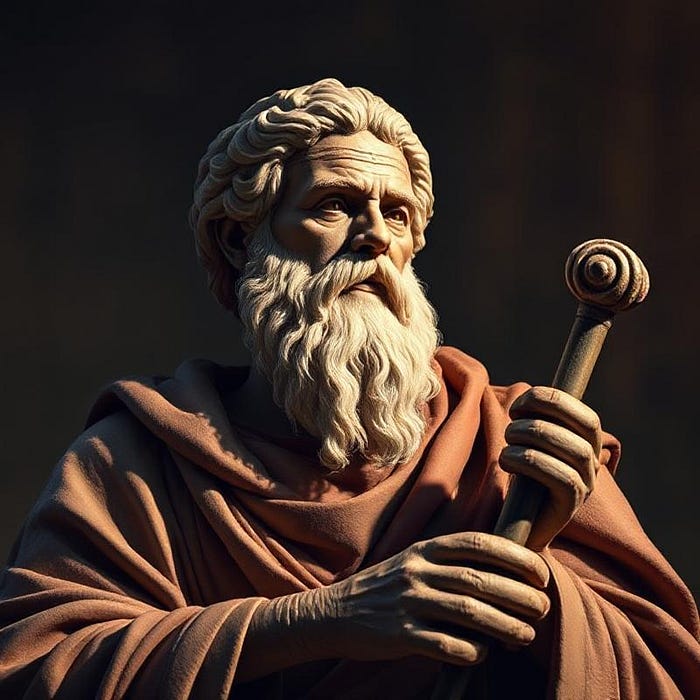
Socrates, dressed in tribon and sandals
Adam, student
Bill, student
Mr Mammonas, lecturer in "Foundations of Western Marketing" at Academy of Human Credentialization and Marketization (AHC&M)
VC Vendor, VC of AHC&M
Sally, Head of AHC&M Marketing and Brand Control (MBC [thus, AHC&MMBC])
Nick, Educational Excellence and Elevation Expert (EEEE) from Un principo viralitas consulting
Other students
Campus security
Young man from Managerial Jargon Generation Team, MJGT
Scene 1: Socrates returns
Setting: Higher Educational Institution somewhere in Western world, c. 2030. Socrates is lying asleep on the public lawn, just waking up.
Adam [A]. Who's that old dero?
Bill [B]. Don't know. Must have had a big night! Hey, Mister, wake up, wake up!
S: Ti esti? Pou eimai?
A. Ha! He's speaking Greek, the old fool!
S. What is this language? And … why can I understand and … speak it? By the Gods! … Hey, boy! Where am I? And what is "Greek"?
A. "What is 'Greek'?" You were speaking it, old man. Priceless.
B. You're on campus, old man. And this is the Academy. Ha, he should know! He even looks like Socrates!
S. What do you mean, I 'look like' Socrates, youth? I am Socrates. But this is not the Academy. It looks nothing like the place. And I was speaking Hellenika. Besides …
A. 'You are Socrates'? Hilarious. Hey Bill, he thinks he's Socrates.
S. (indignant) I don't 'think', my boy. I am. And there is nothing amusing about it. So, if you'll kindly tell me how I got out of the prison, I'd appreciate it. I was just now convincing Crito not to bail me out. He left, and I rested. And next thing, here I am.
B. Crito? Who on earth is Crito?
S. Crito … well, Crito is someone who means well. He, well, loves wisdom, in the manner one loves a hetaira one knows one can never afford. It is better for such men to take a wife. Listen, I thought I had convinced him with my ready-made the-State-as-your-parent speech. But now he has clearly gone and arranged with the guard to whisk me away while I was sleeping. And the Gods only know where I am. In all of Attica, I've never seen this place. Are we in Crete?
A. Listen to him, Bill! Drink has got the better of the old guy. One too many at the costume party last night, old friend? Listen, Mr Socrates, don't you have a home to go back to?
S. Why, yes, my friend. The whole world is the home of an honest man.
A. O, come on! Cut the charade. I mean a bed to sleep in, and someone to look after you.
S. I was being housed at the people's expense, and the guard, a good fellow, was my minder. My execution was delayed, due to the festival of Apollo, but tomorrow or today, I was at last going to pay my debt to Asklepios.
A. 'Debt to Asclepios' — would you listen to him! The LARPing's over, Mr Socrates. Time to go back to being Mr Suburbia, before we call the campus police.
B. Adam, hold on. Do you think …?
A. Do I think what?
B. Well, I don't know. It's impossible, isn't it? But look at him. Pug nose. The toga or whatever it was called. The Greek. What if somehow …
A. Somehow what? Have you gone mad too, Bill?
B. I know, you're right. But why don't we, just for fun, take him to our Foundations class this morning. Just for laughs, you know? Who knows what he might say …
Soc. What's this? A 'Foundations' class? Are you fine youths about to go to a class? Why, who is in Athens at this time? Has Gorgias returned, or is it some other foreign sophist who may finally teach us all the way to wisdom?
(A and B. laugh)
A. No, Mr Socrates. Gorgias is not in Athens. He's been dead these 2400 years, and not a single of his books have come down to us. We learned that last term, you see. But Mr Mammonas is certainly a very wise sophist. And he is teaching us again this morning …
Soc. Well then, there's nothing for it. Take me to this class! I very much look forwards to questioning this sophist, "Mr Mammonas", of whom you speak so highly. Perhaps he can point me towards the wisdom I have been seeking.
(All exit)
2. What happened at the Foundations of Western Marketing class
Setting: lecture auditorium, students with PCs and iphones, Mr Mammonas enters
Socrates in tribon, with A and B, in middle of middle rows of auditorium
M. Welcome everybody, we will begin shortly.
Soc. Excellent. How well he carries himself, and how resonant his voice! Clearly, he must have had the Gorgianic training.
A. This is going to be amazing.
B. (More uncomfortable) It will be interesting, that's for sure.
M. (Clears throat) Welcome again everybody. This is Foundations of Western Marketing, week 3. Last week, you will recall, we looked at the remarkable campaign carried out by the Greek marketing guru, Socrates …
Soc. (Out loud but half-whispered still, incredulous) 'Marketing guru'?
M. But this week, we are going to move forwards from Socrates, to his pupil, Plato.
Soc. Aha! Dearest Plato. But how can this be?
M. Socrates, it will be recalled, was put to death in 399 BCE …
Soc. (Looking around, incredulous) 駧 BCE', what is this nonsense?
Others: Shh! Shh, old man… (some tittering and pointing at Socrates)
M. But before we do, we must of course look back over some of Socrates' key tag lines, and look at the way that he used them to create an enduring brand which, as we know, has lasted for over 2000 years.
Soc. (to A and B, whispered): I know I hang around in the agora, but really? What is this sophist talking about? 'Tag lines'? 'Brand'?
M (Writing on the board and speaking as he does) "The unexamined life is not worth living"
Soc. From my defense speech, yes.
M. "The good man cannot be harmed"
Soc. I have always maintained this.
M. "It is better to suffer injustice than to do injustice"
Soc. Yes. How that agitated Callicles!
M. "Wrong is only ever done through ignorance".
Soc. Well, he has me right, in any event.
M. Now, as marketing students, we can recognize the genius in all of this, can't we, class? Each of these lines is short. It grabs attention, it upsets expectations. It allows Socrates' message to stand out from that of his competitors'. You know, as Callicles says in the Gorgias, Socrates is really asking his potential clients for a complete overthrow of their usual business models.
Soc. What's this? Callicles said all kinds of things, but he never uttered any claptrap about "business models", Zeus be thanked! And what is this "Gorgias" of which he speaks?
(B hands Socrates a copy of Plato's Gorgias)
B. It's one of our textbooks. You know, by Plato …
Soc. Well I never. Who knew Plato was going to write this stuff down! Cheeky lad …
M. … and Socrates' bold market bid, we know, was radically successful. Its genius lies in how Socrates was cunningly able to conceal his true intentions …
Soc. (To all surrounding) 'Cunningly conceal my intentions'? Worse and worse!
M. … which we as students of marketing, this art of all arts, know lay in securing as wide a base of customer and community buy-in as possible to his new initiative, which you will remember he labelled "philosophy". Another brilliant move, from a marketing angle.
(Socrates stands up now, and raises his voice)
Soc. You must excuse me, Mr Mammonas! I have listened patiently to this long speech of yours, when you know that this is not my way. I much prefer to ask questions, and if you wish, to answer any questions which you may now direct to me …
M. Sit down, sir! You are creating a disturbance.
(Some laughing, amazed expressions, guffaws, etc., some students are taking out their iphone/cameras)
Soc. I will no more sit down than I did in what you would call 421 or 378 "BCE", for what reason I cannot imagine, when Aristophanes chose to send me up publically at the theatre in his Nephales.
M. Can someone please call Campus Security? Yes, you there! Stop filming and use that iphone as an actual phone!
Soc. Gentle sophist! I mean you no harm. But you have presented my teachings here to these young Athenians (laughter). So it is only fair that they should also hear directly from me.
M. I don't know what you are playing at, sir. Please, someone, Security …
Soc. Let me ask you this, Mr Mammonas, if that is your name.
M. It most certainly is, and I take it you are 'Mr Socrates', too? (more laughter)
Soc. Yes, I am Socrates (deadpan), son of Sophroniscus, from the deme of Alopece. But hear my question. Just now, you have told your class that marketing is the "art of arts". I know nothing about that. Simon the cobbler hangs his stall with posters, as other traders do. He shouts out promises of discounts and the reliability of his wares. But that any of this is an art, or the art of arts, seems extraordinary to me. So please, before these fine gentlemen remove me (campus security guards have appeared in the doors), please share with me this new wisdom.
(Students all around have their iphones out, pointing at Socrates and Mr. M, recording)
Random voices: yes, go on, sir! Please do! What harm can it do?
M. Mr Socrates, I do not know if you are enrolled in this course, and I don't know which pranksters put you up to this (A and B are hiding their faces in the seats next to Socrates). But since people insist …
As we explored in lecture 1, marketing is the art of arts, and the science of sciences, since without marketing there could be no other arts, or other sciences. Artists could never sell their works, and scientists never fund their experiments. Indeed, entire economies could not function, except by relying on what we are teaching here to these young men and women. Demand would falter, enterprises close, workers go hungry, and all good things be quickly at an end.
Soc. If what you say is true, Mr Mammonas, then marketing has a kind of supernatural power, and I shall only be too glad to be your student. But tell me, as an art or a science, what is it a knowledge of?
M. Excuse me?
Soc. Well, if I ask Adam here (Adam shrinks away in his seat), who is (let us say) a painter, what it is that his art involves knowledge of, he will answer "painting". Isn't that right, Adam?
A. (With trepidation) Yes?
Soc. Good lad. And if I were to ask Bill here, who let's say is a cobbler, what his art is knowledge of, he would say: of making shoes. Isn't that so, Bill?
B. Um … I think so… Is that what a 'cobbler' does?
Soc. And so you see, Mammonas, it is the same question with marketing. Given that you say marketing is an art, what exactly is it that marketing, as an art, is knowledge of?
A. Why, it is knowledge of how to persuade people to buy some things, and not others.
Soc. Very good. We have begun to make progress. So then tell me this, how is it that marketing persuades people? It is by getting them to agree that what they are buying is good, is it not?
M. I suppose so.
Soc. So, the marketer then must have a knowledge of what is good, and what is bad, if he is to successfully practice his art. Would that be true?
M. You could say that. It is not exactly how I was going to present things …
Soc. How you present things can wait for the moment, my friend. You have had your turn. Just now, we must follow the questions where they lead, not where Socrates or Mammonas wants to lead them.
(M. shift uncomfortably on stage, starts looking at his i-watch, glancing at security)
Soc. So the marketer persuades people to buy some things, rather than others, since s/he knows what is good, and what is bad.
M. I'm going to stop you there, Mr. "Socrates" — or whatever it is you call yourself. The marketer claims no such nonsensical knowledge as you say. S/he does however know what people think is good, and how to make things appear to be good. And that is how one sells things, as everybody knows. You can keep "the good" to your own well-stocked imagination!
Soc. But here is the thing, that I cannot do what you say, any more than you can. For if your marketer knows only what appears to be good, and how to make things appear to be good, it seems to me that his marketing is no science, nor even any art.
M. What do you mean?
Soc. Well, a science takes aim at what is real, not at what merely appears. Otherwise it is no science, just a semblance or a game. Would you agree?
M. So it appears.
Soc. Indeed, it appears this way, but here, because it actually is this way. If marketing was an art or a science, it would aim at what is real. If it aims merely at manipulating appearances, or playing to what people happen to imagine to be good, it is not a science but a species of flattery, like pastry cooking.
M. (outraged) Pastry cooking! This is absurd!
Soc. Yet what I mean is simple. You present your class here as teaching the art of arts, and science of sciences. You have even presented my art, that of 'philosophy', as a kind of trumped-up marketing exercise, one to which you attribute a fabulous longevity that I have no idea what you mean. Nevertheless, just now, you and I together have shown that marketing is no art at all, let alone a science. It is rather a species of flattery, which presents what appears to be good in place of any concern for the good itself. But tell me this …
M. Tell you what?
Soc. Isn't it the case that sometimes what appears to someone to be good actually isn't good at all?
M. You tell me.
Soc. Yes, permit me to enlighten you. Imagine a general who thinks that the situation appears favorable for a charge. For he does not realise the enemy has a hidden phalanx behind the rise to his right. When he charges, the signal is given and his advancing line is attacked from the side as well as front, encircled and destroyed. What appeared good to him was not in fact so, you see? But we could think of many less dramatic examples.
M. Phallanxes and cobblers and pastry cooks! Appearances and realities! My friend, don't you realise they shut down your useless philosophy courses years ago here! Why, you should be glad we are teaching your outdated taglines in this place at all any more!
Guards, please, put an end to this spectacle, so we can find out who is behind it!
(growing unrest)
Soc. [shouting over growing melee] Please, my good sir, there is no need for anger! You and I are friends here, in presence of these good people. Both of us are seeking wisdom …
General alarum: the students have encircled Socrates, Adam and Bill, but not in order to apprehend Socrates, so much as to protect him from the advancing security guards. They begin to chant.
Gen. Let him stay! Guards away! Let him stay! Guards away! Let him stay! …
Soc. (above the chant, being carried on the shoulders of Adam, Bill, and several others) My friends, thank you! Eucharisto, dearest of new friends! But please, no violence! Let these good fellows go peacefully, and no trouble!
Adam: [Starting new chant] Socrates! Socrates!
General: Socrates! Socrates!
(Mr. M. leaves, carrying his PC under one arm and shaking his head, while he dials a number on his iphone)
Bill: (above chanting) Everyone, everyone, let's go to the lawn and we can buy Socrates lunch and talk. People can ask questions as they will. How amazing! Please! Come!
Adam: Yes, everyone, come! Amazing!
General: Socrates! Socrates!
(All exit)