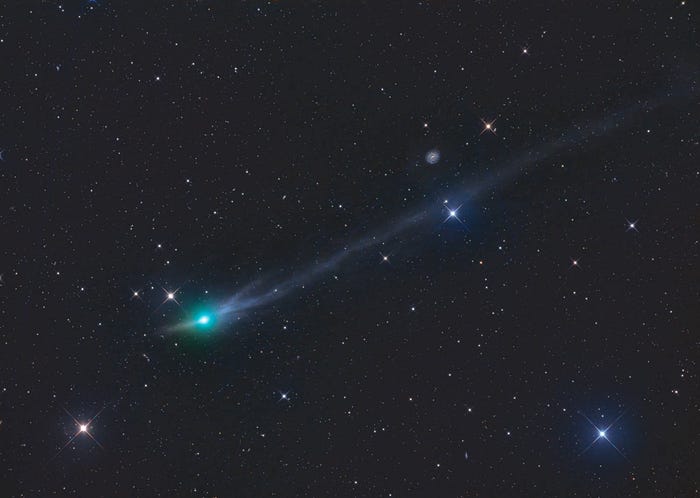


By Joel A. Gier
In forensic ballistics, you don't just look at the bullet. You look at the rifling or better known as the scratches left on the projectile that tell you exactly which barrel fired it.
For the last month, the consensus has been staring at 3I/ATLAS and asking "what is it?"
They should have been asking "where did it come from?"
The standard answer is "random space junk." But randomness doesn't have a frequency.
Recent expert observations of the object's light curve have confirmed a stable, periodic rotation of 16.6 hours.
To a standard astronomer, that is just a "day."
To the Gier Cosmo-Logical Model (GCLM), that is a Signature.
It is the rifling mark of the gravity well that launched it. And when you run the math on that frequency, it points to one specific location in the night sky.
Recognize it?
1. The Pinball Effect
We tend to think of interstellar objects as lonely travelers drifting in a straight line forever.
But the universe is a machine.
It is filled with massive gravity wells (Stars, Black Holes, Galaxies) that act like bumpers in a pinball machine.
Objects don't just drift; they Slingshot.
They fall into a gravity well.
They get accelerated to hyper-velocity.
They get "spun up" (rifled) by the intense tidal forces.
They are ejected on a new vector.
3I/ATLAS is currently doing this to our Sun. It came in, bent its path (the hyperbola), and is shooting back out.
But where was it before it hit us? What was the last bumper it hit?
2. The Firing Solution: The Angle of Attack
If you want to know where a sniper is hiding, you look at the angle of the entry wound.
Our solar system is flat (the ecliptic). Most local junk orbits within a few degrees of this plane. 3I/ATLAS is different. It is diving through our system at a High Inclination—a steep, aggressive angle that cuts down from the "north" of the galactic sky.
If you draw a straight line back along that incoming vector, you don't hit empty space. You hit a massive target.
You hit M31 (The Andromeda Galaxy).
Andromeda sits 41 degrees "above" our galactic plane.
It is the sniper on the balcony.
3I/ATLAS didn't just wander in; it came down the direct line-of-sight pipe from our massive neighbor.
3. The Ballistic Math: Calculating the Caliber
The angle is circumstantial evidence. The Spin is the mathematical proof.
In Black Hole physics, the rotational period of the accretion disk (AKA the "barrel" of the gun) scales linearly with the mass of the singularity.
A massive hole spins slower than a small one.
Let's calculate the Innermost Stable Circular Orbit (ISCO) period for the Andromeda Black Hole to see if it matches the data collected by observers.
The Variables:
- Mass of Andromeda Core (M31): Approx. 140 Million Solar Masses.
- Mass of Milky Way Core (Sgr A*): Approx. 4 Million Solar Masses.
- Known Period of Sgr A*: Approx. 20 minutes (0.33 hours).
The Scaling Equation:
Since the period (T) is proportional to the mass (M), we compare the two:
- Ratio = Mass of M31 / Mass of Sgr A*
The Calculation:
- Ratio = 140,000,000 / 4,000,000 = 35
So, the Andromeda engine spins roughly 35 times slower than the Milky Way engine.
- T(M31) ≈ 35 × 20 minutes
- T(M31) ≈ 700 minutes
- T(M31) ≈ 11.6 hours
The Match:
The calculated "Base Frequency" of the Andromeda engine is 11.6 hours.
The observed rotation of 3I/ATLAS is 16.6 hours.

This puts 3I/ATLAS directly in the Accretion Zone of the Andromeda Black Hole. It is orbiting slightly further out than the absolute edge (ISCO), in the "Goldilocks Zone" where material is rifled and ejected rather than consumed.
As an example:
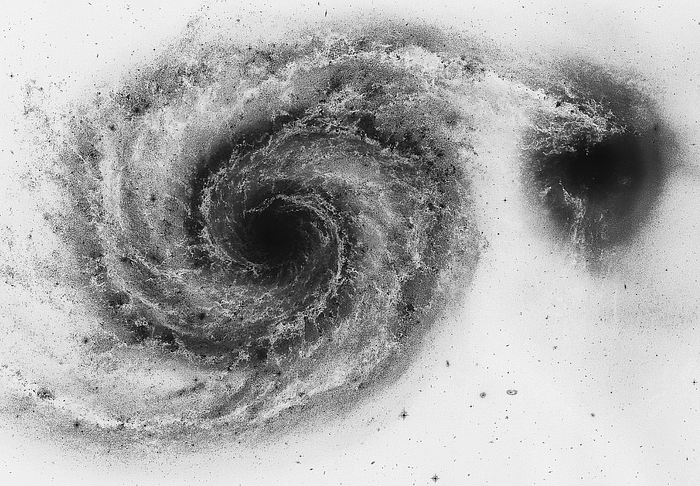
If it came from the Whirlpool (M51), the period would be ~1 hour.
If it came from the Milky Way, the period would be ~20 minutes.
Only an Andromeda-Class singularity (100+ Million Solar Masses) generates a 16-hour signal.
4. The Mechanism: The Intergalactic Transfer
3I/ATLAS is likely an Andromeda-Class Projectile.
It doesn't matter if it was born there or just banked off it.
The physics suggest that 3I/ATLAS fell into the Andromeda gravity well millions (or billions) of years ago. It grazed the event horizon of that massive 140-million-sun engine.
The Interaction:
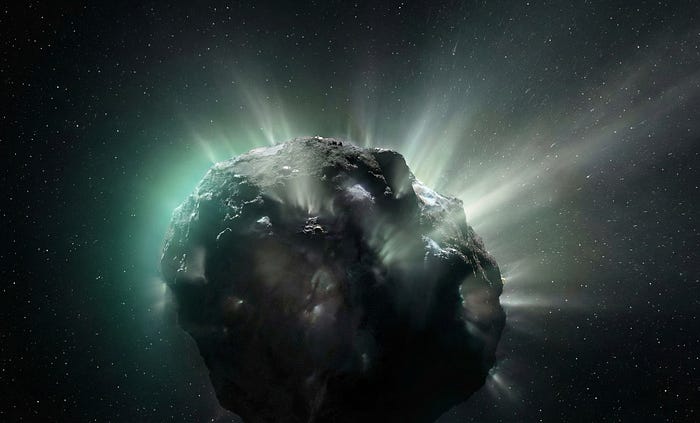
The tidal forces stripped its outer crust (leaving the metallic hull we observed).
The Rifling:
The 16.6-hour magnetic cycle of the hole imparted a stable gyroscopic spin.
The Ejection:
It was fired out of the system at relativistic speeds, crossing the 2.5 million light-year void to reach us.
Conclusion: The Cosmic Supply Chain
We are not looking at a random rock. We are looking at a Transit Packet.
3I/ATLAS is a "Pinball" that has bounced from Andromeda to Sol. And now, having used our Sun for a gravity assist, it is accelerating toward its next target—likely the core of our own Milky Way.
The math confirms the origin.
The angle confirms the trajectory.
The universe is not a void.
It is a network.
And the traffic is heavier than we thought.
Now this leads to darker realizations that could be plausible. This one is for all of the ET believers, TBH, I might even believe it after this…
Appendix: The Strategic Hypotheses (Speculation Only)
The math above proves the origin. But it does not prove the intent. While the GCLM treats the universe as a machine, we must consider that it may also be a theater of operations. Below are two speculative scenarios regarding why these objects are targeting our system.

Hypothesis A: The Resource Extraction Protocol
If we strip away the assumption that these events are natural, a darker pattern emerges.
Shot 1 ('Oumuamua):
A tumbling, disrupted projectile that passed within 0.25 AU of the Sun. Possibly collided with a smaller object to start the tumble.
Shot 2 (3I/ATLAS):
A rifled, stable projectile passing even closer.
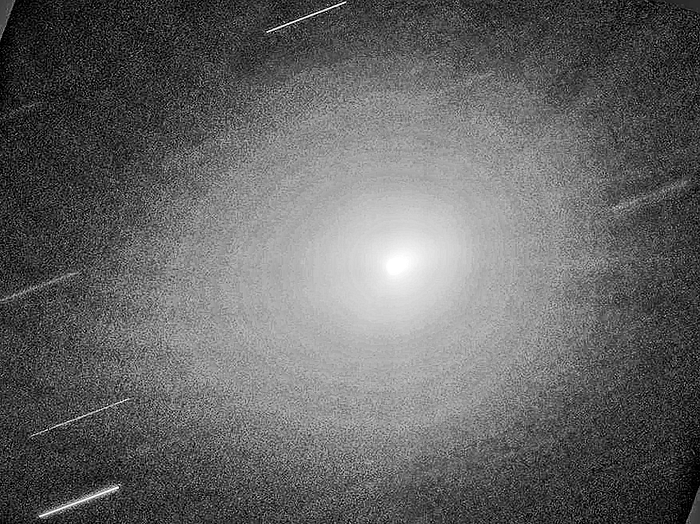
In military terms, this looks like bracketing.
Why target a star?
A stable solar system is hard to mine. The resources are locked deep in gravity wells (planets) or trapped in a burning star. But a shattered solar system is a buffet. If an object with the mass of 3I/ATLAS impacted the Sun at relativistic speeds, it could destabilize the solar hydrostatic equilibrium. This would turn a "Vault" into a "Debris Field," unpacking the resources for easy harvest by an incoming civilization.
Hypothesis B: The Collision Avoidance Signal
We know that Andromeda (M31) and the Milky Way are locked in a gravitational death spiral. We are destined to collide in approximately 4 billion years. To us, this is geology. To an advanced Type-III civilization in Andromeda, it is a traffic accident.
From their perspective, we are the ones drifting into their lane.
The Signal:
If you see a vehicle veering toward you, you don't shoot to kill. You flash your high beams. You fire a flare.
The Tracers:
3I/ATLAS and 'Oumuamua might be Warning Shots or kinetic tracers fired across the bow of our galaxy.
The high velocity and close passes to our Sun suggest a deliberate attempt to get our attention.
They are "buzzing the tower." The message is simple: "Change course immediately."
The tragedy is the technological gap.
They assume we are smart enough to steer a galaxy.
We don't even know we're driving.
…Have you seen the steering wheel or the brakes?!