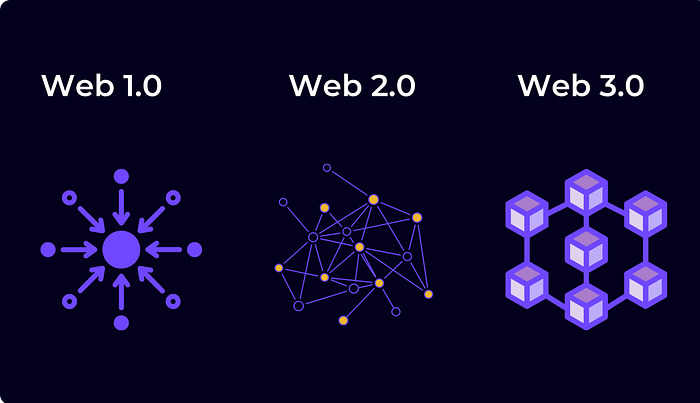

What is Web 3.0? Web 3.0 (Web3) is the third era of the web, meaning to make a decentralized, open, and more intelligent web. Dissimilar to the present Web 2.0, which depends vigorously on concentrated stages, Web 3.0 commitments more control for clients, further developed security and wise applications fueled by arising advancements like blockchain, simulated intelligence and the Web of Things (IoT).
The Evolution: Web 1.0 to Web 3.0 :
1. Web 1.0: The Static Era (1990s) : Web 1.0, launched in the early 1990s, denoted the introduction of the Internet. Spearheaded by Tim Berners-Lee, it presented fundamental advances like HTML (web organizing), URL (interesting web locations), and HTTP (information recovery). During this period, sites were static, and clients fundamentally consumed content. Advancements like email and essential internet banking brought energy, yet association was insignificant.
2. Web 2.0: The Interactive Revolution (2000s-Present) : During the 2000s, Web 2.0 changed the web into a dynamic and client driven stage. Intelligence, social network, and client produced content became focal. Stages like Facebook, YouTube, Instagram, and applications like Uber and Airbnb changed correspondence, amusement, and trade.
Key developments ,like portable web, cell phones, and distributed computing, sped up Web 2.0's compass, leading to the gig economy. Be that as it may, this time additionally saw difficulties like unified control, information security issues, and stage reliance.
3. Web 3.0: The Decentralized Future : Web 3.0 is the subsequent stage, zeroing in on decentralization, receptiveness, and more noteworthy utility for clients. Tim Berners-Lee imagined a "Semantic Web" that empowers PCs to comprehend human language setting, making the web more brilliant. Web 3.0 coordinates advancements like blockchain and simulated intelligence, decreasing dependence on unified stages while further developing protection, security, and effectiveness.
Real-World Example of Web 3.0 : Envision arranging an excursion. Today, you physically look for flights, lodgings, and rentals across numerous stages. In Web 3.0, wise bots will immediately dissect your inclinations and spending plan to suggest customized choices, saving time and exertion.
Why Web 3.0 Matters : Web 3.0 could change enterprises, similar to Web 2.0. It guarantees vivid encounters in the metaverse, secure exchanges through blockchain, and democratized admittance to data. For organizations, adjusting to Web 3.0 might be as much as basic as embracing Web 2.0.
The Bottom Line : Web 3.0 imprints the shift from unified stages to decentralized, keen frameworks. If Web 1.0 was the static endlessly web 2.0 the intuitive age, Web 3.0 addresses a more intelligent, vivid future. As tech monsters like Meta turn toward this vision, the 2020s may turn into the ten years of Web 3.0 strength.