
The best $150 you'll spend this year won't be on another online course.
Most data professionals I meet are caught in the same paradox.
They feel overwhelmed by AI's advancement and underwhelmed by their own preparation. The truth is, while everyone's busy chasing the latest framework or tool, they're missing the most important piece of the puzzle. The foundational knowledge that will truly set them apart in the new landscape.
It's like trying to build a skyscraper without understanding architecture, physics, or the nature of materials: possible but risky.
The six books I'm about to share with you will cover the major gaps in AI literacy today.
To be clear, there are four main pillars for AI literacy:
- Understanding AI Fundamentals: Basic knowledge of how AI systems work, including concepts like machine learning, neural networks, and training data. This includes the knowledge of AI's capabilities and limitations.
- Critical Evaluation Skills: Ability to assess AI outputs and recognize potential biases or errors. Understanding that AI systems can make mistakes and aren't infallible.
- Practical Interaction: Knowing how to effectively communicate with AI systems. Understanding how to use AI tools responsibly and productively. Being able to identify when AI can be helpful and when human judgment is more appropriate.
- Ethical Awareness: Understanding the social and ethical implications of AI use. Awareness of privacy concerns and data collection practices.
Not every pillar is covered by one exclusive book. Nor does each book cover one pillar. But considered together, the six books will give a full picture of these aspects and more.
Read on. Your competition is watching yet another YouTube tutorial…
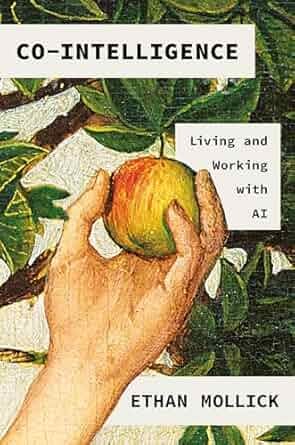
The All Rounder — Co-intelligence
There is no better way to understand something than to interact with it.
The first reactions to LLMs were a widespread discomfort and the nagging feeling that we might be replaced by AI. After reflecting on it, a more moderate view gained traction. This was the idea that AI is going to enhance our capabilities and allow us to do more and better things than before. Sure, some jobs and roles will disappear, but the biggest fear you should have is to not know how to use and collaborate with AI.
That's where Co-Intelligence comes in.
Ethan Mollick is a professor at Wharton specializing in innovation, and has been a great communicator of this line of thought. The book does a great job of giving the reader an understanding of how best to use LLMs and the value that can be gained from them. It also gives concrete advice and tips to get the most out of this new technology.
If you only want to read one book on how to take advantage of the tool that is AI, this is the one you were looking for.
AI in business — Prediction Machines
This book takes an unusual and welcome perspective to AI.
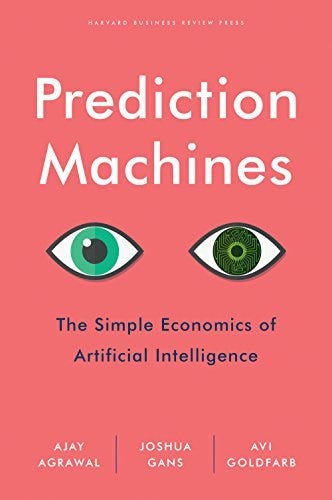
Prediction Machines looks at AI through the lens of economics. Every major technology brings about a shift in value. Some things get cheaper, some become more expensive. How will AI shift the value of data, decisions, judgement? How will that change business models and strategies? That's the sort of questions that this book tries to answer.
This is not a theoretical book, though. You will find frameworks and actionable steps to rethink the place of AI in your company and business strategy.
You can check some of my main takeaways from the book in:
AI and the Future of work — Human + Machine
This is a book for those who think that AI won't end the world.
If you are in that camp, you think that the future is hybrid. AI will inevitably change our reality. The trick is to design the collaboration between humans and machines so that we leverage both side's talents.
As the intro of the book puts it:
The key to understanding AI's current and future impact is its transformation of business processes.
A widespread misconception is that AI systems, including advanced robotics and digital bots, will gradually replace humans in one industry after another.
(…)
In essence, machines are doing what they do best: performing repetitive tasks, analyzing huge data sets, and handling routine cases. And humans are doing what they do best: resolving ambiguous information, exercising judgment in difficult cases, and dealing with dissatisfied customers.
This book first surveys the types of collaboration that we are currently seeing between humans and machines and then discusses the need for a missing middle. This would be the layer where humans and machines would interact and make the most of each other's capabilities.
Must read for those who think collaboration is the path forward.

You can chekc out a longer review of the book here:
Philosophy — The importance of being educable
One of the keys to thinking about a future with AI is knowing the boundaries and limitations of what AI and humans can do.
This is a book about what makes us human.
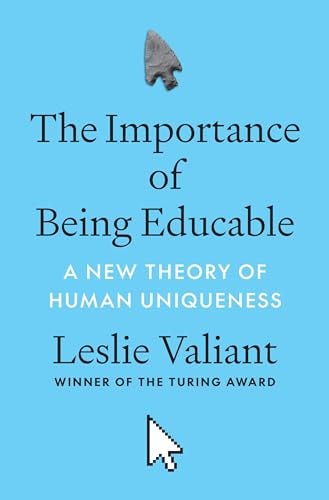
The author, Leslie Valiant, is a Turing award winner and computer scientist. The question he tries to answer is: which is the characteristic that we humans possess that made us so successful as a species? Which characteristic was the civilization enabler?
After discussing a few possibilities, he presents the notion of educability as such civilization enabler.
Educability is the ability we humans possess of applying knowledge we have acquired in situations that where unforeseen at the time we acquired the knowledge.
In other words, educability is the ability to join dots that are far away from each other.
This book will give you both the comfort of knowing that there are certain things that remain uniquely human and an idea about how to stay relevant.
Keep making connections.
Know Your History — How Data Happened: A History From the Age of Reason to the Age of Algorithms
A key part of being AI literate is knowing its rich history.
From the statistical notions we take for granted today to the ethical implications of AI algorithms, the history of AI is full of twists and turns.
This book tells several interesting stories:
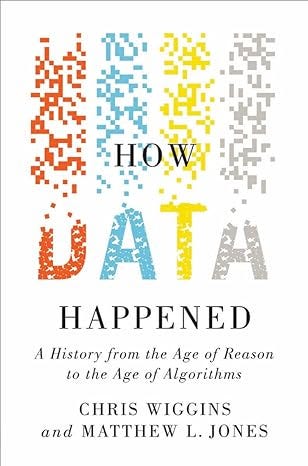
- It tells the story of how Data was central in WWII efforts and how the success of the code breaking endeavors led to attention, funding and progress in the field.
- It tells the story of how Artificial Intelligence arose and how it went from trying to model human thought and process logical statements to pattern recognition.
- It tells the story of some of the big companies that lead the way in the collection and use of data for personalization and add placement.
Not only does the book tell all these stories, but it ends up with a discussion of the ethical implications of algorithms being more present in our lives.
How Data Happened is a good place to start reading about the history of AI and Data Science. Every chapter could be a book on its own, so you can get a broad overview and look for a book on any specific topic that interests you afterwards.
Fiction — Frankenstein
A classic among classics.
One might think that data science and AI are new subjects. The truth is that the problems they pose are as old as technology and creation themselves. There are few books that present the ethical questions about scientific advancement and the consequences of pushing technological boundaries quite like Frankenstein.
Whether you focus on the monster that learns to live in a world that's new for him or the creator who struggles with the consequences of creating an intelligent being, there is much in this book that resonates with our reality today.
One of my favorite quotes from the book:
Invention, it must be humbly admitted, does not consist in creating out of void, but out of chaos; the materials must, in the first place, be afforded: it can give form to dark, shapeless substances, but cannot bring into being the substance itself.

Conclusion
AI Literacy is a tricky subject.
As the field of AI and its applications evolve, the notion will change. Yet the fundamentals will remain the same. These same fundamentals are what will bring you an edge in your day to day and accelerate your career.
Focus on breadth over depth and let me know how it goes.
Happy reading!
If you're up for other book recommendations for data professionals, you might want to chek out these articles: