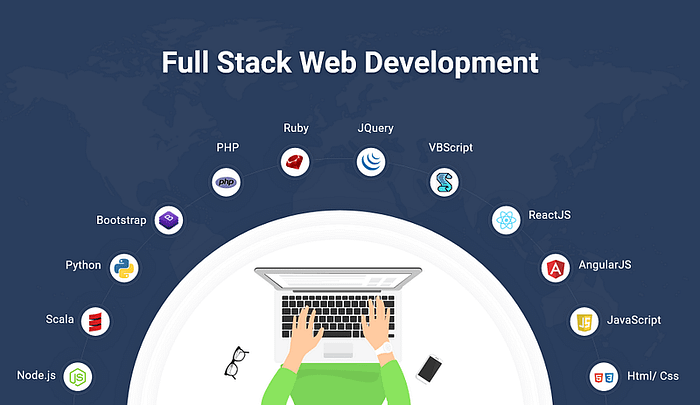

If you're reading this, you're probably standing at the edge of something big.
Maybe you're stuck in tutorial hell. Maybe you're tired of watching developers on YouTube earn $$$ and wondering, "Where do I even start?" Or maybe you secretly dream of becoming a full-stack developer, but the roadmap feels like a giant mountain.
I've been there. And I promise you: becoming a full-stack developer is not about learning everything — it's about learning the right things in the right order.
This is the beginner-friendly roadmap I wish someone gave me years ago.
Let's start simple, then go deep — step by step.
🌱 Step 1: Foundations — The Only Place to Start
Before frameworks, before backend, before databases, you must master core web fundamentals.
HTML
Learn structure. Tags. Forms. Semantic HTML.
CSS
Flexbox → Grid → Responsive design → Media queries.
JavaScript (Your main superpower)
Don't chase frameworks yet. Focus on:
- Variables
- Functions
- Arrays & Objects
- DOM manipulation
- Fetch API
- Events
- Promises & Async/Await
Why this matters: Everything else — React, Node, APIs, databases — is built on this foundation. 💡 Mini Project Ideas (After Step 1)
- Portfolio website
- Todo App
- Weather App (Fetch API)
- Color Picker
- Calculator
- Image Slider
These small apps build confidence and teach problem-solving.
Step 2: Frontend Framework (Choose One)
Most companies use React, so that's the best starting point.
Why React?
- Easy to learn
- Giant community
- Most tutorials, jobs, and open-source projects
- Works everywhere (web, mobile, desktop)
What to learn in React:
- Components
- Props
- State
- Hooks (useState, useEffect)
- Conditional rendering
- Routing
- API calls
- Context API
- Basic Redux
React Project Ideas:
- E-commerce UI
- Blog App
- Movie Search App
- Authentication UI
- Dashboard with charts
Step 3: Backend Basics — Where the Magic Happens
To be a full-stack developer, you must understand how servers work.
Learn Node.js + Express.js
What to focus on:
- Building APIs
- Routing
- Controllers
- Middleware
- Authentication (JWT)
- Cookies & Sessions
- Error handling
- File uploads
- Request/response cycle
- Connecting APIs to databases
Why this matters: This is the backend you'll use in 90% of full-stack jobs.
Step 4: Databases — How Your App Remembers Everything
There are two major types:
SQL (structured)
- PostgreSQL
- MySQL
NoSQL (flexible)
- MongoDB
Which should you choose? If you're a beginner: MongoDB is simple. If you want long-term career power: PostgreSQL is king.
What to learn:
CRUD operations
Joins (SQL)
Schemas
Relationships
Indexing
ORMs (Prisma, Mongoose, Sequelize)
Step 5: Connecting Frontend + Backend
This is where you become full-stack.
Learn how to:
- Call your backend API from React
- Send data using POST/PUT
- Handle sessions and JWT tokens
- Build protected routes
- Fetch user data after login
- Upload images
- Store files
A simple example (React → Node.js):
// React
const login = async () => {
  const res = await fetch("/api/login", {
    method: "POST",
    headers: { "Content-Type": "application/json" },
    body: JSON.stringify({ email, password })
  });

  const data = await res.json();
  console.log(data);
};
// Node.js
app.post("/api/login", async (req, res) => {
  const { email, password } = req.body;
  // validate user…
  res.json({ message: "Logged in successfully" });
});
This simple connection is the foundation of everything full-stack.
Step 6: Deployment (Your App Goes Live)
Learn how to host your app on:
Frontend:
- Vercel
- Netlify
Backend:
- Render
- Railway
- AWS
- Digital Ocean
Database:
- MongoDB Atlas
- Supabase
- Neon (Postgres)
Deployment teaches you real-world debugging — the skill that turns developers into professionals.
Step 7: Authentication — A Must for Every Full-Stack Dev
Learn how to implement:
- JWT authentication
- Google login
- GitHub login
- OTP login
- Password hashing (bcrypt)
- Refresh tokens
- Protected routes
This is a major interview topic.
Step 8: Build Real Full-Stack Projects
Here's your personal 3-project portfolio plan:
1) MERN/Full-Stack Auth App
- Register
- Login
- Forgot password
- Protected routes
- JWT
2) Full-Stack Blog App
- Write, edit, delete posts
- Upload images
- User permissions
- Pagination
- Search
3) E-commerce App
- Products
- Cart system
- Checkout
- Payment gateway
- Admin panel
- Order management
These three projects alone can get you interviews.
Step 9: Version Control (Git + GitHub)
You only need the basics:
- git init
- git add
- git commit
- git push
- branching
- pull requests
Employers always check GitHub. Your projects are your real-world proof.
Step 10: Soft Skills (Secret Weapon of Developers)
- Problem-solving
- Debugging
- Clear communication
- Clean code practices
- Writing documentation
- Reading other people's code
These skills are what turn beginners into professionals.
Bonus: What NOT to Learn as a Beginner
Skip these in the beginning (they waste time):
❌ TypeScript ❌ Docker ❌ Microservices ❌ Next.js (until React basics are strong) ❌ Kubernetes ❌ WebSockets ❌ Design Patterns
You can learn them later.
❤️ Final Advice (From a Developer Who's Been There)
Becoming full-stack is not about learning fast. It's about learning consistently.
If you study:
- 1 hour per day
- 6 days a week
- for 6 months
You will be job-ready.
Your journey won't be easy. But it will be worth it.
And one day, you'll look back and say: "This roadmap changed everything for me."