
Discipline doesn't work for everybody
I was staring at my journal. It reads 'Day 343.5: Au revoir'. It means 'until we see each others again' in French.
Over the past 300+ days, I have written a total of 361 entries. Yes, I counted them. On some days, I wrote two entries. I am surprised myself. Why you ask? I am never consistent with anything. I change hobbies faster than I change a song.
My partner and I lived 180 miles apart. Early on, she suggested we start journaling.
What started as a simple summer play evolved into a daily habit. Writing to each other made us feel involved in each other's lives despite the distance. Before sitting down to write, I'd ask myself 'What's the question I want to answer in this entry?'
This trick saved me many times from writer's block. We even joked about turning both our journals into a book one day.
Why discipline doesn't work for everybody
Now, you're thinking, 'Come on, dude, having an accountability partner is no biggie.'
Here's the issue: you're right, but it goes deeper. People are different.
I used to get frustrated whenever someone drops the famous line:
'You need some discipline'
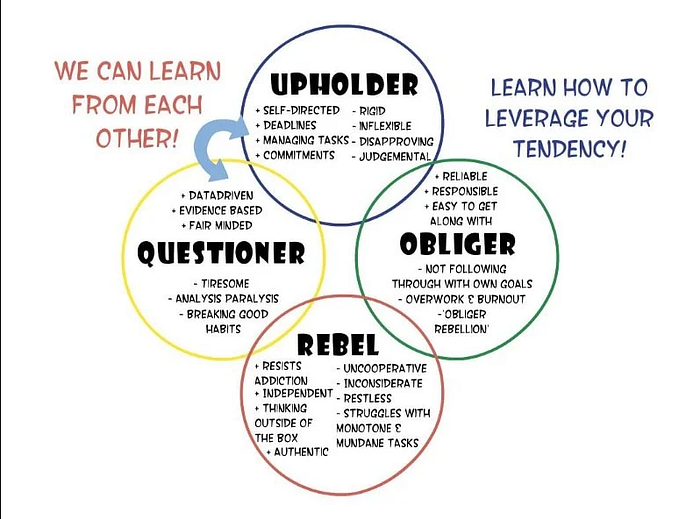
I love the work of Gretchen Rubin. Her Framework the four tendencies was the aha moment I needed. She basically put people into 4 groups:
- Obliger: An obliger is someone who finds it easy to meet external expectations but struggles to meet their own. This is the writer who thrives with deadlines from others but might find it hard to sit down and write their own novel without external pressure. This is the most common tendency — and that's also me.
- Upholder: An upholder finds it easy to meet both internal and external expectations. These are the writer who say they'll finish a novel by the end of the year — and they do. This is the self-starters who stick to their writing schedules without any external motivation.
- Questioner: A questioner will meet expectations, whether internal or external, but only if they agree with the reason behind it. This is the writer who needs to know why they're writing an article or why a certain book idea is worth pursuing. The source of the expectation doesn't matter as long as it makes sense to them.
- Rebel: A rebel defies expectations, both internal and external. They see expectations as limitations to their freedom. This is the writer who will work on their novel or blog post only when they feel like it. Deadlines might make them lose interest, but when inspiration strikes, they can produce high quality work.
You can take the quiz!
How to make it work
I have worked for a well-being startup for 4 years. I produced a podcast featuring top productivity/wellbeing experts Like Nir Eyal and Alexis Haselberger.
So, I learned a few things about productivity and how to get things done. Below are some tips depending on your quizz result above.
Obliger (for writers working with editors or clients)
You must know exactly who you're accountable to. Is it your editor, your publisher, or your writing group?
If you struggle to meet deadlines or stay on track, Let your editor act as your accountability partner. You could check in daily for a quick 10-minute chat or set weekly goals together.
In the meantime, enter what Alex Hormozi calls the season of no. No more projects until you deliver what's on your plate.
Obliger (for independent writers)
Join a writing group, either online or in person, to share goals, get feedback, and stay motivated.
You can also lean on a trusted friend or partner to help keep you accountable. Send them your writing goals for the week and follow up on what you accomplished.
Being an obliger myself, a project based approach worked for me. Instead of saying 'I wanna write for an hour every day' I say 'I will write 3 stories about [insert theme here]'.
Upholder (for writers working with editors or clients)
Editors and clients love working with you because you're reliable and always deliver on time. But you need to be careful not to overwork yourself. Before saying yes to a new project, assess whether it fits into your current schedule.
Upholder (for independent writers)
Align your writing projects with your goals. Once you complete one goal, move on to the next. And remember: If it's not a "hell yes," it's a no. Be selective about the writing projects you take on.
Questioner (for writers working with editors or clients)
You need to understand the reasoning behind a project before you can commit. But some editors or clients might interpret your questions as pushback.
Learn how to ask for more details in a non-confrontational way. Instead of a blunt "Why are we doing it this way?" try saying, "I want to make sure I got this right, can you explain the thought process behind this approach?"
Questioner (for independent writers)
When you're writing for yourself, make sure you have a solid rationale for why you're pursuing specific projects. Is this novel the one you're most passionate about?
Taking the time to understand the "why" behind your projects will help you stay motivated. Use pro/con lists to help you decide which writing projects to take on and which ideas to pursue.
Rebel (for writers working with editors or clients)
You value your creative freedom and might struggle with the constraints of deadlines.
But remember, you chose this project. Remind yourself that this writing assignment pays the bills. You can pursue passion projects later of course.
Rebel (for independent writers)
You have a writing schedule that works for you, so embrace your autonomy. Set just one "must do" each day to keep yourself on track, but leave room for spontaneity.
If one project isn't sparking joy, Let it rest and pick something else for a change.
In most cases, the novelty will go away after a week. So, ask yourself if you are ditching the project because it's not a shiny toy anymore or because the idea doesn't work. If it's the former, give yourself a 30 day trial. Trust me, 30 days are enough to give you clarity about this.