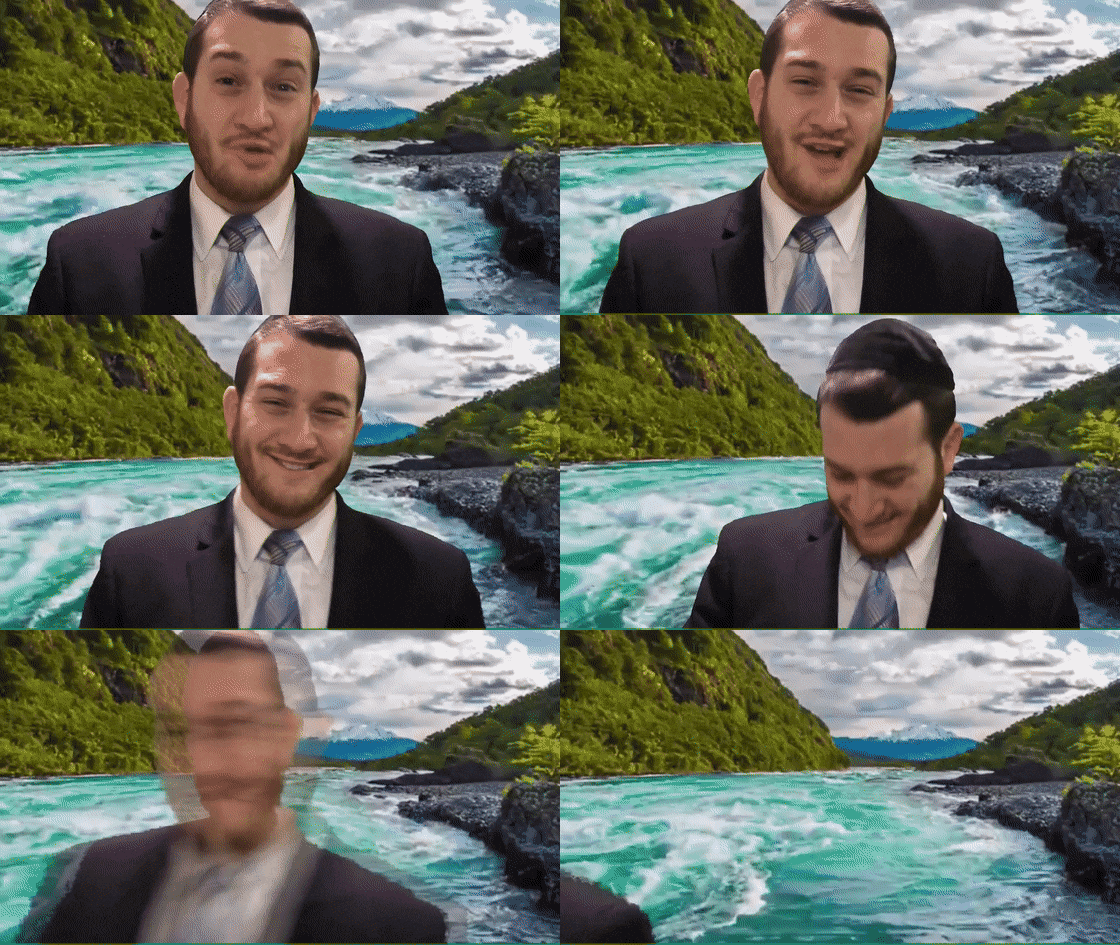

…once you have identified what your vision and mission are, you need to be able to consistently let people know about that vision and mission. Because there are other people out there that can make it happen. I can't tell you how many people felt called to be a part of "The Chosen," just to do whatever…whatever it may be. If we didn't have our content out there, if we weren't consistently sharing that vision and mission with the world, we would never get the help. It doesn't matter what it is. So you have to include people along the way. For us, we'd like to increase our Chosen Army. That's what we call them, getting the people that are helping us get it out to the world. That's really important.
I had the pleasure of talking to Derral Eves, Executive Producer and Co-founder of the global hit, "The Chosen." Derral is an esteemed executive producer and co-founder, renowned globally for his expertise in YouTube and online video marketing. With a rich professional experience spanning over two decades, he has a proven record in audience development and project distribution. He considers his involvement in "The Chosen" as the pinnacle of his career, drawing from all his prior professional and personal experiences.
A global hit series, "The Chosen" has been viewed more than 500M times, with more than 20M unique app downloads, and has been translated into more than 50 languages across seven continents, in 190 countries. The show is distributed by Lionsgate, and is available for streaming on Netflix, Prime Video, Peacock, Fox Nation, for free on TheChosen.tv app, and is also available on DVD at Walmart. Additionally, seasons 1–3 will begin airing on the CW Network starting July 16 at 8:00 P.M. ET/PT. "The Chosen" has collectively garnered more than $35M at the domestic box office, which includes episodes and a Christmas special to movie theaters/Fathom Events ("The Chosen" was #1 at the box office for its Fathom opening weekend, beating out "Avatar"). It also remains Fathom's top-grossing theatrical release to date.
Currently in production for season four, success of "The Chosen" represents a sea of change in how people consume television and content — a code that Derral has seemed to crack and his №1 career passion and focus! Over the course of its first three seasons, the series has garnered praise from critics and fans alike for its historical and biblical accuracy, culturally diverse cast, playful spirit, stirring drama, genuine humor, and disruptive impact.
Derral is a Wall Street Journal best-selling author of "The YouTube Formula" and the founder of Creatus, a distinguished marketing and consulting firm. Furthermore, he also founded VidSummit, an annual video conference. His knack for nurturing YouTube channels is evidenced by his impressive record of aiding 34 channels to garner over a million subscribers from scratch, contributing to an impressive 84 billion video views on the platform.
The core of Derral's values are his family and a strong work ethic. He is known for his passion, hard work, and genuine desire to see others succeed. His honest and straightforward approach to client interaction has earned him respect in the industry.
With a Bachelor's degree in Public Relations and Marketing, Derral started his career by establishing a web hosting and design company. He then invested in the newspaper industry to support his Internet business, ultimately transitioning into the web sphere with the Creatus marketing brand in 1999.
Ever since, he has been instrumental in the success of various global brands, including Red Bull, NBC, and Adobe Software. He has helped generate billions of views on YouTube and been an executive producer on several viral video campaigns. Among Derral's notable achievements is Squatty Potty's ice cream pooping unicorn ad, which won the "Ad of the Year" award at the 2015 Webbys.
Yitzi: Derral, thank you for joining us. I'd love to hear about your origin story. Can you share your childhood experiences and how you grew up?
Derral: Sure, happy to. I grew up in a small town in Utah, one of 10 kids. My best friends were my family, and we lived close to my grandparents, aunts, and uncles. It was a great environment to grow up in. I was always fascinated by content. I remember my uncles, who I thought were the coolest, inviting me to watch a movie they had just seen. They had to watch it again because their mom wouldn't let them go to the theater twice. They took me to see "Empire Strikes Back," and it was amazing! That's when I knew I wanted to do something related to film, television, or video. Over the years, I became even more interested in content. I came across some disruptive ads online, like Wendy's "Where's the Beef" campaign and Dunkin' Donuts' "Fred the Baker." I saved up my paper route money and bought a VCR so I could record and share these ads with my friends. We didn't have DVRs back then, so it was a way for me to connect with others through the content I enjoyed.
Later that year, I saw Apple's Super Bowl commercial for the Macintosh, directed by Ridley Scott. It was so disruptive, and everyone was talking about it. That's when I knew I wanted to do ads. I dedicated my life to learning about marketing and advertising, and in high school, I fell in love with the "Saturday Night Live" sketch comedy. I thought it was fantastic, and I wanted to use humor in ads. They had some hilarious ad parodies, which I used to record over family memories, much to my mom's dismay. She still hasn't forgiven me for that. After high school, I took a break and went on a mission trip to Paraguay, where I spent two years in the jungle. It was a transformative experience, and I learned a lot about serving people and God. When I returned, I knew I wanted to pursue a career in marketing and advertising. I aimed to create Super Bowl commercials and got a degree in the field.
A pivotal moment came when I received job offers from notable ad agencies after graduation. I was thrilled about the opportunities, but I had to make a life-changing decision because I found out I was going to be a dad. I wanted my daughter to have the same close-knit family experience I had, so I decided to turn down the job offers in LA and Chicago and stay where I was. Instead, I started my own agency in 1999, focusing on helping businesses establish an online presence and convert views into transactions.
In 2005, while browsing Craigslist for a desk, I stumbled upon an ad. It offered a new iPod in exchange for getting 100 people to sign up on YouTube. I was intrigued. Steve Jobs had just introduced the new iPod, which was as small as a pack of gum but could hold a thousand songs. I went for it and visited YouTube. It was a game-changer. Finally, you could hit play, and the video would start immediately without buffering. I also discovered its webmaster tools, which excited me because my agency specialized in web design and ranking websites. I realized I could embed videos on websites, and that was a pivotal moment for me. I had been waiting for this opportunity on the internet for a long time. Over the next year and a half, I focused on creating and embedding videos on every website I managed and sold. I ended up making 865 videos. In late 2007 and early 2008, all those videos started ranking number one.
Super Bowl commercials were really impactful for me at the time, so I started focusing on creators who were generating buzz with their content. Eventually, I transitioned into audience development, which is where I found my passion for growing audiences on YouTube, getting views, and building communities. That's where it all began for me. I had a love for Jesus, YouTube, and audience development, and that's how it all started.
Yitzi: That's an amazing story. So, what was the next step for you? How did you go from there to co-creating "The Chosen" — one of the most popular phenomena of all time in terms of engagement?
Derral: Well, I had a talent for identifying potential in people from a mile away. I would come across content on YouTube that I felt aligned with my interests, and I would think, "I can help them with my skill set." My strengths lie in strategy, tactics, and effectively engaging and growing audiences, making sure they feel connected.
At that time, I had started a conference called VidSummit, which we're celebrating our 10th year now, but back then, we were just starting out. This conference brought together YouTubers and content creators to learn strategies and tactics for building a business.
During that time, a friend of mine showed me a short film created by someone for their church. Being a Jesus enthusiast, I decided to give it a watch and engage with it. The short film revolved around a struggling shepherd and intertwined the perspective of the shepherd with the nativity story of Jesus Christ.
As I watched, I could tell that it had a low budget, but the story captivated me completely. I thought, "This creator is amazing!" It touched me and spoke to me on a deep level. I knew I wanted to be a part of it, even if it meant just holding the light or doing whatever I could to contribute.
The following week, I met the creator, Dallas Jenkins, and he shared his vision for a TV show. Something just clicked for me. I realized I could build an audience around this guy because he had real talent. He just needed to become an influencer on YouTube. We needed to promote the story he wanted to create and use that to secure funding.
So we joined forces, started a business, acquired the rights to his short film from the church, and used it along with social media content to showcase our vision for the TV show. This led to us breaking the all-time crowdfunding record in film and television, paving the way for the creation of "The Chosen."
I want to clarify that Dallas is the driving force behind "The Chosen." He writes and directs the scripts. I handle the marketing and audience development, but it's all based on his vision and creation. I use my knowledge and experience to support and promote the project, making people aware of "The Chosen." It has been an incredible journey over the past six years.
Yitzi: What was your long-term vision for the project? How do you hope to make an impact on the world with this?
Derral: That's a great question. When we first started, we basically locked ourselves in an Airbnb and wanted to map out our plan. Our initial goal was to raise the funds to complete season one. But it wasn't just about one season. We wanted to tell the entire story, spanning seven seasons.
At that point, our primary focus was on becoming self-sufficient. We wanted to find ways to monetize the project beyond Kickstarter-style campaigns. Additionally, we simply wanted the world to see it. I remember reading about "Game of Thrones" and how it had a billion viewers. I thought, "If 'Game of Thrones' can attract a billion viewers, why can't we achieve the same with a story about Jesus Christ?"
That was several years ago, and since then, we've been fully dedicated to Dallas' vision of telling the best possible story about Jesus Christ, the most influential figure of all time and for eternity.
Our second goal is to reach a billion people with this project. We're doing everything we can to maximize its reach. We're even giving it away for free because we genuinely want as many people as possible to be impacted by the content. Our goal is to get it out to a billion people.
Yitzi: What lessons do you think people can take from watching the series? What can they learn from the themes and motifs of the past season?
Derral: Well, surprisingly, this show isn't really about Jesus Christ. It's more about the people who were broken in one way or another. When he came into their lives and started teaching them the truth, you could witness their transformation. You see them realizing how broken they truly are and then, by God's grace, they're saved and can see their journey from being a follower to becoming a disciple and eventually an apostle. It's a beautiful progression.
When you look at the world today and compare it to the first century, you notice a lot of similarities. There's still wars, rumors of wars, hatred, bigotry, and unrighteousness. The way people treat others, especially women, hasn't changed much. We're facing many of the same problems and issues.
Back then, the Messiah came and taught a message that brought about change. I believe that people today are finding the content of the show relevant to their lives. They can resonate with the characters who dealt with various issues. They either know someone or have personally been impacted by similar struggles. They see what Jesus actually taught, and it's beautiful. Our ultimate goal is to create excellent content that leads people closer to God. We hope it inspires them to pray, to dive back into the Bible, and if they're not religious, at least to become more aware of God and develop a deeper relationship with Him.
Yitzi: You've been blessed with a lot of success. Share with our readers five things you need to create a film that makes an important social impact. What are the five ingredients that people can do to replicate your success?
Derral:
- I think the first one is you have to have passion about something. Both Dallas and I are passionate about Jesus Christ and we've already given our lives to Him, and will do anything and everything in our power to get His message out there. So I think passion needs to be number one.
- Number two is that you have to have a clear vision. What are you trying to do? I think with that clear vision, it will help you communicate to people what that vision is and what that mission is. So it's easy to understand. So I think if you're going to do a movement, regardless of whether it's video content, a movie, or television and film, I think the passion needs to be there, but also you have to have that vision and mission.
- The third thing would be, once you have identified what your vision and mission are, you need to be able to consistently let people know about that vision and mission. Because there are other people out there that can make it happen. I can't tell you how many people felt called to be a part of "The Chosen," just to do whatever…whatever it may be. If we didn't have our content out there, if we weren't consistently sharing that vision and mission with the world, we would never get the help. It doesn't matter what it is. So you have to include people along the way. For us, we'd like to increase our Chosen Army. That's what we call them, getting the people that are helping us get it out to the world. That's really important.
- Once you have those three things, I think it's really good. Now, I do believe the content needs to speak to the viewer. You need to be able to create content that would really connect with the viewer and that the viewer would be emotionally tied to. If you're really trying to impact people, I think there needs to be a value proposition, whether it's literally inspiring them, educating them, or entertaining them. All three, there needs to be some value in your content.
- The last thing would be helping not only the viewer, but the audience wanting to share it. I think even though you've engaged, what is the shareable moment? What are you able to do to get people to actually talk about it in conversations? I think a lot of people look at merchandising as a way to make money. Well, Dallas and I, we look at it as a way to have a walking billboard. If you have a saying or something on the shirt, people are going to see it and they're like, "Well, what does this 'Binge Jesus' thing mean?" or "What does 'Get Used To Different' mean?" And they're going to have conversations about this show that we're passionate about.
So, I think those are the elements that I would look at, those five things. There's more for sure, but I think those are things that I would always consider when I'm doing a project.
Yitzi: This is our last question. Derral, you have significant influence due to your platform and your great work. If you could inspire a movement or spread an idea that would benefit the most people, what would that be?
Derral: Different people are motivated by different things. Personally, what motivates me is to see individuals who can uplift the world and have a net positive impact. I want them to be able to share that with the world. I genuinely believe that the world needs more things that bring light, goodness, and wholesomeness. Currently, my focus is entirely on making an authentic representation of Jesus visible to the world. The more people who can see that, the better. So for me, I won't give up until we reach a billion people. And to be honest, once we achieve that, I'll celebrate for a brief 2.4 milliseconds.
After that, I'm ready to aim for two billion. That's what I want — to reach two billion people. I believe it's possible. I want the world to witness that. Overall, I think that God has given us talents, abilities, and passions. I simply want to see more good in the world through online content, content that uplifts rather than tears down and makes it a deplorable place.
Yitzi: Unbelievable! I wish more people were like you. What you're doing is amazing. You're truly countering the negativity in mainstream Hollywood. How can our readers continue to follow and support your work?
Derral: Simply go on social media and find "The Chosen." If you haven't seen it, watch it. And for us, the key is to share the impactful moments online. The surprising thing is, the easiest way to reach a billion people is by connecting with just one person. When someone is deeply affected, they share it, and one becomes two, two becomes four, four becomes eight, and so on, until we reach a billion people. I genuinely believe that if you can find something in the show that truly impacts you and share it, it helps us spread the word even further, extending the reach of the kingdom in a unique and beautiful way. I challenge all of you to do it.
Yitzi: It has truly been a delight and pleasure to meet you. I wish you continued success and blessings, and I hope we can connect again when you release your next monumental project.
Derral: I appreciate that. It was a pleasure. Have a beautiful day.