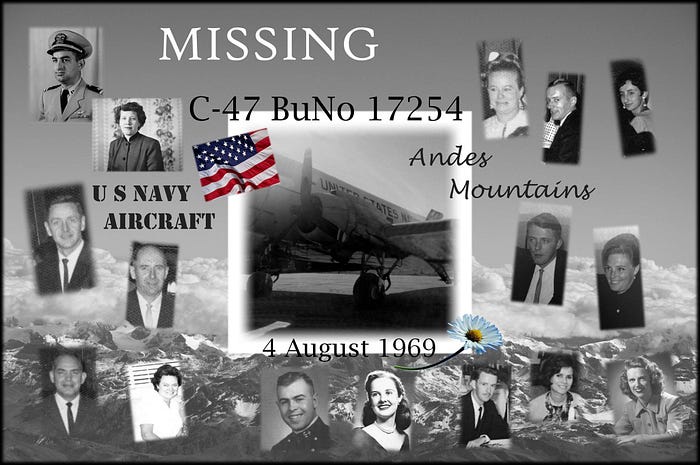

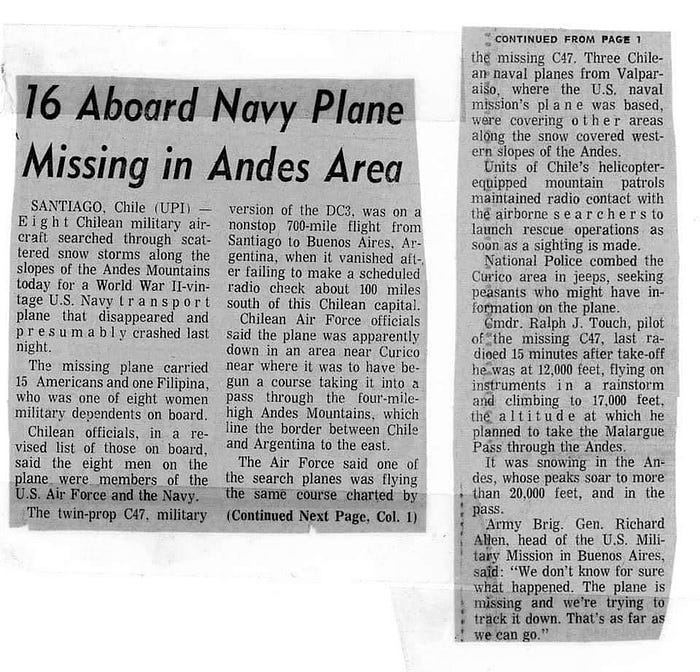
It was August 4, 1969, and a U.S. Navy passenger plane had just gone missing over the Andes Mountains with 16 people onboard. It was flying from Santiago, Chile to Buenos Aires, Argentina for routine "calendar maintenance", which was done on a quarterly basis. In addition to the four crew members, there were 12 passengers flying "Space-Available", a special benefit that allowed service members and their dependents to travel for free if empty seats were available on a military plane. The passengers were military members on authorized leave, as well as civilian dependents, and some were married couples traveling together to Buenos Aires — a popular tourist destination with shopping and other recreational activities. Seats on a flight like this were in great demand, and there was usually a lottery to see who would be fortunate enough to get one. The plane was not just an everyday "flying boxcar" ferrying cargo, rather, it was a special "American Legation United States Naval Attache" aircraft, specially configured to transport diplomats and VIPs.
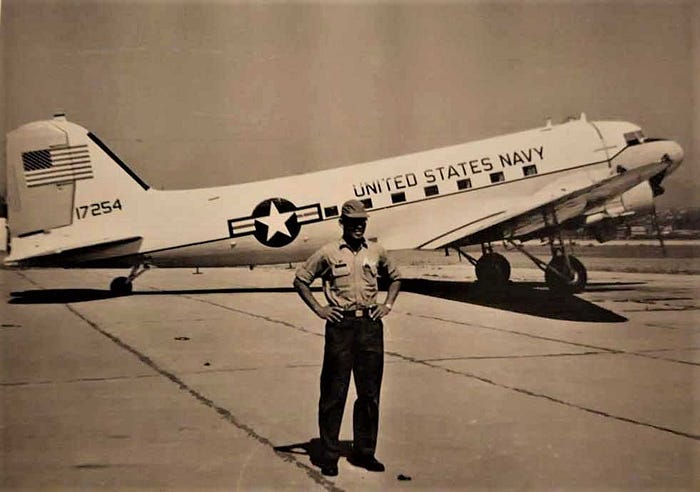
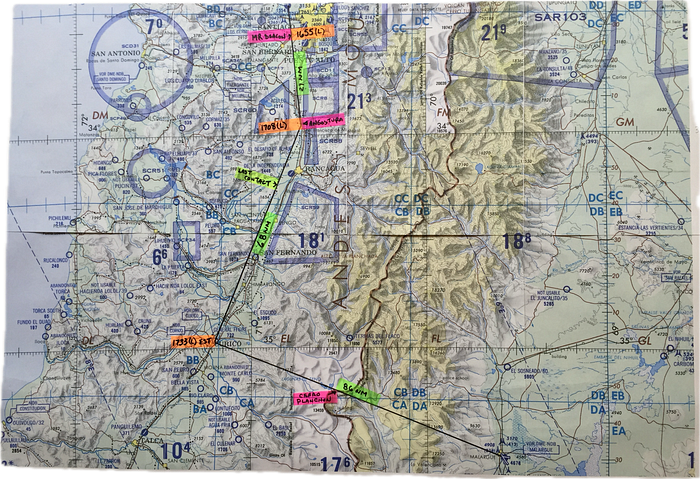
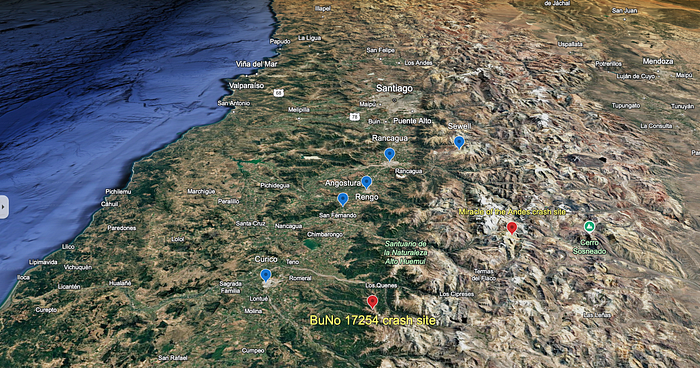
August was winter in the southern hemisphere, and flying over the Andes Mountains was tricky, with some peaks towering to an elevation of over 22,000 feet. Unpredictable weather conditions could play havoc with aircraft, as they dealt with hazards like thermally forced circulations, downslope winds, gravity waves, low-level jets and orographic precipitation. The lost plane was a U.S. Navy C-47M (BuNo 17254), a World War II vintage piston-powered propeller model, equipped with supercharged engines and deicing equipment. It had a service ceiling of 24,450 feet and a cruising speed of 175 mph, but the cabin was not pressurized. While modern airliners could fly high enough to avoid bad weather, the C-47M could not go nearly as high or as fast. The pilot in command was Cmdr. Ralph Touch, U.S. Navy, who had just completed a tour as commanding officer of patrol squadron VP-56, and he was the new Deputy Chief of the Naval Mission at the U.S. embassy. His co-pilot was Lt. Cmdr. James Kuhn, U.S. Navy, who was also an experienced maritime patrol aviator with over 4000 flight hours logged — 1400 of these in the C-47. While Touch had over 6000 flight hours, he did not have much experience flying over the Andes, but Kuhn did, as he was nearing the end of his tour of duty in Chile. When the flight plan was being readied, there were weather reports of icing conditions above 5000 feet and high winds, which had caused the closure of some aerial routes over the mountains earlier in the day. The flight had already been delayed by one day, so Touch made the call to fly, as Kuhn readied an IFR (instrument flight rules) flight plan, so they would be able to fly "on instruments" if weather conditions obscured their visibility. They were scheduled to fly from El Belloto Naval Air Station to Buenos Aires, Argentina, with an intermediate stop at Los Cerrillos airport in Santiago, Chile to pick up passengers. After departure was made from Santiago at 4:50 pm (local), a routine radio check-in was made over Angostura at 5:07 pm while flying at 12,000 feet, and the plane was scheduled to reach Curico at 5:33 pm, where it would turn southeast to cross the mountains. Air traffic control heard part of a conversation where Kuhn recommended that Touch climb to 14,000 feet to avoid bad weather on their flight path. At 5:15 pm, air traffic control contacted BuNo 17254 to report its altitude, and they responded that they were still at 12,000 feet. This was the last verified contact with the aircraft, although one minute later, the sound of engines was heard, presumably due to an open microphone. What happened then, and why weren't there any more radio calls? An emergency may have occurred due to ice buildup on the wings or props, and this would have demanded maximum effort to keep the plane flying. According to Cmdr. Gary Quinlan, U.S. Navy (retired), a highly experienced naval aviator and commercial pilot: "One of the first aviation lessons I learned with the Navy is "Aviate, Navigate, Communicate". When things start to become "busy"… Aviate-fly the aircraft. Make sure you are in control of the aircraft at all times. Navigate- make sure you are where you should be in the sky. Then and only then, try to make sure you communicate with the air traffic controller. I believe they transmitted the report, and it was never received due to icing on the aircraft's radio antennas, or the weather precluded the reception at the ATC station."
After contact was lost with the plane, an emergency was declared by air traffic control, and a massive rescue effort was mounted. Planes and helicopters from the Chilean, Argentine and U.S. Air Forces, crisscrossed a huge swath of territory along and adjacent to the flight path, but bad weather and 30 feet of snow cover hampered their efforts to see anything. To make matters worse, F-86 fighters and some other search and rescue aircraft could not complete their flights due to severe icing. A total of 162 missions and nearly 1,000 hours were flown with 972 persons assisting in the search efforts. Ski troops on the ground were utilized as well, and some family members of the victims traveled to Chile, acting as observers during the operation. After 10 days, the search was called off with plans to resume in the spring after the snow melted, but this was not done, possibly due to political upheavals and deteriorating relations with the U.S. government at the time. The cause of the crash was determined to be due to poor weather conditions, and no findings of misconduct were made. What was the urgency to make a five-hour flight over the Andes Mountains in bad weather at night? No one knows for sure. Perhaps the plane was carrying time-sensitive communications such as "airgrams" bound for the U.S. Embassy in Buenos Aires? Airgrams were used at that time by the U.S. ambassador and others as a means of securely communicating classified information, and the military dictatorship in Argentina was certainly concerned about the political environment in Chile. Interestingly, Touch had served as a courier for secret documents before, as his son observed him carrying a locked briefcase that was handcuffed to his wrist when he traveled as a passenger on a previous flight to Buenos Aires. Pressing CIA business may have been afoot, as the U.S. government was worried that Chile might become "another Cuba", and large amounts of money were being spent with the hope of defeating Salvador Allende Gossens, a popular socialist politician and candidate for president in the 1970 elections.
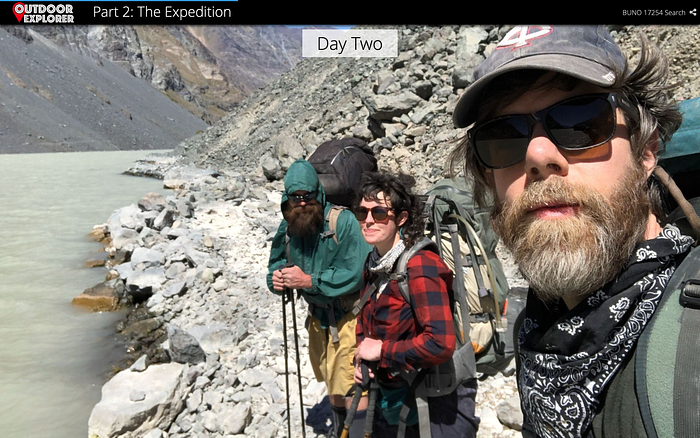
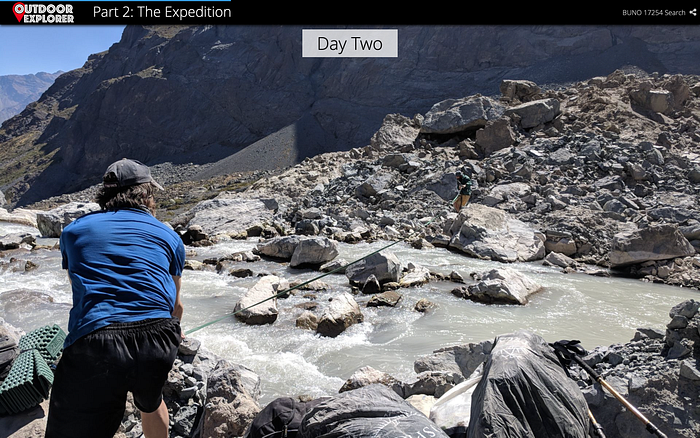
There was a long pause before any more search efforts were mounted, but family members never gave up, as they persevered to find answers by writing and visiting their Congressional representatives, military and State Department personnel, as well as anyone else they thought could help them in their quest for information. It was incredibly frustrating, especially since several family members died without ever knowing where the remains of their loved ones were, and what had happened to BuNo 17254. After years without any progress in finding the plane, Brandon Lovejoy decided to travel to Chile in 2019 to try to find the crash site. Mr. Lovejoy was a nephew of the co-pilot, Kuhn, and his mother, Betty Lovejoy, was Kuhn's sister and closest living relative. Mrs. Lovejoy relates that her parents received news of their son's death initially by telegram, followed by an official visit with U.S. Navy personnel. When asked if she ever heard anything further from U.S. government or Navy representatives in the 55 years since the death notification, she said: "No, I never got anything". Mr. Lovejoy and Andrew Gustin, a trained geologist and cartographer, spent considerable time and effort researching, planning and crowdfunding a 3-person expedition to travel to the most likely spot where the wreckage would be located. Much of this research involved a review of the 160-page Manual of the Judge Advocate General (JAGMAN) investigation of the crash. It was a herculean effort from a logistics and execution standpoint, as the team navigated treacherous river crossings, huge boulder fields and unstable ice formations in their search to bring closure for the extended families of those that perished in the crash. Ultimately, the search was unsuccessful, but a detailed multimedia account of their activities shows that they gave the best effort humanly possible in their quest.
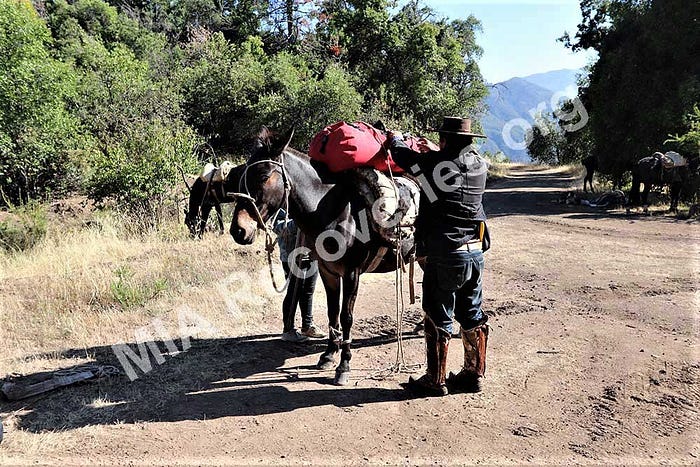
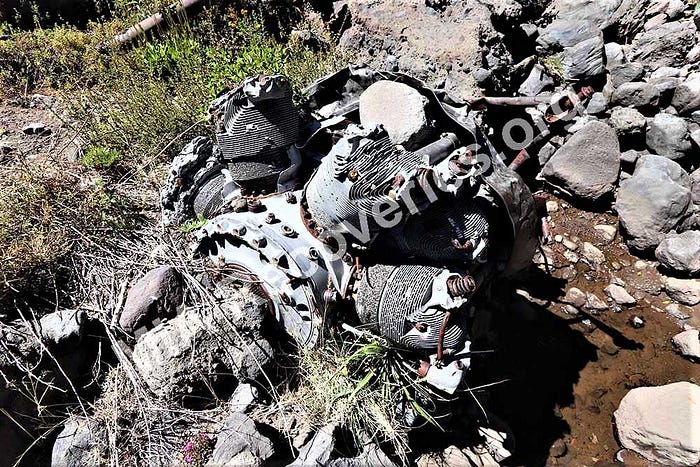
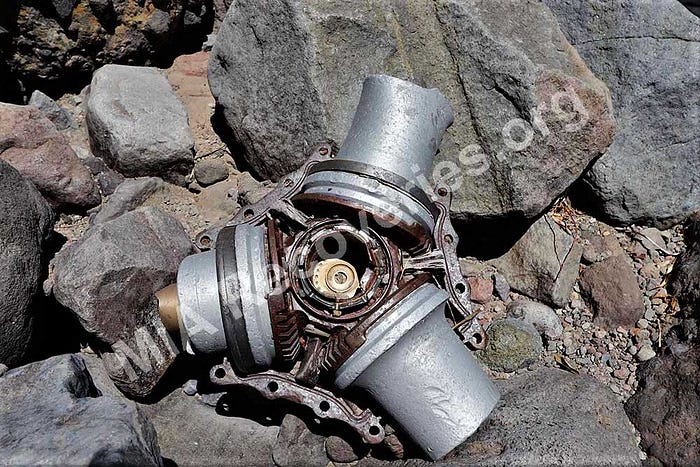
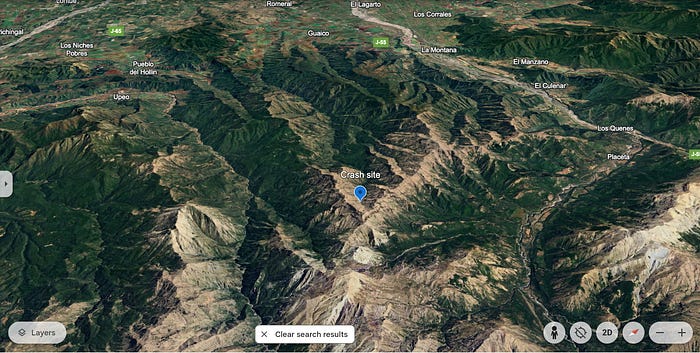
A couple of years later, another search was mounted by Clayton Kuhles, founder of MIA Recoveries, Inc. He was an experienced mountain climber, and largely self-funded independent investigator, who had located 26 military crash sites since 2003, mostly from World War II transport planes that crashed in the mountains of the China-Burma-India (CBI) theater of operations. Some of the sites that he discovered were later excavated by the Defense POW/MIA Accounting Agency (DPAA), resulting in the recovery and positive identification of several sets of human remains. Kuhles recently gave a presentation about his work at Yavapai College in Arizona, and Alan Burghard, a sharp-eyed retired Naval Criminal Investigative Service (NCIS) Special Agent and U.S. Marine Corps lieutenant colonel, alerted this reporter about the story of BuNo 17254. Kuhles learned about the crash from family members of the victims, and he traveled solo to Chile in 2021 to try to locate it. While talking with local residents, he heard a story about a plane crash in an area near the planned flight path of the aircraft which sounded credible, and he was guided to a remote area in the mountains by a local rancher. It was an arduous multi-day trek, and he reports finding wreckage from BuNo 17254 on February 24, 2021, including radial aircraft engines and metal wreckage with the number "14184" stenciled on it, which would be consistent with the unique construction number for that aircraft. Respecting the sanctity of a possible mass grave, Kuhles did not remove any artifacts, but carefully photographed and documented what he observed, as well as the exact location of the crash. Several pictures and a detailed report about the crash investigation and the wreckage found are posted on his website. Kuhles relates that he gave this information to the U.S. Embassy in Santiago soon after his discovery but did not hear anything for three years until Lt. Col. Louis Harrington, U.S. Army, contacted him. It was Kuhles' opinion that he was a representative from the Defense Attache's Office (DAO) at the U.S. embassy. Harrington reportedly requested information about the location of the crash site, which Kuhles gave him, as well as an offer to come to Chile to guide him to the wreckage. Kuhles describes what happened next: "They cut off communication basically when I gave him the name and contact info for my local person who could get them to the site, and he asked me if he could make it." A recent email sent to Harrington asking about his involvement in the search has gone unanswered. Kuhles also mentioned that after the conversation with Harrington, he received communications from his local contacts in Chile that U.S. Embassy personnel had recently traveled to the crash site, followed by Chilean military activity, suggesting that search and recovery efforts may be underway.
Outreach was made to the U.S. Embassy Santiago Press Section requesting information about their knowledge of the crash and any current recovery efforts. They recommended that inquiries be forwarded to the Caribbean Office of Public Diplomacy and Public Affairs (WHA/PDA), Bureau of Western Hemisphere Affairs. A reply from Press Officer Nina Reyes was received three weeks ago, with assurances of a response, but none has been forthcoming, despite follow-up requests for information. An email to the Chilean Embassy in Washington, D.C. yielded a quick answer from Fernando Martin Garcia Naddaf, Press and Cultural Attaché, and he said that they were unaware of the BuNo 17254 crash and would forward the question to their Naval Attaché, but no response has been received yet. Finally, the DPAA was queried about their knowledge of the crash, and Sean Everette, Media Relations Team Lead for Outreach and Communications, responded: "After speaking with our historians who would be researching this crash, we do know about it. However, this incident is not included within DPAA's Congressional mandate of finding those still missing from our past wars and conflicts. While the Vietnam War was going on, the crash happened in South America and was not combat related, which is why we are not tracking any of the missing individuals. The individual services (in this case, USN and USAF) still have responsibility for the families of these casualties. If the services were to come to us through official channels to help them work on this case, we could possibly help them, but as of right now, that has not happened."
It is no secret that the U.S. government had a long history of involvement in anti-communist activities in the Caribbean, Central and South America, some of which predated the Cold War. These operations included the Bay of Pigs Invasion in Cuba, Operation Condor, dirty wars, and the CIA's involvement in multiple coup d'états and political assassination plots. It was a dark period for U.S. foreign policy, and our government may be unwilling to admit that our military presence in Chile was related to any of those activities. Cold War crashes are currently investigated by the DPAA in other parts of the world such as: the former Soviet Union, Yugoslavia, Hungary, East Germany, North Korea, Albania, the East China Sea, the Straits of Formosa, the People's Republic of China and North Vietnam. It is time to acknowledge that the Cold War was global, and its boundaries must be extended to include the Western Hemisphere. The DPAA has precedent for the recovery of a non-combat aircraft loss in South America, specifically in Brazil, where a B-24H Liberator (serial number 42–95064) was lost after departing Trinidad in the British West Indies on April 11, 1944, carrying 10 personnel on a ferrying mission to Belem, Brazil. The flight failed to reach Belem and a search mission was unable to locate its crash site. The crew didn't survive the incident, and their remains were not recovered at that time. In 1990, a Brazilian private citizen discovered aircraft wreckage in the jungle, north of Macapa, Brazil, and the tail number confirmed it as the missing Liberator. The finding was reported to the U.S. Defense Attaché Office, Brazil, and from 1994 to 1995, Central Identification Laboratory–Hawaii (CILHI, now DPAA) teams excavated the site and retrieved human remains and artifacts. Scientists used laboratory analyses and circumstantial evidence to account for all 10 of the missing airmen from among the recovered remains.
By all indications, Kuhles has found the wreckage of BuNo 17254, and U.S. and Chilean Embassy staffers that could confirm or deny his claims have remained silent, despite repeated requests for information. Why the outgoing US Ambassador to Chile, Bernadette M. Meehan, did not address the crash or the families' concerns during her tenure is known only to her. The next logical step would be to send a recovery team with special capabilities to locate, excavate and preserve any artifacts and human remains that can be found. The best choice for this would be a DPAA team, similar to the ones that were sent after Kuhles' previous discoveries which led to successful recoveries of human remains. Kuhles has even offered to lead a team back to the crash site, and his tax-exempt public charity, MIA Recoveries, Inc., is the vehicle he has used to partially fund these expeditions in the past. Capt. Frank Guest, U.S. Navy (retired), a former Destroyer Squadron Commander and nephew of Kuhn, had experience in training with the Chilean armed forces. He suggested that a joint Chile-U.S. military training exercise might be a way to bring DPAA assets to the crash site while enhancing joint interoperability, and he said: "It is safe to say that the DOD services have a long history of bilateral training exercises with the Chilean armed forces".
As to the DPAA's Congressional mandate, it can be argued that BuNo 17254 was undoubtedly a Cold War era crash, and it deserves the same attention and respect that the DPAA is devoting to 14 other missions with 126 missing personnel from that same era. Jana Churchwell Scott is a professional genealogist who has worked closely with the DPAA, and she focuses on military service and records research. Having personally suffered the loss of her own relatives during wartime, her career has been dedicated to the memory of missing service members and their families, in her work with The MIA Recovery Network, as she states: "The people who work for DPAA are not the issue. The legislative directive is the problem for non-combat missing, and it just needs to be modified. The change needs to be that if a family member of a non-combat missing military member and/or dependent makes an active inquiry to DPAA, then the agency must respond with time and resources. Further, if some related discovery is made to the loss, then they also must be responsive to it."
As the relatives of those who perished age and pass on themselves, there is a unique opportunity for closure for the siblings, children and grandchildren of those who were lost. The DPAA could expedite a team to Chile to verify, once and for all, the identity of the wreckage and communicate this with the families. It would be appropriate for the incoming U.S. Ambassador to Chile, Brandon Judd, to make this one of his first priorities.
Sons, daughters, mothers, fathers, brothers and sisters were lost with no answers or closure for the families left behind, and 55 years of waiting has been too long. In Churchwell Scott's own words: "Human and monetary resources are finite, however in the grand scheme of things, non-combat missing aren't that numerous, but they matter no less. If no man is left behind, then mean what you say and say what you mean."
Capt. John Michael Williams, Sr., U.S. Navy, is a freelance journalist and a retired medical and civil affairs officer who served combat tours in Iraq and has done humanitarian missions in the U.S. Southern Command (SOUTHCOM) area of operations. He formerly served as Reserve Surgeon, U.S. Pacific Fleet in Pearl Harbor, HI. He has a special interest in the study of human factors associated with aircraft mishaps and in the location and recovery of downed aircraft.

The crew members and passengers of BuNo 17254 were:
· Cmdr. Ralph J Touch, U.S. Navy; pilot, from Des Moines, Iowa
· Lt. Cmdr. James P Kuhn, U.S. Navy; co-pilot, from Osage, Iowa
· Chief Aviation Electronics Technician Joe Fernandez, U.S. Navy; radioman, from El Paso, Texas
· Chief Aviation Machinist's Mate John T Higgins, U.S. Navy; aircraft mechanic, from Medford, Massachusetts
· Lt. Cmdr. Harold L Mooney, U.S. Navy; passenger, from New York, New York
· Staff Sgt Frank A Homer, U.S. Air Force; passenger, from Cincinnati, Ohio
· Technical Sgt Robert L Paterson, Jr, U.S. Air Force; passenger, from Pine City, New York
· Staff Sgt Ronnie J Ball, U.S. Air Force; passenger, from Forsyth, Missouri
· Shelby Penn Mooney; wife of Lt. Cmdr. Mooney, U.S. Navy, passenger
· Elizabeth Anne Smith; wife of Capt. Floyd E Smith, U.S. Navy, passenger
· Norma Ann Heist Touch; wife of Cmdr. Touch, U.S. Navy, passenger
· Carol Tilton; wife of Cmdr. Robert L Tilton, U.S. Navy, passenger
· Claudine Cox Fernandez; wife of Chief Fernandez, U.S. Navy, passenger
· Carol Homer; wife of Staff Sgt Homer, U.S. Air Force, passenger
· Esther Zuluaga Paterson; wife of Technical Sgt Paterson, U.S. Air Force, passenger
· Norma R Orcutt Ball; wife of Staff Sgt Ball, U.S. Air Force, passenger