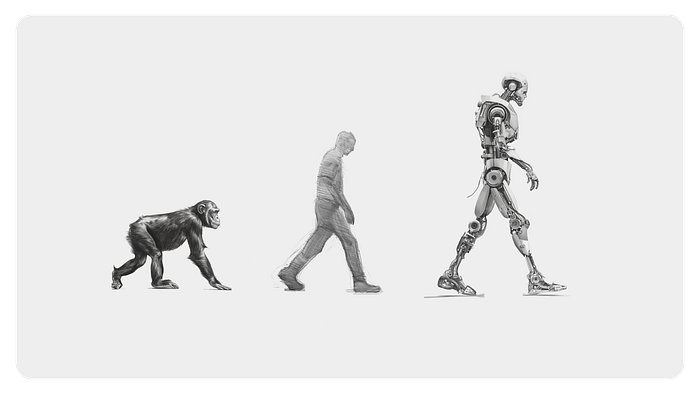

The Theory of AiVolution
Darwin missed it; The rules of biology don't apply anymore.
You'd think that when we evolve from Apes, then the next thing on the list is becoming a better version of ourselves.
- We've been becoming smaller and smarter.
- So, in a thousand years, it only makes sense that we'd have arched necks because we use our phones all the time and maybe become even smaller.
Evolution is straightforward in this sense and can't be challenged. Although, it'll require quite a while for us to evolve. But let me ask you this — Do you think you're in control of this process? You're not.
Nature takes its course. Whatever fits fits.
- If people are using phones 24/7, then we'll have hunched backs.
- If working out is not a necessity anymore, then we'll become fatter.
Whatever fits, fits.
Do you know what really fits in our day? Artificial freaking intelligence.
It's like adding salt to an omelet. It's kind of not necessary, but it is.
AI is loved for one reason — it makes life easier.
This seems to have been mankind's objective since the Industrial Revolution. We need to create things that make our lives faster and easier.
Speed is no joke when it comes to us humans. Our current attention span is around 8.25 seconds, while a goldfish's attention span is 9 seconds…
Did I lose your attention? I wouldn't if you were a goldfish.
Some products like McDonald's are loved by people because they contain dopamine. It tastes great and just chemically feels good.
Uber makes us commute faster, so let's use it. We used it a lot, and in the first six years, they reached 10 billion trips. They finally reached 100 million users after six years of operations.
Then, a chatbot comes into the market, allowing people to generate almost any online content resembling human quality. That chatbot reaches 100 million users in two months.
Whatever fits, fits.
The only problem with us people is that we're always greedy for more. Uber knows it. Mcdonalds knows it. OpenAI knows it.
- UberEats, UberPool?
- McAnything really.
Chatbot that does everything not enough? How about images? How about videos? How about mimicking the voice of other humans in 15 seconds?
Sam Altman knows that there's no pleasing this mass market. If they offer all of those features, they'll be very rich, but people will want more.
Like what? Mobility? A robot that actually mimics a human with a similar intelligence?
Figure.ai jumps into the equation, creating a humanoid that could do the construction work you're not capable of doing as a human being.
Should this be done by a human or an AI?
For the next few decades, this question will be at the forefront of every strategic decision, but forget about the answer for now and let me add some more context.
- Take movies, for instance — Do you prefer human-produced or AI-generated content? You probably haven't watched AI-generated movies, but are you open to the idea?
Deloitte posed this question to Gen Z:
The point is that your opinion won't affect whether or not AI-generated content permeates the internet. It all depends on future generations. So, to answer the previous question:
- "If AI-generated content is as good as human content, it'll spread everywhere."
And here's a follow-up question: "Is AI-generated content as good as human-generated content?"
Well, it's not, but think about it this way:
- If, in 2000, human content was 99% better than AI-generated content.
- Then, in 2015, human content was 90% better than AI-generated content.
- And then, in 2023, human content was 50% better than AI-generated content.
Then we've got a problem.
AI-generated content is getting exponentially better in quality. The moment the difference is no longer drastic is the same moment when your grandchildren would be watching the Taitanic (I'm not sorry).
- A ship steered by robots doesn't see an iceberg and crashes. Wait, that's not realistic. Okay, I guess AI movies won't have any mistakes with human error — the future of the film industry is still safe.
On the topic of films: OpenAI, the company that brought us GPT, is releasing a tool called SORA — which can pretty much create videos like this:
Let's think about it another way:
- Titanic cost nearly $200 million to produce (If adjusted for today's currency).
- Programs like Sora or Pika will allow you to create videos similar to (or better than) the above for almost $60 per month.
$60 vs $200 is quite the comparison…
So, should this be done by a human or an AI?
Answers supporting AI have been increasing in recent years — and that's the core problem: We'll be competing against what we built.
The world isn't going to fire Hollywood to start making its own Titanics just yet — that'd be pandemonium. It would make a good movie, though (*furiously takes notes*).
- First, we'll start small — removing the simple jobs that AI can handle.
- But in a hundred years, we won't even need software developers! (Relax, you'll be gone by then).
Every job nowadays has someone saying, "AI can do this; I'll create a startup that does that, and I'll get rich!"
- Construction? Figure AI is building a robot that could handle that.
- Design? Midjourney creates images that are winning awards.
- Writing? I'm a writer. We won't ever get replaced… Ha! Ha. Ha? This job was dead the moment ChatGPT launched. Yes, I'm doomed, but I can laugh about it.
Well, if I was writing to sell — I'd be in trouble. But since I'm writing to tell a story, I think I'll survive for now. Aren't you reading because you're interested in hearing a story?
- Would you be as interested if you knew this story was AI-generated? Probably not.
- Your great-grandkids, though?
Are we evolving our brain or replacing it?
What's 12 x 15? 11 x 19? 9 x 12?
Nowadays, most people need their phones to answer the above questions.
Here's why: As a kid, we memorized multiplication tables. Then we grew up and thought that you don't need to do math in your head since calculators can do it faster…
We simply reduced our brain's workload by outsourcing the job to a calculator, and we were happy to do so.
Your grandchildren will face this "calculator dilemma" with almost everything from food choices to their 9–5 jobs. If AI could do it faster and more accurately, why bother?
If that's true, why are people panicking and calling AI an existential crisis? It should be good news, no?
Calculators were a mistake.
We're on this rock, floating through space to evolve and survive.
- To survive, we need to evolve.
Our evolution has now shifted from the physical to the mental.
- We're not hunters anymore — we evolved because we've started challenging our minds. If a bear is trying to eat us, we gotta work smart — not hard.
We've spent the last few millennia investing in our tiny brains by challenging them. And rest assured, you don't need to think of maths or science… We'll have an AI that handles all of that.
You can just sit at home and relax, not worrying about food or shelter — all thanks to the robots we'll have working on our behalf.
- If the average human won't face any problems.
- Then, the average human won't challenge their brain anymore.
- So, the average human won't need to evolve.
Instead of continuing to invest in our tiny brains, we're panicking about an AI chip shortage because the more we invest in AI, the better it becomes.
- It's not The Matrix — it doesn't have to be malicious — no one has to launch nukes. All it has to do is make our lives easier — and nature will take its course.
So, just sit there and watch our IQ get lower and lower.
But I can't leave on such a depressing note… So, let's get to the optimistic part:
You can say I'm naive, but I believe in humans.
I believe that sooner or later, we'll see that something isn't right. We're comfortable right now, but the moment we stop being comfortable, which will inevitably happen, we'll object:
- "AI shouldn't design everything."
- "AI shouldn't decide our schedules."
- AI shouldn't evolve while we stagnate."
The small daily actions are small parts of the evolutionary marathon — don't give that up.
Keep doing the small things, and reject AI's shortcuts (even if it takes more time) because you need the experience.
And that's what helps me sleep soundly, but what are your thoughts? Let me know in the comments, and we can start a discussion.
I'm Al, a business consultant in Zurich, Switzerland. I believe in the power of delivering value to you, the reader. Follow me on various social media platforms if you're interested in the value of my content.