
A new CX is emerging
Ecommerce is heading into its next evolution.
From bricks and mortar, to desktop, to mobile, every phase has shifted the shopping interface. But while logistics and mobile UX have improved, the core experience of ecommerce – typing into a search bar, filtering grids, tapping between tabs, purchasing across different sites – hasn't meaningfully changed in over a decade.
Now, AI promises a new interface. Not just chatbots or assistants, but goal-driven, autonomous agents that can act on behalf of users to search, filter, decide, and even check out.
But this future won't materialise on AI alone. The infrastructure – merchant-side data, APIs, taxonomy, checkout access – is outdated and unprepared. If AI discovery and agentic commerce business model is going to work, the entire ecommerce stack needs to evolve.
But before we race ahead, it's worth asking: why didn't previous waves of fashion discovery innovation succeed?
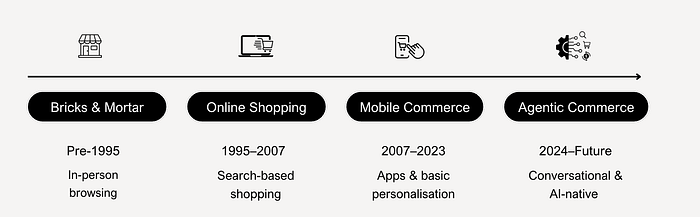
Legacy challenges: looking back
The last decade saw a wave of fashion discovery startups - Polyvore, Lyst, ShopStyle, Wanelo, Spring etc - each promising to reinvent how people find and buy fashion online. Most ultimately failed to scale or sustain their business models.
The reasons weren't just technological. They were structural:
- 📦 Catalog Fragmentation: Incomplete brand participation meant platforms lacked the full product ranges expected.
- 🔗 Broken Attribution Models: Last-click systems hijacked affiliate revenue. Platforms that drove discovery often lost out at purchase.
- 💳 No Native Checkout: Users faced multiple carts, shipping fees, and return policies, a friction-filled experience that killed conversion.
This combination created a wave of failed platforms and it has left a legacy of skepticism about third-party discovery layers.
Now, what is agentic commerce?
Agentic commerce refers to a model where autonomous AI agents handle the core steps of shopping on behalf of a person. These aren't static filters or product recommendation widgets. They're capable of reasoning, evaluating tradeoffs, and making decisions aligned to your goals.
In practice, this means:
- Understanding user context, taste, preferences, and intent
- Searching across multiple merchant sources, not just one site
- Ranking and filtering options
- Initiating or completing a transaction
They aren't just responsive. They act for you - proactively, and sometimes collaboratively with other agents.
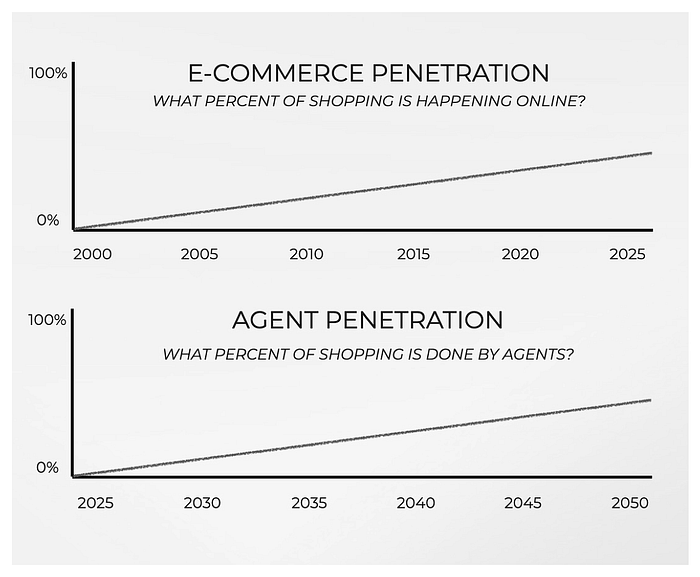
Why this matters
Discovery no longer starts with a search bar. Instead, agents can pre-filter, pre-select, and pre-negotiate what users see - flipping the traditional ecommerce funnel. Agents may soon replace the "homepage" as the starting point of shopping for many.
For consumers:
- 🧠 Less cognitive load
- 👁️ Context-aware, personalised suggestions
- ⚡ Optional autonomy (you set how much they do)
For merchants:
- 🔥 A fundamental shift in discoverability
- 🛠️ New requirements for data, APIs, and checkout access
- 🎯 A critical need to optimise for agent-based traffic
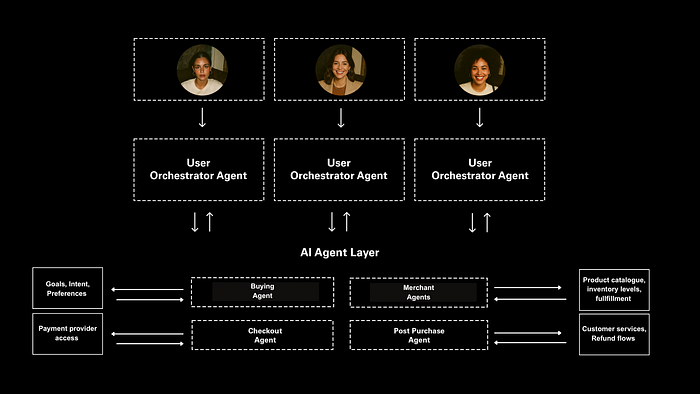
Where we're heading: multi-agent systems
The future won't be a single agent acting alone. Instead, expect networks of agents collaborating:
- Buyer agents understand goals and preferences.
- Merchant agents surface SKUs, pricing, and availability.
- Checkout agents handle fulfilment, loyalty, and payments.
- Post-purchase agents manage queries, refunds, and reorders.
But right now, these flows are fragmented and merchant systems were built for human browsers, not machine agents.
What needs to exist for this to work
Ecommerce systems were designed for human browsers, not machine agents. That needs to change.
On the buying side:
• Goal and intent modelling • Taste graphs and user context engines • Interoperable agent protocols • Permissioned payment access
On the merchant side:
• Standardised inventory and pricing APIs • Structured, enriched product data • Agent-compatible PDPs • Autonomous checkout endpoints
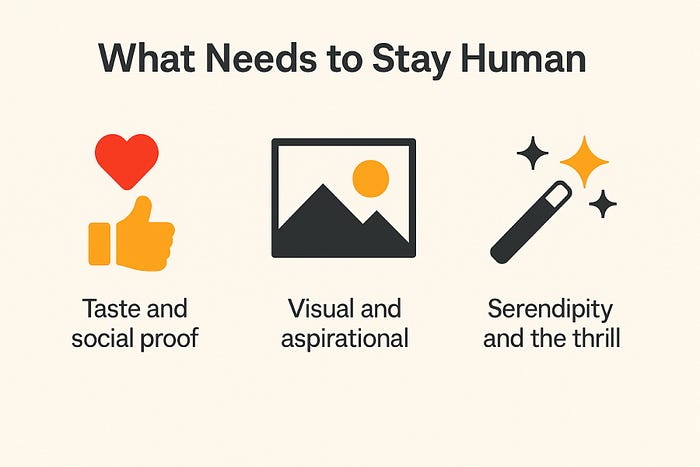
What needs to stay human
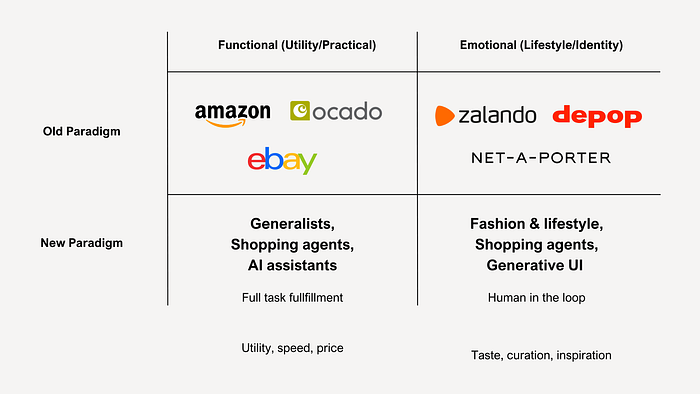
AI can reduce effort but can't replicate taste, culture, or aspiration. Shopping in lifestyle categories is inherently visual and social.
Not all interfaces will be conversational. Many will remain browsable and generative, with agents quietly powering search, discovery, and checkout. Full autonomy isn't always desirable - buying a toaster is different from curating a outfit. Variable autonomy will be key - shoppers want inspiration, not just optimisation and the joy of discovery still matters.
What's blocking this now?
Even the best AI agents can't function without access, as I mentioned to begin with there are legacy issues but also challenges with new systems that still need to evolve further:
- API access to inventory and price is limited or unavailable
- Product feeds are often messy, unstructured, or out of date
- Checkout flows are designed for logged-in human sessions, not agents
- Affiliate systems still operate on traffic and last click attribution
This isn't just a tech problem. It's a systemic legacy issue across the ecommerce ecosystem.
Who's building here?
Several players are tackling parts of the puzzle:
- AI-native commerce startups are crawling product feeds and structuring and enriching data themselves
- Others are building preference, wardrobe, calendar, and lifestyle-linked intent graphs
- Fintechs are experimenting with autonomous checkout infrastructure and attribution systems
In truth it is likely going to take a combination of all of the above and many still lack deep access to merchant data. The infra layer – from catalogue to checkout – remains the missing link - which is the piece to unlock a agentic driven business model and customer experience that will deliver genuine unit economics that work.
Power dynamics and platform control
If agents do control discovery and checkout, who owns the customer relationship?
• Will brands and retailers be on board with optimising for these new discovery and demand layers or will they resist and compete?
• Will platforms like Shopify or Wix evolve to become agent-compatible infrastructure providers?
• Or will new startups build from scratch - creating the first native agentic storefronts, machine readable catalogues and universal API access?
This raises existential questions for brands and platforms alike. If you're not optimised for agent-based discovery going forward, you're potentially missing a major shift.
The opportunity
The winners will bridge two parallel evolutions:
- DTC Storefronts - hyper-personalised, brand-forward, story-rich.
- Agent-Compatible Infrastructure - structured, discoverable, and machine-readable.
Whoever solves the last-mile challenge of agent-to-merchant interaction will own a critical layer of the future commerce stack.
There's greenfield here for founders, infra teams, and ecosystem builders.
In summary
Agentic commerce has the potential to meaningfully disrupt ecommerce.
Success in this space hinges on three factors:
1️⃣ Overcoming distribution challenges to achieve sustainable CAC. 2️⃣ Building a radically better user experience (where AI gives an edge). 3️⃣ Solving the legacy business model flaws that plagued earlier platforms or defining entirely new business models
If you're building here, or trying to fix these structural challenges, let's talk.