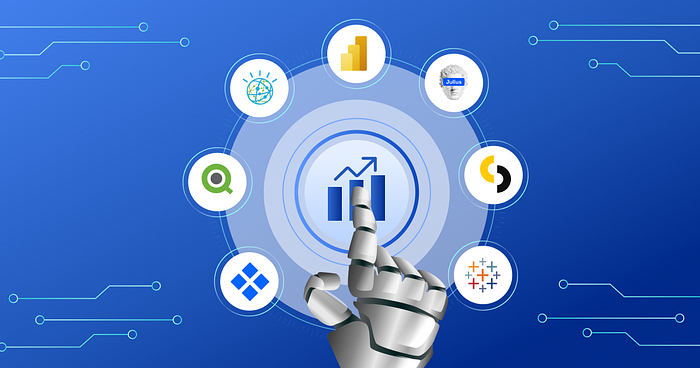


Generative AI tools are revolutionizing data analysis by enhancing speed and accuracy. These Generative AI tools help to simplify the process of analyzing data, identifying patterns, making predictions, and turning complex information into clear and actionable insights.
Whether you're new to data analysis or a seasoned pro, these tools can make your work more efficient and help you to excel in your career.
Data analytics and AI are set for significant advancements. By 2030, the market for data analytics is predicted to grow to $745.15 billion, and AI is expected to expand to $2,025.12 billion.
Check out this interesting article -
Best Generative AI Tools for Data Analysts
Generative AI tools stand out for their ability to automate complex tasks, enhance data visualization, and provide deeper insights.
These tools enable data analysts to boost their efficiency and make better-informed decisions. Let's explore some of the best generative AI tools that are transforming the field of data analysis.
1. Tableau
Tableau provides dynamic dashboards and intuitive data visualization tools, simplifying the process of exploring and presenting data visually. The AI-powered Ask Data feature allows users to ask questions in plain language and receive quick graphical responses. This allows users to interact with their data without needing any coding skills.
Features -
- Tableau offers interactive, shareable dashboards for creating visually appealing data presentations effortlessly.
- Its user-friendly drag-and-drop interface allows anyone to create detailed visualizations without needing technical skills.
- Tableau seamlessly integrates with multiple data sources, allowing effortless data combination and analysis.
- With real-time analytics, Tableau delivers up-to-date insights for timely decision-making.
Pricing:
- Tableau Public: Free Trial
- Tableau Viewer: $15 per user/month
- Tableau Explorer: $42 per user/month
- Tableau Creator: $70 per user/month
2. Microsoft Power BI
Microsoft Power BI is a well-known generative AI tool that creates detailed reports and dashboards from multiple data sources. Power BI easily connects to various data sources and integrates smoothly with other Microsoft applications.
It lets you transform and model data using Power Query and Power Pivot, and provides custom visualizations to make the data more engaging and relevant.
Features -
- Microsoft Power BI enables interactive data visualization for deep insights and trend analysis.
- It delivers instant access to data from multiple sources, guaranteeing current information for prompt decision-making.
- Customizable dashboards enable users to adapt visualizations to their unique business requirements, enhancing data clarity and communication.
- AI capabilities, automate data analysis, revealing patterns and trends to inform strategic decisions effortlessly.
Pricing:
- Basic: Free Trial
- Power BI Pro: $10 per user/month
- Power BI Premium Per User: $20 per user/month
3. IBM Watson Analytics
IBM Watson Analytics is a cloud-based service that equips business users with powerful tools for data mining and predictive analytics. By automating insights and identifying trends, it helps uncover relationships and patterns within data. Using AI algorithms, it enables users to make informed, data-driven decisions.
Features -
- IBM's Watson Discovery uses AI to visually annotate text in documents and integrate structured understanding, enhancing document comprehension.
- Automated analysis techniques simplify data analytics by reducing analyst responsibilities, making it easier to develop advanced predictive models with minimal prerequisites.
- Users can customize dashboards to interact with real-time data and collaborate on visualizations.
- This technology transforms spoken words into written text and can also turn written text into audio.
Pricing: Free trial.
4. Sisense
Sisense enriches analytics for a diverse user base by seamlessly integrating deep insights from AI and machine learning into various applications.
The platform offers user-friendly low-code and no-code applications, ideal for those who value simplicity. Developers leverage SDKs and APIs to craft customized solutions, enhancing their workflow flexibility.
Users engage with advanced AI-driven analytics through intuitive visualizations such as clear charts and graphs. They seamlessly explore data using natural language queries, gaining insights powered by natural language generation and generative AI technologies.
Features -
- Sisense simplifies the visualization of complex data.
- Professional management of massive data sets.
- Quick data cleaning for focused analysis.
- Discovering ideas through thorough data exploration.
5. Akkio
By enabling seamless business analytics and accurate forecasting, Akkio empowers data analysts to analyze datasets, predict outcomes, prioritize job management, score leads, forecast sales, and optimize income. Its intuitive design allows newcomers to easily customize data without any hassle.
Features -
- Analytical methodologies that predict the future.
- Organize priorities with a list to improve job management.
- It also includes lead scoring to identify potential buyers.
- Predicting sales and income.
Pricing:
- Basic: $49 per user/month
- Pro: $99 per user/month
- For more Pricing check out here.
6. Julius AI
Julius AI provides tailored data analysis tools and a web-based solution designed for CSV file analysis. Users can upload their files to leverage AI-driven analysis capabilities.
The platform includes data visualization through clear charts and graphs, an intuitive interface for exploring data, predictive analytics for forecasting, and the capability to develop precise statistical models delivering dependable outcomes.
Features -
- Utilizing data visualization through basic charts and graphs.
- Developing a user-friendly interface for easy data exploration and analysis.
- Predicting trends through forecasting using predictive analytics.
- Developing distinctive statistical models to yield reliable findings.
7. Qlik
Qlik is a generative AI tool specializing in data visualization, analytics, and business intelligence. They provide a platform called Qlik Sense, which allows users to create interactive visualizations and dashboards from multiple data sources.
Qlik Sense is known for its user-friendly interface that enables users to explore data, create insights, and make data-driven decisions without requiring extensive programming skills. It supports a wide range of data integration capabilities, making it popular among businesses for its flexibility and powerful analytics features.
Features -
- Utilizes drag-and-drop functionality to organize and analyze data.
- Offers commentary and analysis alongside displayed data.
- Automatically connects relevant datasets for comprehensive analysis.
8. Polymer
Polymer, a state-of-the-art generative AI tool for data analysis, excels in user-friendly features. Renowned among AI tools for data analysts, Polymer effortlessly generates visualizations and presentations, eliminating the need for manual scripting.
It continuously monitors market fluctuations, empowering informed decision-making, and facilitates strategic planning for long-term business objectives. It also evaluates financial performance to optimize profitability and ensures operational efficiency by monitoring critical KPIs.
Features -
- Stay updated on market fluctuations for informed decision-making.
- Develop strategic plans to establish long-term firm expansion goals.
- Conduct profitability analysis to optimize financial performance and maximize profits.
- Review key KPIs to maintain smooth operations.
Pricing:
- Basic: $5 per month
- Starter: $25 per month
- Pro: $50 per month
- Teams: $125 per month
Closing Thoughts
Generative AI tools have fundamentally reshaped the landscape for data analysts, offering powerful new ways to handle complex tasks and extract valuable insights from data. These generative AI tools free up analysts to focus on higher-level analysis and strategic decision-making by automating tasks like pattern recognition, data synthesis, and predictive modeling. This transition not only boosts efficiency but also elevates accuracy and reliability in data interpretation.
Note: To eliminate problems of different kinds, I want to alert you to the fact this article represent just my personal opinion I want to share, and you possess every right to disagree with it.
If you have more suggestions, I'd love to hear about them.
Know Your Author
Claire D. is a Content Crafter and Strategist at Digitalogy who can transform your content ideas into clear, compelling, concise writing that forges powerful connections with readers.
Connect with me on Medium, Linkedin, & Twitter.

This story is published on Generative AI. Connect with us on LinkedIn and follow Zeniteq to stay in the loop with the latest AI stories.
Subscribe to our newsletter and YouTube channel to stay updated with the latest news and updates on generative AI. Let's shape the future of AI together!
