
Google just quietly launched something that's going to transform product management interviews across the entire tech industry. While everyone was focused on their latest AI announcements, they were testing a completely new interview format in India that incorporates AI tools directly into the evaluation process.
As someone who has coached hundreds of job seekers through product management interviews and spent years as a VP of Product designing hiring processes, I can tell you this: every major tech company will be copying Google's approach within the next 12 months. The question isn't whether this change is coming — it's whether you'll be ready when it arrives.
But here's what most companies are going to get wrong. They're going to focus on the surface-level mechanics of adding AI tools to interviews without understanding the deeper shift in what skills actually matter for product managers in the AI era.
After analyzing the three variants that are already emerging and coaching candidates through early implementations, I've identified which format will become the gold standard and why most companies will choose the wrong one.
The Seismic Shift in PM Skill Evaluation
Before diving into the specific formats, it's crucial to understand why this change is happening now and why it represents such a fundamental shift in how we evaluate product management capabilities.
Traditional PM interviews test theoretical knowledge and hypothetical problem-solving. Candidates memorize frameworks, practice case studies, and demonstrate their ability to think through problems in controlled environments. These skills matter, but they don't reflect how product managers actually work in 2025.
Modern product managers spend their days using AI tools to accelerate research, generate prototypes, analyze data, and communicate ideas. The ability to effectively leverage these tools while maintaining strategic thinking and user empathy has become just as important as traditional PM skills.
"We realized we were hiring people based on how they performed in artificial scenarios while ignoring their ability to use the tools that would make them successful in the actual role. The new format tests both traditional PM thinking and modern workflow integration."
Google's innovation isn't just about adding technology to interviews. It's about creating evaluation methods that more accurately predict real-world performance in AI-augmented product roles.
Format 1: The 45-Minute Vibe Coding Case
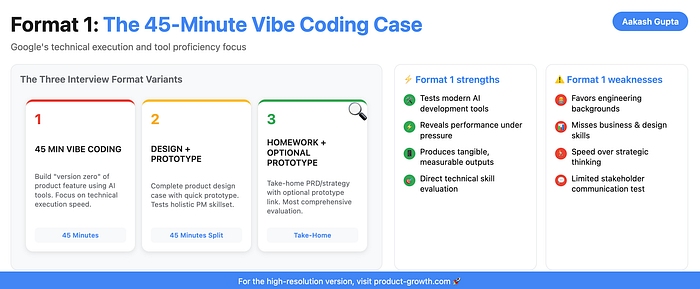
The format Google initially tested in India focuses heavily on technical execution and tool proficiency. Candidates receive a product challenge and must build a working "version zero" prototype using AI coding assistants and rapid development tools.
This approach evaluates several key capabilities: comfort with AI development tools, ability to translate product concepts into functional prototypes, speed of iteration and problem-solving, and technical communication during the building process.
The sessions are intense and revealing. Candidates who are comfortable with AI-assisted development can quickly build impressive prototypes that demonstrate their product thinking. Those who aren't familiar with these tools struggle to complete basic functionality within the time constraints.
Strengths of Format 1: It directly tests the technical skills that modern PMs increasingly need. It reveals how candidates work under pressure with unfamiliar tools. It produces tangible outputs that are easy to evaluate objectively.
Weaknesses: It may favor candidates with engineering backgrounds over those with strong business or design skills. It could miss important PM capabilities like user research, market analysis, and stakeholder communication. The emphasis on speed might not reflect the more thoughtful, strategic aspects of product work.
Companies adopting this format tend to be engineering-heavy organizations that value technical depth and rapid prototyping capabilities.
Format 2: Product Design + Prototype
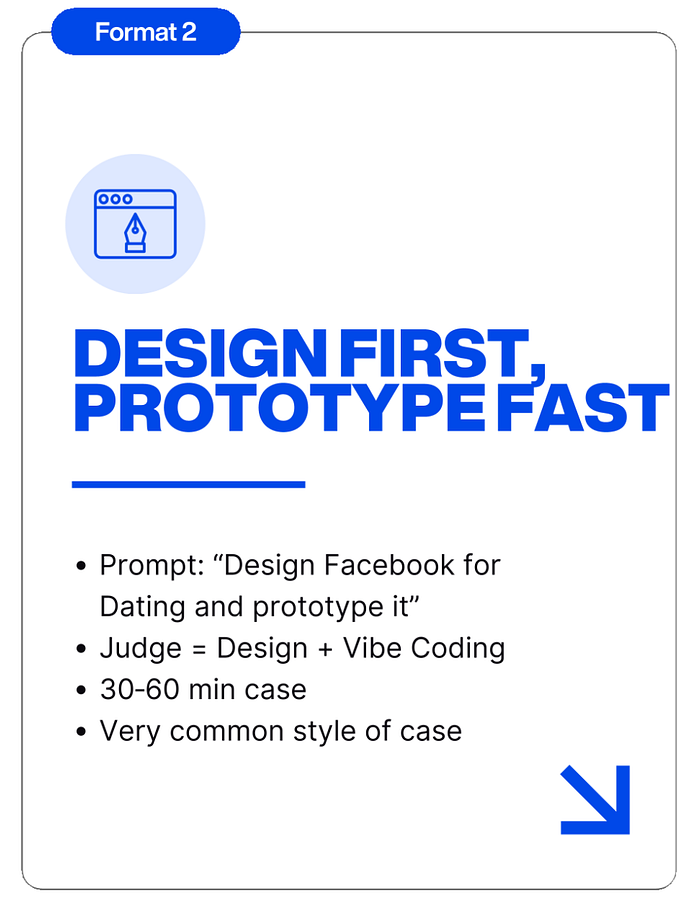
The second variant combines traditional product design thinking with a practical prototyping component. Candidates work through a complete product case — identifying user needs, defining requirements, creating user flows — and then build a quick prototype to demonstrate their solution.
This format attempts to balance traditional PM evaluation with modern tool proficiency. The design phase tests strategic thinking, user empathy, and problem decomposition skills. The prototyping phase evaluates technical comfort and ability to communicate ideas through working examples.
The sessions typically involve: 30 minutes of traditional product design work, 15 minutes of rapid prototyping using AI tools, integration discussion connecting design decisions to implementation choices.
Strengths of Format 2: It maintains evaluation of core PM skills while adding modern technical components. It tests both strategic thinking and execution capabilities. It provides a more holistic view of candidate capabilities than purely technical or purely strategic approaches.
Weaknesses: The format can feel rushed, with insufficient time to demonstrate depth in either area. It may favor generalists over specialists who excel in specific domains. The transition between design and prototyping can feel artificial rather than reflecting natural workflow integration.
Many mid-size tech companies are gravitating toward this format because it feels like a safe middle ground between traditional and innovative approaches.
Format 3: Homework with Optional Prototype
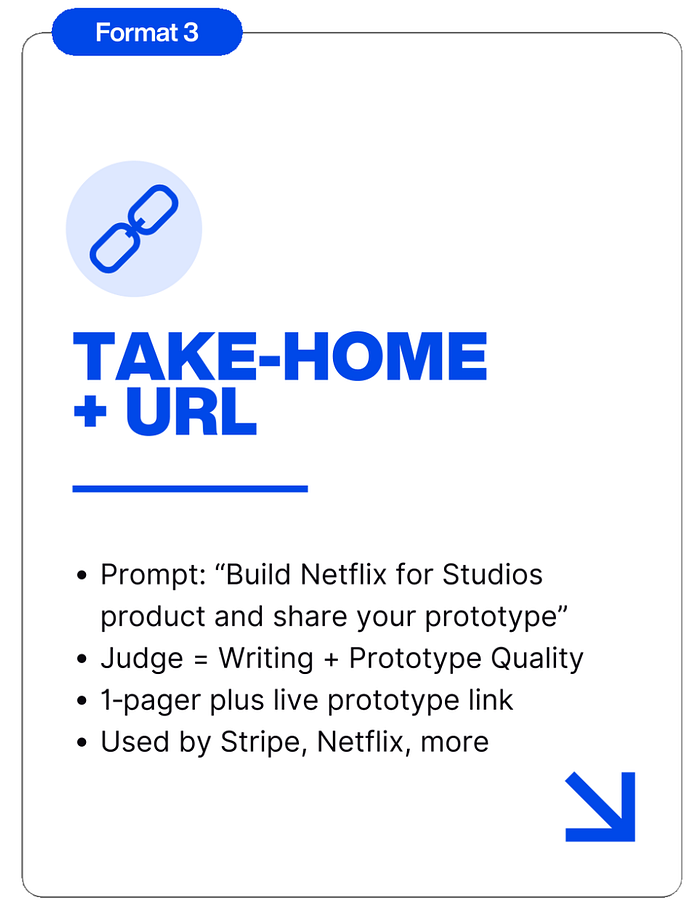
The third variant, which I believe will become the industry standard, takes a different approach entirely. Candidates receive a comprehensive take-home assignment that asks them to design a product feature, with an optional component to include a working prototype link.
This format most closely mirrors actual product management work. Candidates have time to conduct research, think strategically about the problem, create comprehensive documentation, and optionally demonstrate their technical capabilities through prototyping.
The assignments typically include: detailed product requirements document (PRD), market research and competitive analysis, user journey mapping and wireframes, success metrics and measurement framework, optional: working prototype or demo link.
As I discussed in my recent newsletter, this format provides the most comprehensive evaluation of how candidates approach real product challenges when they have adequate time and resources.
"Format 3 is the closest thing to actual product work I've seen in interviews," one senior PM who recently went through this process told me. "You get to show strategic thinking, research skills, communication ability, and technical comfort all in one comprehensive package."
Strengths of Format 3: It allows candidates to demonstrate their best work without artificial time constraints. It tests the full range of PM skills from strategy to execution. It provides insight into how candidates manage complex projects independently. The optional prototype component lets technically inclined candidates showcase additional skills without penalizing those who focus on other strengths.
Weaknesses: It requires significant time investment from candidates, which may limit the applicant pool. It's harder to standardize evaluation across different reviewers. It doesn't test performance under pressure or real-time problem-solving abilities.
Why Format 3 Will Dominate
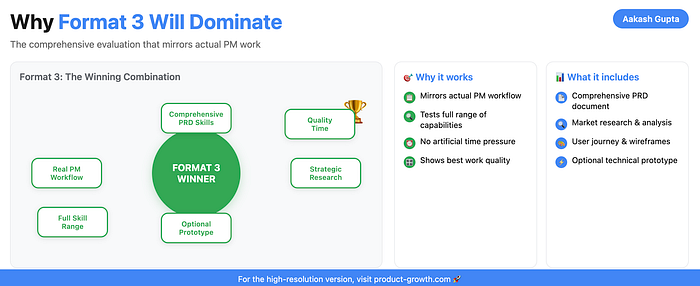
After coaching job seekers through all three formats and analyzing their effectiveness from both candidate and company perspectives, I'm confident that Format 3 will become the dominant approach for senior product management roles.
The homework format with optional prototyping perfectly captures the hybrid skill set that modern product managers need: strategic thinking, research capabilities, communication skills, and technical fluency.
More importantly, it reflects how product managers actually work. The best PMs don't make decisions in 45-minute sprints. They conduct research, iterate on ideas, gather feedback, and refine their approaches over time. Format 3 allows candidates to demonstrate this more realistic working style.
Companies that adopt Format 3 will attract higher-quality candidates who appreciate the opportunity to showcase their comprehensive capabilities. They'll also get better hiring signals because they're evaluating candidates in conditions that more closely resemble actual work environments.
You can find detailed strategies for excelling in each format on my main website, including specific frameworks and templates that have helped candidates succeed.
The Implementation Challenge
While Format 3 offers the best evaluation framework, it also presents the biggest implementation challenges for companies. Creating good take-home assignments requires significant upfront investment from hiring teams. Evaluating comprehensive submissions takes more time and expertise than grading technical exercises or design presentations.
Most companies will choose Format 1 or 2 because they seem easier to standardize and scale. This creates an opportunity for candidates who prepare specifically for Format 3 implementations, as they'll be competing in a smaller, more sophisticated candidate pool.
The companies that invest in properly implementing Format 3 will have significant advantages in attracting and identifying the best product management talent. Those that choose easier-to-implement formats may miss out on candidates who excel at the comprehensive thinking that actually drives product success.
Preparing for the New Reality
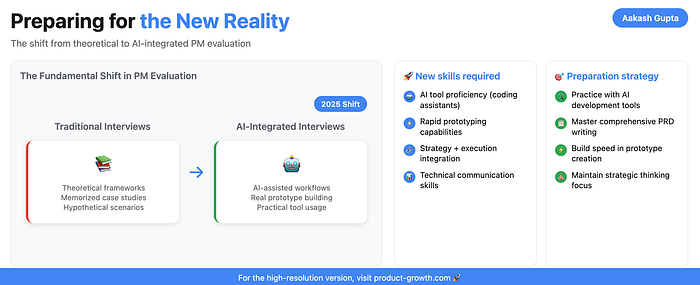
Regardless of which format becomes most common at your target companies, the underlying message is clear: product managers need to develop comfort with AI-assisted workflows while maintaining strong strategic and communication capabilities.
The candidates who succeed in these new interview formats will be those who can seamlessly integrate AI tools into their product thinking without losing sight of user needs, business objectives, and market dynamics.
I recently created a comprehensive guide covering all three formats, which you can access through my LinkedIn profile where I share regular updates on interview trends and strategies.
The Broader Implications for Product Management Careers
Google's new interview format represents more than just a hiring innovation. It signals a fundamental shift in what skills the industry values in product managers.
The days of pure strategic thinking divorced from technical implementation are ending. The future belongs to product managers who can bridge strategy and execution, leveraging AI tools to accelerate their work while maintaining the human judgment that technology cannot replace.
This shift creates both opportunities and challenges for current product managers. Those who adapt quickly by developing AI tool proficiency alongside their existing skills will have significant advantages. Those who resist the technical aspects of modern product work may find themselves at a disadvantage in competitive job markets.
For aspiring product managers, the message is even clearer: technical comfort is no longer optional. You don't need to become an engineer, but you do need to become comfortable using AI tools to prototype, analyze data, and accelerate your product development workflows.
What This Means for Companies
Beyond the immediate hiring implications, Google's interview innovation reflects broader changes in how product teams operate. Companies that understand this shift will gain competitive advantages by building more effective product organizations.
The most successful companies will be those that recognize the need for product managers who can operate effectively in AI-augmented environments while maintaining the strategic thinking and user empathy that distinguish great product work from mere feature development.
As I explored in a recent Medium article about AI's impact on product management, the companies that thrive will be those that use these tools to amplify human capabilities rather than replace human judgment.
The Question Every PM Should Ask
As this new interview format spreads across the industry, every product manager should ask themselves: "Am I prepared to demonstrate both strategic thinking and technical execution in the same evaluation process?"
The answer to that question will determine whether you're positioned to take advantage of the opportunities that this shift creates or whether you'll be caught off-guard by changing expectations.
The future of product management interviews is here. The question isn't whether you'll encounter these new formats — it's whether you'll be ready to excel when you do.
What steps are you taking to develop the hybrid skill set that these new interview formats evaluate? And which format do you think will become most common at the companies where you want to work?