
Product management is an end-to-end game. You uncover how to improve customers' lives while collecting business value. You need a sound strategy and solid tactics.
Let's be honest, who's really playing the product game?
Most people play the bullshit management game, which is the art of doing things that drive no value but suck the soul out of you.
The more bullshit you handle, the less value you create.
I won't lie.
I did more product management than bullshit management, and I believe most product folks do the same. Yet, you can get beyond it if you have two things: a lot of courage and a pinch of audacity.
Let's start by facing reality.
A brief story:
My first promotion came because I consistently increased the team's velocity by 30%. I got the title of Senior Product Manager. I was thrilled and thought I was nailing it. Only to learn later that we just shipped stuff but created no value.
My realization: I was a backlog manager, not a product manager.
Now it's your turn to face reality.
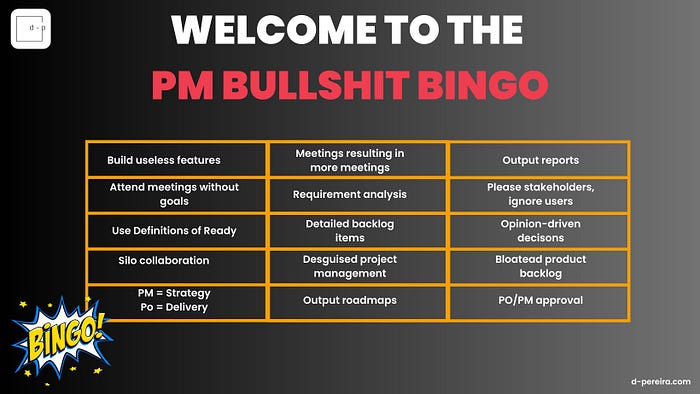
Look at the following image and tell me if you're winning the bullshit bingo or not. I bet you're going to strike a few things there.
How do you feel about it? Is that what you really should be doing?
This episode of Untrapping Product Teams isn't for everyone.
I won't sugarcoat anything, but I will give you insights to help you break free from the nonsense. Keep reading if you're ready to get where most people don't get.
Do You Have a Nose for Bullshit?
How do you feel about any of the following situations?
- Developers complain tickets aren't clear enough and demand a stronger definition of ready.
- Stakeholders have loads of ideas and push you to load your backlog.
- Estimates take most of the refinement session's time.
- Product people sign off on work from software engineers.
- You attend several meetings, resulting in several more meetings.
If you bow to the above, you will end up doing more bullshit management than product management. Seriously.
Reflect on how the above helps you drive more value. Can you answer that?
Anything that doesn't contribute to value creation sets you apart.
When you develop a nose for bullshit management, you don't do what people want, you do what's necessary. Let's talk it through.
1. Detailed Tickets = Contracts
Instead of writing better tickets, collaborate closely with your team.
Collaboration will beat coordination. You don't want a team of coders, you want a team of achievers.
Lead by context, not control.
2. Bloated Backlog = No Space to Embrace the Unknown
We all know stakeholders will always have the most brilliant ideas in the world. Yet, loading your backlog with ideas without challenging them will cripple innovation.
Instead of saying yes to everything, say no to remain focused.
Yet, saying no is challenging because people hate that. The best way is to help people understand why you should not advance with their brilliant ideas. Ask questions:
- How does this cool idea relate to our current strategy?
- Which evidence do you have supporting it?
- How do customers deal with that currently?
- How many customers will benefit from it?
- What's in it for the business?
- How often do customers face that?
- How much do they care about it?
- What happens if we don't act?
A long list? Yes.
It's better to ask many questions before bloating your backlog than to have a bloated backlog lacking context.
Sometimes, deleting your backlog is your salvation to do what matters. Here's a story for you.
Once, I had a backlog of 1772 items. And my manager wanted me to read it all.
I did try reading all the items, but I could not understand them as they were unrelated. It was a Christmas wishlist from finance, operations, customer service, marketing, and everybody else.
After three days, I took a chance. I deleted everything untouched for 6 months. I knew people would receive emails, so I waited to see what happened. Two replies, a marketing analyst who claimed he never wrote that "nonsens,e" and a QA engineer thanking me for closing the bug because it was fixed long ago.
I repeated that a few times, and it only brought clarity.
Whatever is important will come back to your plate with the proper context.
3. Estimates = False Expectations
Most teams get in trouble because of estimates.
No matter how they put, estimates become a "committment" and that sucks.
You should estimate to build shared understanding, not to create a project plan. Once, Maarten Dalmijn suggested that teams should start forecasting and stop estimating. He mentioned that teams should change the forecast as more information becomes available. That's better than estimation.
If you want to go further, start investing.
As a product folk, define the worth of an idea and how much time you want to invest in it. Then, work backwards. Increase investment when you get evidence justifying it, and cut it altogether when you have nothing hinting it's worth continuing.
Are you still with me?
Get my best weekly insights for free at dpereira.substack.com
4. Tickets Sign Off = No Accountability
Do you have someone approving tickets from Software Engineers? If you have that, stop it. That's a horrible idea, here's why.
- Software Engineers descend to coders
- Product people become a bottleneck
- Impossible to drive accountability
- Quality standard set by the product person, not the team
- Unavoidable handovers
If you genuinely want to empower teams, you should:
- Clarify the context (If you got the answers from section 2, your life will be easier)
- Define desired outcomes
- Collaborate to achieve results beyond tasks
Sadly, many teams still have siloes inside the team.
The only way to win the product game is to play it collaboratively. You cannot win if responsibilities are scattered.
If you doubt that, here's a story for you.
I loved to sign off on tasks. It made me feel powerful.
Eventually, I learned the high cost of that and decided to remove the "PM approval" from our workflow.
Initially, software engineers still turned to me for decisions. Instead of telling them what to do, I asked what they thought was the best action. Within that, I noticed which context they lacked and could correct it.
After 3 months without "PM Approval," we shipped more, and morale increased.
I wish I had done that earlier.
5. Meeting Marathons = No Focus
It has never been easier to schedule a meeting. You can find a lot with 10+ people and get everyone in the room to discuss stuff. What do you say about it?
Let's do a brief meeting health check?
- Do your meetings have a clear goal?
- Do you receive the agenda before the session?
- Do you consider other ways of achieving the desired result before slotting a meeting?
- Do you invite only participants who are necessary to reach the goal?
- Do meetings result in reasonable actions and clear ownership?
- Do you take into account the cost of context switching?
- Do you limit meetings to what matters most at this moment?
If you answered yes to all questions, you've got a sustainable approach to meetings. Otherwise, you need to take action.
I know that's pretty easy to have meeting marathons with many people. With hybrid work and modern tools, it's easy. Yet, being busy doesn't mean driving value. Having distracting meetings will set you and your value apart.
Don't let a meeting marathon eliminate your chances of doing what matters.
Here are a few tips:
- Limit meetings to 20 hours a week.
- Set focus time for deep work — 3-hour slots
- Have breaks between meetings
- Ensure you don't default to meetings — async methods can work
- Start with the goal, and ditch meetings unrelated to it
Break Ordinary Rules If You Want to Become Extraordinary
The world is full of people trapped in their comfort zone. They let the status quo define how they work. They check in, do their stuff, check out, and repeat that daily.
Let me be blunt.
You cannot become an extraordinary product person if you let ordinary rules limit you.
Remember how we started our chat?
You need a lot of courage and a pinch of audacity. When you feel the fire in your belly, act now, learn, adapt, share, and improve. That's how you can grow.
It can be scary to take action when most people follow whatever is happening. Know your pain. If paying the bullshit bingo isn't for you, then act when people watch.
Actions You Can Take Now
- Clean up your backlog — everything untouched for more than 3 months is good to go. Delete them if you dare, or archive them if you're more conservative.
- Remove any approval step you have, and start truly leading by context.
- Take ownership of your time by ruthlessly reviewing your meetings.
- Practice saying no by asking more questions
Share in the comments how you take action to transform this game!
Shall we reshape the product world together?
Whenever you're ready, I can help you boost your career
Join the 3-week mastermind that transforms product managers into product leaders executives rely on.