
Imagine you are a business owner. You open your analytics dashboard one morning and freeze. Overnight, your website's organic traffic has dropped by 40 percent. No errors, no warnings — just silence where your audience used to be.
You are not alone. Across industries, thousands of small business owners are staring at similar graphs. The reason? A single change in Google's code, rolled out quietly in mid September 2025.
This is how one technical decision reshaped how the internet is discovered, why Reddit's stock lost billions, and what every business that depends on search visibility needs to learn.
What Actually Happened
On September 17, 2025, Google disabled a setting called the num=100 parameter.
It sounds like obscure technical jargon, but its effects were massive.
Before the change, automated systems like AI assistants and SEO research tools could fetch the top 100 Google search results at once. Imagine a library with 10 floors of books. These tools could take an elevator with glass walls and see every floor at once.
After the change, that elevator disappeared. They could now only see the first 10 results, one trip at a time. To reach the 100th result meant taking 10 separate trips.
For websites ranking in the top 10, nothing changed. For everyone else, visibility dropped off a cliff.
Search Engine Land later reported that 77 percent of sites lost unique ranking visibility, and nearly 9 out of 10 saw a decline in impressions. Anything beyond the first page had effectively become invisible to modern discovery tools.
he Reddit Wake Up Call
Few companies felt the shock more dramatically than Reddit.
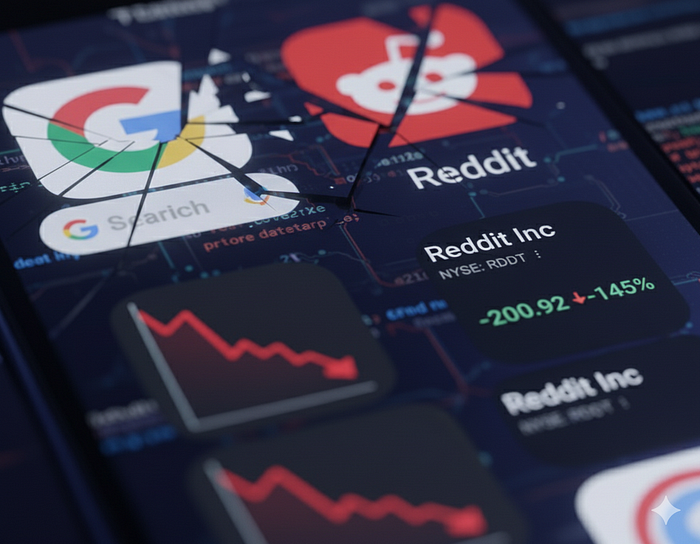
Between September 29 and October 2, Reddit's stock price fell from around 240 dollars to 201 dollars, erasing roughly 14 percent of its market value in days.
The cause was not a scandal or a hack — it was visibility. Data from Promptwatch showed Reddit's citation share in ChatGPT responses fell from 29.2 percent to just 5.3 percent after the change — an 82 percent collapse.
Why? Because most Reddit threads live beyond the first page of search results. Once AI systems could no longer reach those deeper pages efficiently, Reddit stopped being cited as a source. Less visibility meant fewer visitors, which led to declining engagement, and investors reacted fast.
Analyst Brad Erickson at RBC Capital put it simply: Google's change limited AI models to just one tenth of their previous data depth. For a platform built on attention, that was devastating.
Why This Matters for Small Businesses
The uncomfortable truth is that most small businesses live beyond the top 10 results.
That's where local service providers, niche blogs, and small e commerce sites quietly get discovered. Google's change did not erase them — but it made it far less likely that automated systems or AI search tools will find them.
It is like moving your shop from the main road to a back alley. You are still open — but far fewer people will walk by.
Even SEO professionals were hit hard. Their rank tracking systems relied on that same num=100 parameter. Now, tracking a full keyword list requires 10 times more effort and cost, and sometimes even triggers Google's anti bot defenses.
But the deeper lesson for business owners is not about SEO mechanics — it is about dependency.
The Distribution Lesson
When your main discovery channel is owned by one platform, you do not own your traffic — you rent it.
Google just reminded the world of this. Facebook did it when they changed their algorithm and wiped out publisher reach. Twitter did it by restricting API access. Apple did it when privacy updates crushed Facebook's ad targeting.
Each time, businesses that depended on a single gatekeeper paid the price.
The pattern is simple: dependence equals vulnerability.
What Agile Businesses Do Differently
Businesses that survive these shifts share a mindset: treat distribution as an asset, not a dependency.
1. Build owned audiences. Email newsletters remain the most reliable channel. When a subscriber joins your list, that connection is direct — no algorithm in between. Brands like Morning Brew and Exploding Topics have built multi million dollar businesses through this model, reaching audiences that no Google update can take away.
2. Diversify discovery channels. People do not rely on Google alone anymore. They search on TikTok, YouTube, LinkedIn, podcasts, and newsletters. The goal is not to be everywhere — it is to be where your customers are. A B2B SaaS company might focus on LinkedIn and niche newsletters. A visual brand might thrive on Instagram or Pinterest. Local services might focus on Maps optimization and community groups.
3. Offer real free value. Tools, templates, calculators, and checklists create organic visibility and goodwill. Exploding Topics grew early traction by offering a free, no login trend discovery tool — something genuinely useful, not a gated lead magnet.
4. Think like a media company. Instead of a single website hoping for search traffic, create multiple touchpoints — podcasts, short videos, community spaces, and useful content that builds brand recall. When people think of a need, they should think of your brand, not a Google search box.
The Practical Path Forward
You do not need massive budgets to adapt. You need strategy.
Start by auditing where your traffic comes from. If more than 60 percent depends on organic search, it is time to diversify.
Then build one owned channel — an email list is the easiest place to start. Deliver weekly insights or resources your audience actually wants.
Next, map where your customers spend time online. Engage there intentionally instead of spreading effort thin.
Finally, create something free and useful that solves a small but real problem. That is how brand trust compounds.
This is not about abandoning SEO. It is about ensuring SEO is not your entire foundation.
The Real Story
The num=100 change was a small technical tweak — but its message was huge.
Platforms can reshape entire industries with a few lines of code. Reddit's losses showed how fragile attention can be when it is rented, not owned. Thousands of small businesses felt that fragility overnight.
The way forward is not panic — it is independence. Own your audience. Diversify your reach. Build brand equity that no algorithm can erase.
Because the internet is rented land, and smart businesses always have a plan for when the landlord changes the rules.
What do you think?
Have you seen changes in your traffic or rankings after Google's update? How are you adapting your marketing strategy? Share your experience in the comments below.
References
- https://searchengineland.com/google-num100-impact-data-462231
- https://www.interodigital.com/blog/google-quietly-killed-the-num100-parameter-heres-why-your-rankings-and-impressions-just-got-weird/
- https://embryo.com/blog/google-just-removed-num100/
- https://searchengineland.com/google-search-confirms-it-does-not-support-the-results-per-page-parameter-462244
- https://trajectdata.com/navigating-googles-num100-removal-what-it-means-for-serp-monitoring/
- https://www.thatawesomedigitalagency.com.au/blog/google-removes-num100-parameter/
- https://finance.yahoo.com/news/reddit-stock-tumbles-concerns-over-165326001.html
- https://finance.yahoo.com/news/reddit-stock-falls-for-second-day-as-references-to-its-content-in-chatgpt-responses-plummet-135203534.html
- https://in.investing.com/news/analyst-ratings/reddit-stock-falls-as-rbc-notes-declining-user-activity-and-chatgpt-citations-93CH-5028794
- https://www.techwyse.com/blog/digital-marketing-101/google-drops-100-results-per-page