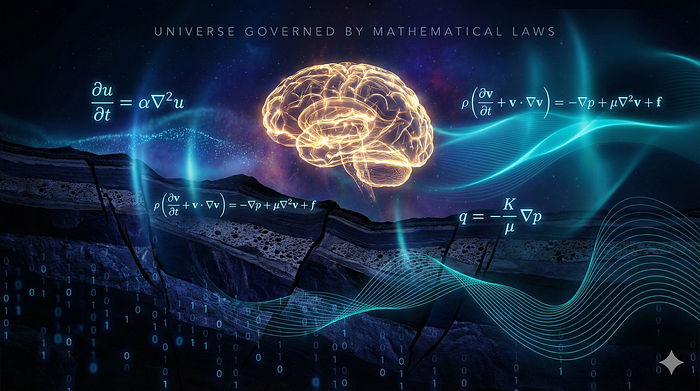

With data.
Images. Numbers. Measurements. Samples.
Fragments of reality, frozen in time.
We feed these fragments into neural networks and ask them to learn the world.
And sometimes, it works.
The network learns to recognize faces. It learns to predict markets. It learns to generate language.
It appears intelligent.
But beneath the surface, something is missing.
Because the universe was never made of data.
Data is only the shadow of reality
Data is sparse.
Reality is continuous.
When you measure temperature at 100 points underground, you do not capture the temperature field. You capture only 100 shadows of it.
Between those points, the temperature still exists.
It flows.
It diffuses.
It obeys laws.
The diffusion equation governs its evolution:
∂u/∂t = α ∇²u
This equation does not need measurements to exist.
It defines how temperature moves everywhere — even where you never measured it.
Data gives you samples.
Physics gives you structure.
And structure is infinitely more powerful.
Neural networks without physics are blind
A standard neural network learns by minimizing error between predictions and observations.
It asks one question:
"How do I match the data?"
It does not ask:
"Does this obey reality?"
This distinction is everything.
Because infinitely many functions can match a finite dataset.
Some are physically correct.
Most are not.
Without constraint, the network may learn a function that fits the data perfectly — and violates the laws of physics everywhere else.
It becomes an expert at imitation.
But it does not understand.
The universe runs on differential equations
Reality evolves through relationships, not samples.
Velocity changes according to forces:
F = ma
Heat evolves according to diffusion:
∂u/∂t = α ∇²u
Fluid motion follows Navier–Stokes:
∂u/∂t + u·∇u = −∇p + ν∇²u
Groundwater flows according to Darcy's Law:
u = −k ∇h
These equations do not describe isolated points.
They describe continuity.
They connect every point in space and time into a single coherent system.
They impose constraint.
And constraint is what makes reality stable.
Intelligence emerges from respecting constraint
When a neural network learns without physics, it searches an infinite space of possible functions.
Most of that space is nonsense.
But when you impose physical laws, something extraordinary happens.
The space collapses.
The network is no longer free to learn anything.
It can only learn what is physically possible.
This is the idea behind Physics-Informed Neural Networks (PINNs).
Instead of training only on data, we train on equations.
The loss function becomes:
Loss = Data Error + Physics Error
Where physics error measures how much the network violates the governing differential equation.
The network is punished not only for being wrong — but for being impossible.
And slowly, it learns functions that satisfy both observation and law.
Not imitation.
Understanding.
Physics is infinitely dense information
A single differential equation contains more information than millions of data points.
Because data tells you what happened.
Physics tells you what must happen.
Data is descriptive.
Physics is prescriptive.
This is why physics generalizes.
A neural network trained only on data may fail outside its training range.
But a network constrained by physics continues to work.
Because physics does not change when data ends.
The diffusion equation still governs heat in places you never measured.
Navier–Stokes still governs fluids you never observed.
Constraint extends intelligence beyond observation.
Reality is compressible because it is constrained
If the universe were made only of data, it would be incomprehensible.
Every event would be independent.
Every measurement would be isolated.
There would be no patterns.
No prediction.
No science.
But reality is compressible.
Because a small set of equations governs an infinite number of phenomena.
The same diffusion equation governs:
Heat in the Earth Pollution in the atmosphere Pressure in porous rock Probability in quantum mechanics
Different systems.
Same constraint.
This is not coincidence.
It is structure.
Neural networks alone cannot discover physics easily
Because physics is not obvious from finite samples.
It emerges from consistency across space and time.
A neural network may approximate physics.
But without constraint, it cannot guarantee it.
This is why purely data-driven models often fail in scientific domains.
They lack inductive bias toward reality.
They lack respect for constraint.
They treat the universe as a dataset.
But the universe is not a dataset.
It is a system.
The future of AI is not bigger models
It is better constraints.
For decades, progress in AI came from scaling data and parameters.
Bigger datasets.
Bigger networks.
More compute.
But scientific machine learning follows a different path.
It does not rely on scale alone.
It relies on structure.
By embedding physics into neural networks, we create systems that are not only accuratebut reliable.
Not only predictive but consistent.
Not only intelligent but grounded in reality.
This is a fundamental shift.
From learning patterns to learning laws.
The deepest truth
The universe does not store data.
It enforces relationships.
It does not memorize states.
It evolves through constraint.
Data is only what we observe.
Physics is what governs.
And intelligence — true intelligence — emerges not from memorizing observations,
but from understanding constraint.
The future of AI will not belong to models that see the most data.
It will belong to models that understand the deepest structure of reality.
Because the universe was never made of data.
It was made of laws.