Urban air pollution has become one of the most serious challenges faced by modern cities. Rapid urbanization, increasing vehicle density, industrial activities, and construction work have significantly degraded air quality. Polluted air directly affects human health, ecosystems, and economic productivity. To address this issue effectively, cities need intelligent systems that can predict air pollution, explain the reasons behind predictions, and support transparent decision-making.
A Digital Twin–Enabled Explainable AI (XAI) system offers a powerful and practical solution. This blog explains the concept in simple language, describes how the system works, and highlights its benefits for smart cities and policy makers.
Understanding Urban Air Pollution
Air pollution refers to the presence of harmful substances in the air, such as particulate matter (PM2.5 and PM10), nitrogen dioxide (NO₂), sulfur dioxide (SO₂), carbon monoxide (CO), and ozone (O₃). In cities, the main sources include:
- Vehicle exhaust
- Industrial emissions
- Power plants
- Construction dust
- Biomass burning
- Weather conditions like low wind speed and temperature inversion
Air pollution is not constant. It changes with time, location, traffic flow, weather, and human activity. This makes prediction and control very complex. Traditional monitoring systems provide only historical data and limited forecasting ability.
What Is a Digital Twin?
A digital twin is a virtual replica of a real-world system. In the context of urban air pollution, a digital twin represents a city or part of a city in a digital environment.
It combines data from:
- Air quality sensors
- Weather stations
- Traffic systems
- Satellite observations
- Urban infrastructure maps
The digital twin continuously updates itself using real-time data. It behaves like a "living model" of the city. Any change in traffic, weather, or emissions is reflected in the digital twin almost instantly.
In simple words, a digital twin allows us to see and test what is happening in the city without touching the real city.
Role of Artificial Intelligence in Air Pollution Prediction
Artificial Intelligence (AI) is used to analyze large volumes of data collected by the digital twin. Machine learning and deep learning models can learn patterns between pollutants, weather conditions, traffic density, and time of day.
AI helps to:
- Predict pollutant concentration hours or days ahead
- Identify pollution hotspots
- Detect abnormal pollution events
- Handle missing or noisy sensor data
However, most advanced AI models act like a black box. They give accurate predictions but do not explain why pollution is increasing or which factor is responsible.
This lack of transparency creates trust issues, especially for government agencies and policy makers.
Why Explainable AI Is Important
Explainable AI (XAI) solves the transparency problem. XAI techniques help users understand how and why an AI model produces a particular prediction.
In an air pollution system, XAI can explain:
- Which factors contributed most to pollution increase
- Whether traffic, weather, or industry is the main cause
- How changes in wind speed or temperature affect pollution
- Why pollution is high in one area but low in another
This makes the system trustworthy, interpretable, and suitable for public decision-making.
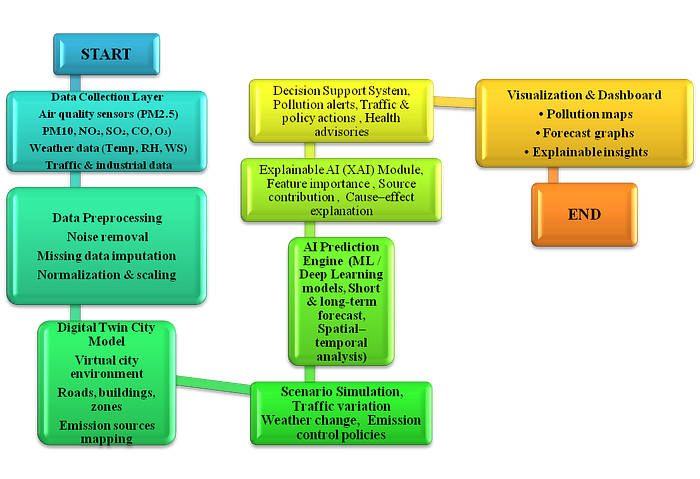
Digital Twin–Enabled Explainable AI System Architecture
The system consists of five main layers:
1. Data Acquisition Layer
This layer collects real-time and historical data from multiple sources:
- IoT-based air quality sensors
- Meteorological data (temperature, humidity, wind speed)
- Traffic flow and vehicle density
- Industrial activity records
- Satellite and GIS data
Data quality is critical, so preprocessing steps like cleaning, normalization, and missing value handling are applied.
2. Digital Twin Layer
The digital twin creates a virtual model of the city environment. It maps pollution sources, roads, buildings, and weather zones.
This layer allows simulation of scenarios such as:
- Increase in traffic during peak hours
- Industrial shutdown during weekends
- Effect of rain or wind on pollution dispersion
The digital twin provides spatial and temporal context to AI models.
3. AI Forecasting Layer
This layer uses machine learning and deep learning models to predict pollutant levels. Common models include:
- Recurrent Neural Networks (RNN)
- Long Short-Term Memory (LSTM)
- Convolutional Neural Networks (CNN)
- Hybrid and ensemble models
These models learn complex relationships in the data and generate short-term and long-term air quality forecasts.
4. Explainable AI Layer
The XAI layer interprets the predictions made by AI models. Techniques such as feature importance analysis and local explanations are used.
This layer answers questions like:
- Why will PM2.5 increase tomorrow morning?
- Which factor caused the pollution spike today?
- How much did traffic contribute compared to weather?
The explanations are presented in simple visual and textual formats.
5. Decision Support Layer
This is the most practical layer for city authorities. It provides actionable insights such as:
- Traffic diversion recommendations
- Emission control alerts
- Early health warnings
- Policy impact analysis
The system supports informed, data-driven, and transparent decisions.
Key Advantages of the Proposed System
Improved Prediction Accuracy
The combination of digital twins and AI improves forecasting accuracy by using real-time, multi-source data and spatial information.
Transparency and Trust
Explainable AI ensures that predictions are not black-box outputs. Decision makers can understand and trust the system.
Scenario Testing Without Risk
Authorities can test pollution control strategies in the digital twin before applying them in the real city.
Real-Time Decision Making
The system supports quick responses to sudden pollution events, such as traffic jams or industrial accidents.
Public Awareness and Accountability
Clear explanations make it easier to communicate pollution causes and control measures to the public.
Use Cases in Smart Cities
- Traffic Management: Reducing vehicle flow in high-pollution zones
- Urban Planning: Designing green corridors and low-emission zones
- Public Health: Issuing early warnings to vulnerable populations
- Policy Evaluation: Measuring the effectiveness of emission control policies
- Emergency Response: Managing pollution spikes during festivals or fires
Challenges and Future Scope
Despite its advantages, the system faces some challenges:
- High initial cost of sensor deployment
- Data privacy and security issues
- Sensor calibration and maintenance
- Computational complexity
Future developments may include:
- Integration with citizen mobile sensors
- Edge AI for faster response
- City-to-city digital twin collaboration
- AI-driven automated policy recommendations
Conclusion
A Digital Twin–Enabled Explainable AI System for Urban Air Pollution represents a next-generation solution for smart cities. It combines real-time monitoring, accurate forecasting, transparent explanations, and intelligent decision support.
By making pollution predictions understandable and actionable, this system bridges the gap between advanced AI technology and practical urban governance. It empowers city authorities, builds public trust, and supports healthier and more sustainable urban living.
As cities continue to grow, such intelligent and transparent systems will play a crucial role in shaping cleaner and smarter urban environments.