

Both NVidia and Google recently released dev board targeted towards EdgeAI and also at a cost point to attract developers, makers and hobbyists. Both the dev boards are primarily for inference, but support limited transfer learning re-training. The Edge TPU supports transfer learning training using weight imprinting technique. Both of the dev kits consists of a SOM (System-on-Module) connected to a dev board which has various connectors like USB, Ethernet, microSD slots etc. This is a comparison of the hardware for the two dev kits which can be used as Single board computer (SBC) and not the Edge TPU USB stick. If you don't want to read the whole article, in my opinion the Coral Edge dev kit is slightly better value for the money as it includes essential peripherals like Wifi and Bluetooth however the Jetson Nano has better software support (both INT8 and FP16 Inference).
Coral Edge TPU Dev board
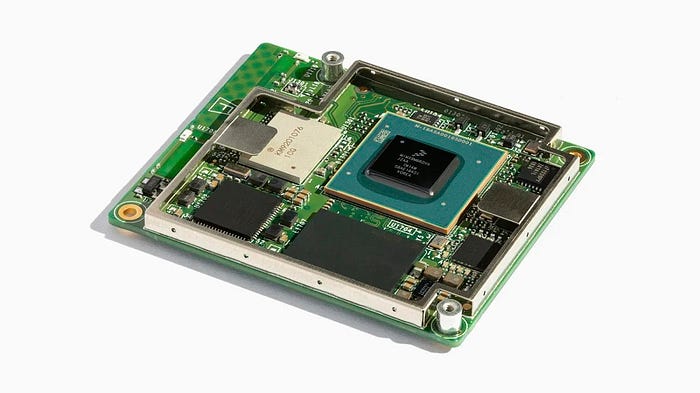
The size of the whole kit is — 88 mm x 60 mm x 22 mm while the size of the SOM only is — 48 mm x 40 mm x 5 mm. So people can also design their own base boards of different form factor and connect to the SOM. The board only comes with a u-boot bootloader and later one can load a image like Mendel linux. Several examples/tutorials are here. Pre-trained models for the board are available here.
The NXP iMXM processor on the Coral SOM also has a Vivante GC7000 lite graphics GPU — could it be used anything other than graphics? Detailed specs — https://coral.withgoogle.com/docs/dev-board/datasheet/
Buy it here — https://coral.withgoogle.com/products/dev-board
The Edge TPU SOM is available now for $114.99 and just the Edge TPU (without the NXP processor) is available as a Mini PCIe, M.2 A+E key, and M.2 B+M key for $34.99 each.

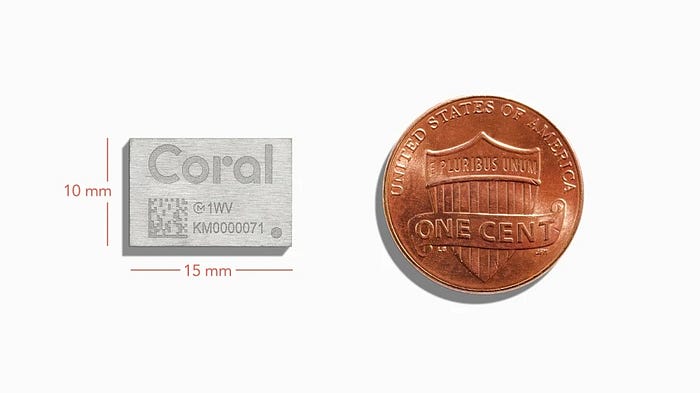
Soon the Edge TPU will be available as a MCM (Multi-Chip module) which can be soldered on board, the MCM contains the Edge TPU chip and a PMIC (Power management Integrated Circuit) for power management. The Edge TPU can perform 4 TOPS at 2 TOPS/watt.
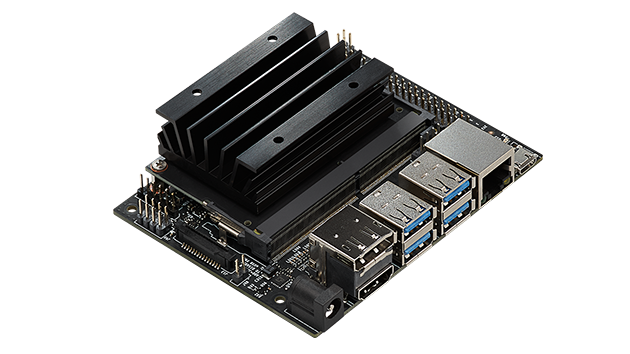
NVIDIA Jetson Nano Dev kit
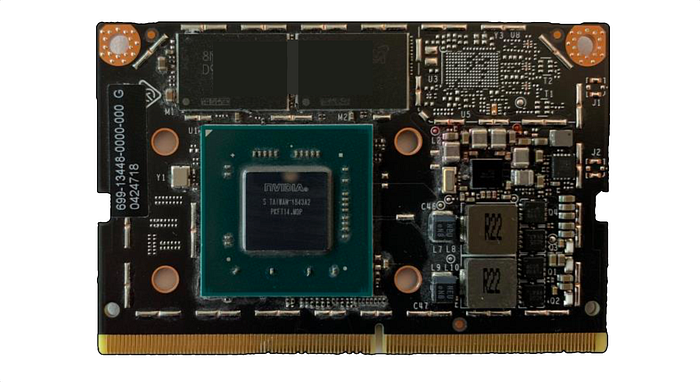
Like the coral board here also a SOM connects to the baseboard. The Jetson SOM is slightly bigger — 69.6 mm x 45 mm. The board comes with Ubuntu 18.04 based environment. According to NVidia docs Nano can do 472 GFLOPs (Gigaflops per second) and supports 5W and 10W power consumption modes.
Detailed specs — https://www.nvidia.com/en-us/autonomous-machines/embedded-systems/jetson-nano/
Buy it here — https://www.nvidia.com/en-us/autonomous-machines/embedded-systems/jetson-nano/
Comparison
Below is a comparison of the hardware features of the two boards
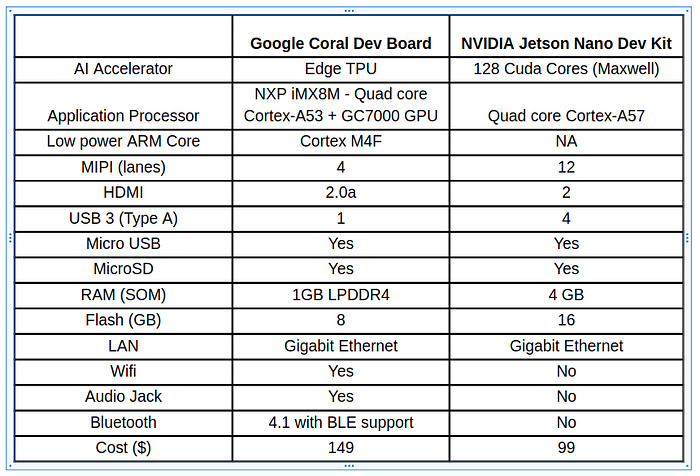
The Coral Edge board will be available with 2GB and 4GB RAM options in future.
Performance
Nvidia has provided some performance comparison for Jetson Nano with other SBC like Raspberry Pi 3 , Google Coral Edge TPU board — https://devblogs.nvidia.com/jetson-nano-ai-computing/
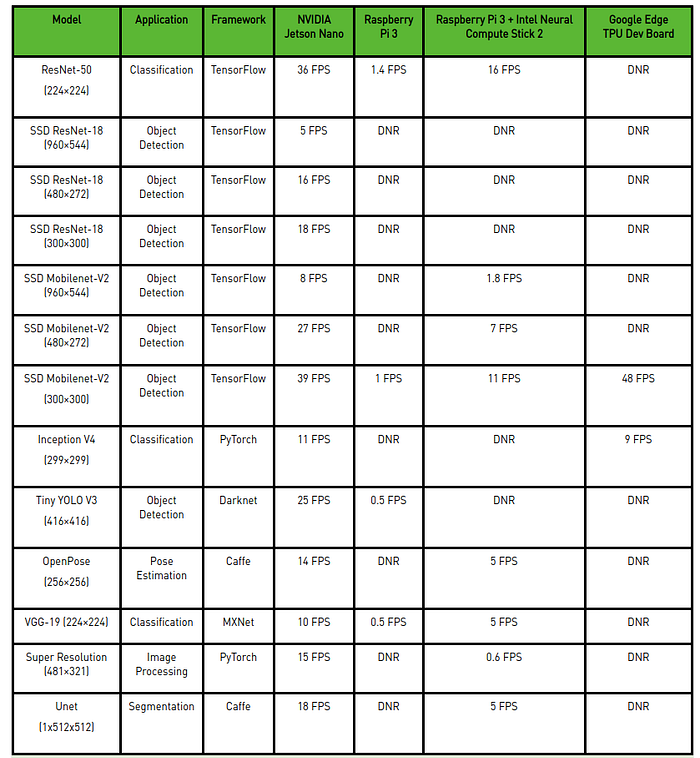
In the above results Jetson Nano used FP16 precision.
Very few results are present above for the Coral Edge TPU board as it cannot run pre-trained models which were not compiled for Edge TPU using post training quantization or quantization aware training. Google has provided some comparison relative to desktop CPU (64-bit Intel(R) Xeon(R) Gold 6154 CPU @ 3.00GHz) performance and when using embedded CPU (Quad-core Cortex-A53 @ 1.5GHz)
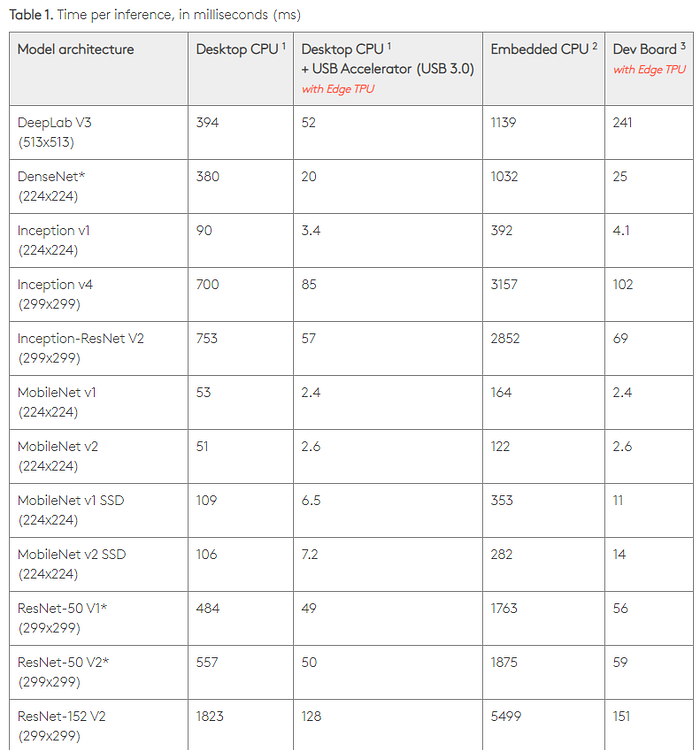
More results here — https://github.com/jolibrain/dd_performances
and https://www.phoronix.com/scan.php?page=article&item=nvidia-jetson-nano&num=3
Conclusion
In my opinion the Coral Edge TPU dev board is better because of the below reasons —
1. The Coral dev board at $149 is slightly expensive than the Jetson Nano ($99) however it supports Wifi and Bluetooth whereas for the Jetson Nano one has to buy an external wifi dongle.
2. Additionally the NXP iMX8 SOC on the coral board includes a Video processing unit and a Vivante GC700 lite GPU which can be used for traditional image and video processing. It also has a Cortex-M4F low power micro-controller which can be used to talk to other sensors like temperature sensor, ambient light sensor etc. More sensors here — http://lightsensors.blogspot.com/2014/09/collection-of-various-sensors.html
The Jetson also has Video encoder and decoder units. Additionally Jetson Nano has better support for other deep learning frameworks like Pytorch, MXNet. It also supports NVidia TensorRT accelerator library for FP16 inference and INT8 inference. Edge TPU board only supports 8-bit quantized Tensorflow lite models and you have to use quantization aware training.
I am interested in working on deep learning for edge applications, I have experience in NLP, computer vision and scalable systems, if you are hiring you can contact me here.
Additional useful links