
Today's article is intentionally random, because real developer life is random.
This is not a syllabus. This is not a curated interview list.
This is a collection of questions, situations, and pressures that almost every Java developer faces — whether you're preparing for interviews, working with Spring Boot, dealing with production issues, or silently worrying about AI and the future.
If you're a Java developer, this article will feel familiar. If you're not, share it with one — they'll relate more than you expect.
🌟 Access Alert! 🌟 If you're a member, just scroll and enjoy! Non-members, click here for full access.
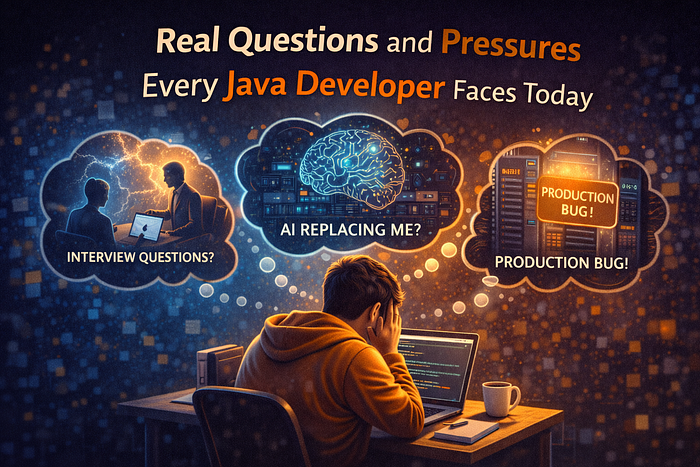
"I Know Core Java… But Interviews Still Make Me Nervous. Why?"
This is something even experienced developers don't talk about openly.
You may have worked on real projects, fixed bugs, handled deployments — and yet, when an interviewer asks about equals() or HashMap, your mind suddenly goes blank.
This happens because interviews compress years of experience into a few minutes. They don't test your daily workflow — they test how well you can explain fundamentals under pressure.
The truth is: nervousness doesn't mean you don't know Java. It means you care.
"Why Do Interviewers Still Ask the Same Old Questions?"
Questions like:
- Difference between
==andequals() - How HashMap works
- Why String is immutable
These questions are not outdated — they are filters.
Interviewers ask them to see:
- If you truly understand object behavior
- If you've debugged real issues
- If you can connect theory with practice
A confident explanation beats a memorized answer every time.
"I Use Spring Boot Daily, But Explaining It Is Hard"
Many Java developers feel this.
You use annotations, repositories, controllers, configurations — but when someone asks "How does Spring Boot actually work?", things suddenly feel fuzzy.
That's normal.
Spring Boot hides complexity on purpose. Interviewers don't expect internals-level depth. They want to hear that you understand auto-configuration, dependency injection, bean lifecycle, and configuration management — not framework magic.
Using something daily doesn't automatically mean you can explain it — explanation is a separate skill.
"I Fixed Production Bugs… But Interview Questions Feel Unrelated"
This is a very senior-level frustration.
You've:
- Debugged production issues
- Handled DB slowness
- Fixed memory leaks
- Dealt with outages
Yet interviews focus on concepts instead of your real problems.
The reason is simple: interviews can't simulate production. They rely on conceptual proxies to judge how you think.
When you connect interview answers to production examples, interviewers listen more carefully.
"Why Does Real Work Feel Harder Than Coding Rounds?"
Because real work has:
- Unclear requirements
- Legacy code
- Time pressure
- Business constraints
- Responsibility
Coding rounds are clean. Production is messy.
If work feels harder than interviews, that doesn't mean you're bad — it means you're dealing with reality.
"I'm a Few Years In… Am I Growing or Just Working?"
This question hits after 2–5 years of experience.
You start wondering:
- Am I learning anything new?
- Am I becoming replaceable?
- Should I switch stacks?
- Should I move to AI?
- Should I change companies?
This phase is normal.
Growth at this stage comes from:
- Understanding systems, not just code
- Knowing why things break
- Learning debugging, performance, and design
- Improving communication
Not from chasing every new trend.
"Everyone Talks About AI… Should I Be Worried?"
This question is now unavoidable.
Yes, AI can:
- Generate boilerplate
- Explain errors
- Write queries
- Speed up development
But AI still cannot:
- Understand business context
- Own production failures
- Design trade-offs
- Handle ambiguity
- Replace accountability
Senior developers don't fear AI — they use it wisely.
AI reduces effort, not responsibility.
"Sometimes I Feel Like I'm Just Copy-Pasting Code"
This thought quietly haunts many developers.
Using Stack Overflow, GitHub, or AI doesn't make you less of a developer. What matters is:
- Do you understand what you're using?
- Can you debug it when it breaks?
- Can you explain why it works?
Understanding grows over time. Nobody writes everything from scratch in real projects.
"Why Do Simple Bugs Take So Long to Fix?"
Because software is not just code.
A "simple" bug may involve:
- Data inconsistencies
- Environment issues
- Race conditions
- Configuration mismatches
- Unexpected inputs
Time spent debugging is not wasted time — it's where real learning happens.
"What If I Forget Syntax in a Coding Round?"
Almost everyone does.
Interviewers care far more about:
- Your approach
- Edge cases
- Communication
- Problem breakdown
Calm thinking beats perfect syntax.
"Why Do I Feel Pressure Even After Cracking the Job?"
Because cracking the job is not the end — it's the start of responsibility.
Suddenly:
- People depend on your code
- Deadlines exist
- Mistakes have impact
- Expectations rise
This pressure is uncomfortable — but it's also how confidence is built.
"Am I Falling Behind Everyone Else?"
This comparison trap hits everyone.
You see:
- Others learning new tools
- Others posting achievements
- Others switching roles
But what you don't see is:
- Their struggles
- Their confusion
- Their failures
Consistency beats visibility. Quiet progress compounds.
Why This Article Is Random — And Why That's Intentional
Because developer life is not linear.
Some days:
- You feel confident
Some days:
- You doubt everything
Some days:
- AI excites you
Some days:
- It scares you
If you're still learning, still curious, and still trying — you're doing fine.
Thanks for reading this random, honest, and relatable article till the end.
If this resonated with you:
👉 Follow me for more real-world Javaava developer stories 👉 Support my writing by buying me a coffee ☕ 👉 Share this with your Java developer friends
And now your turn 👇 💬 What's the most relatable situation you've faced as a Java developer? Interviews, AI pressure, production bugs, burnout, or career confusion?
Drop it in the comments — let's support each other 🚀