
"Did you learn anything, or was it really about the diploma?" he asked.
My initial response was: "WHAT?" "What do you mean?" "Of course I learned something!" Feeling my cheeks heat up and my heart start to race, my defences went up automatically. Of course, I learned something. I'd just spent $60,000 and more than 1000 hours of reading, writing, research, class time, group projects, and thinking time, completely dedicated to the pursuit of my Master's Degree. All while holding down a teaching job, solo parenting a teenage daughter, an unruly dog, two cats, and two households. So yes, I wouldn't have done it if I didn't want to learn.
I expected this attitude from a lot of people in my life — I'm the first in my family to get my Master's, and among my friends, the oldest person to do so. But I was shocked by how many well-educated people asked me this question.
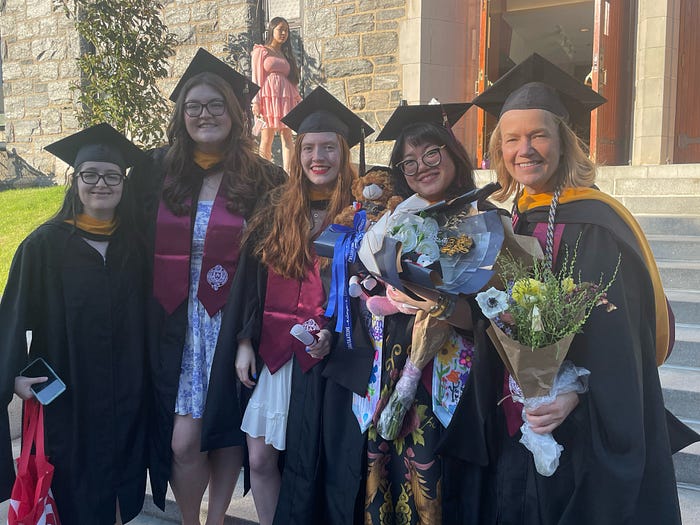
On the day of graduation, I brushed it off. The celebration was too important and too exciting. Check us out: my not-so-new friends: Joy, Colleen, Kristen, and Sophie — we were all so happy! We'd all pretty much started the program at the same time two years ago, and we shared at least one class in common each semester. Though I could easily be any of their mothers, I learned sooo much from each of them.
On campus at Fordham University, we processed into the gymnasium, squeezed into tightly lined up folding chairs, and sat nervously through speeches until it was time to walk across the stage for our fake diplomas and obligatory photos with the Dean. It was long and stuffy, but also over in a flash. And, outside afterwards, we hugged our families as they presented us with flowers. And in Joy's case, stuffed animals!
Not once that day were we graduates discussing whether we learned anything.
But, the question ate at me all the way home and into the next day. I'm ok with binary choice…one or the other? Yes or no. Black or white. 1's or 0's. Whether we like it or not, most decisions are binary. Even the ones that don't seem like it.
And to me, it was both. Why can't it be both? Education is both a journey and a destination, right? To me, I learned a lot. On some days, I read so much, thought so much, and wrote and rewrote so much that I thought my brain might burst.
…I also really wanted that piece of paper. The letters at the end of my name.
Educators getting educated is such an interesting look of analysis — the perspective that I gleaned about my own experience matters less to me than how the nuances behind that question affect the millions of students graduating from high school and college every year in the United States. Why do we educate? What do we get out of more education? Who does it serve to invest time and money on learning more? And lastly, under what conditions do our learning experiences benefit from the community in which we learn, as opposed to simply learning on our own?
My generation, Gen X, grew up thinking that a college degree meant getting a job and doing better than your parents. For the most part, that seemed to be working out, but by the time Generation Y came out in the mid-1980s, technological changes were making such an impact on companies and production cycles that the prospect of quality of life expansion started to become elusive. In parallel to these changes was the skyrocketing cost of an education. And, more and more companies, organizations, and governments have made a 4-year degree a minimum requirement for employment.
Affluent families could afford to educate their children through college. Cut to — college connections are often the best pathway to a first good job. Little by little, the need for the piece of paper masked the learning experience as the reason for pursuing a degree.
Now, as we face some of the most significant questions ever faced by humans, we need authentic, interdisciplinary thinking more than ever. We need teenagers, early adults, and anyone else in pursuit of an academic milestone to do more than get to the finish line. We need them to learn, grow, make connections, take risks, all along the way. The journey of all students affects the destination of us all.