
The world of software development is evolving rapidly, and .NET developers are no longer restricted to building traditional web apps or APIs or powerful backend services. Today, they're building:
- AI-driven experiences: chatbots
- Recommendation engines
- Predictive systems,
and even generative AI tools. All within the .NET ecosystem.
In this post, we'll explore how you can integrate ML.NET, OpenAI, and Azure AI services into your .NET applications to create powerful, intelligent solutions.
Why .NET Is Perfect for AI Integration
While Python has been the de-facto AI language for years, Microsoft has made significant progress in democratizing AI for C# and .NET developers. With:
- ML.NET: Microsoft's native machine learning framework for .NET
- Azure AI Services: Vision, Speech, Language, and Decision APIs ready to use
- OpenAI integration via Azure: Access GPT-4, Codex, and DALL·E seamlessly through Azure OpenAI
- .NET 9 and C# 13: Making AI integration easier with performance and async improvements
.NET is now a complete environment for building AI-powered enterprise applications.
Architecture: Bringing It All Together
Here's a simplified architecture diagram of how ML.NET, Azure AI, and OpenAI can work together:
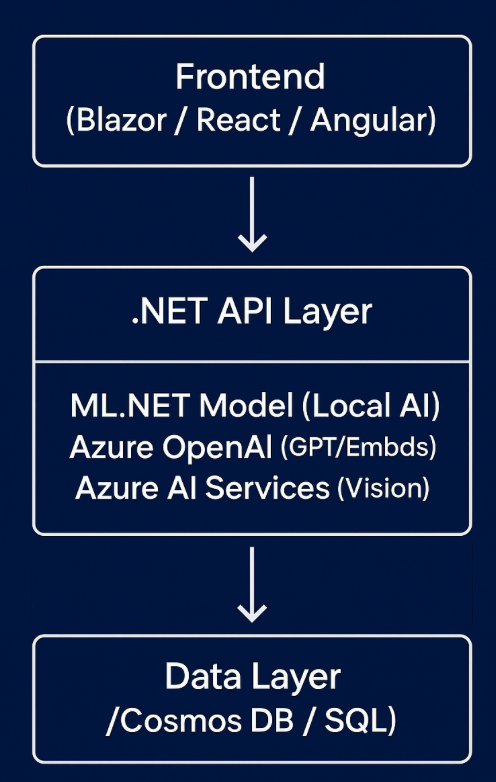
Each component has a role:
- ML.NET: For on-prem or custom predictive models (classification, regression, anomaly detection)
- Azure OpenAI: For generative AI (text generation, summarization, chatbots)
- Azure AI Services: For perception intelligence (image, speech, sentiment)
- .NET APIs: Orchestrate everything with DI, minimal APIs, and async pipelines
ML.NET: The Foundation for Local AI
If your enterprise demands on-premises AI (no external API calls), ML.NET is a great fit.
Example: Predicting customer churn
using Microsoft.ML;
using Microsoft.ML.Data;
var context = new MLContext();
var data = context.Data.LoadFromTextFile<CustomerData>("customer.csv", hasHeader: true, separatorChar: ',');
var pipeline = context.Transforms.Concatenate("Features", new[] { "Age", "Usage", "SubscriptionMonths" })
    .Append(context.BinaryClassification.Trainers.SdcaLogisticRegression());
var model = pipeline.Fit(data);
context.Model.Save(model, data.Schema, "churnModel.zip");
You can then load this model in your web app and make real-time predictions.
Azure OpenAI: Generative AI Meets .NET
Azure OpenAI brings GPT-4, DALL·E, and embeddings APIs directly into Azure, with enterprise security and governance.
Example: Chatbot Integration
var client = new OpenAIClient(new Uri("https://your-endpoint.openai.azure.com/"),
    new AzureKeyCredential("<your-key>"));
var response = await client.GetChatCompletionsAsync(
    "gpt-4",
    new ChatCompletionsOptions
    {
        Messages =
        {
            new ChatMessage(ChatRole.System, "You are a helpful assistant."),
            new ChatMessage(ChatRole.User, "Explain anomaly detection in ML.NET")
        }
    });
Console.WriteLine(response.Value.Choices[0].Message.Content);
✅ Secure ✅ Scalable ✅ Compliant with enterprise policies
Azure AI Services: Cognitive Intelligence at Your Fingertips
Microsoft's Cognitive Services (now part of Azure AI) let you add intelligence in minutes:
ServiceUse CaseSDKComputer VisionOCR, image tagging, captioningAzure.AI.VisionSpeechText-to-Speech, voice recognitionAzure.AI.SpeechLanguageSentiment, translation, summarizationAzure.AI.TextAnalyticsDecisionPersonalizer, anomaly detectorAzure.AI.AnomalyDetector
Example: Sentiment Analysis:
var client = new TextAnalyticsClient(
    new Uri("<endpoint>"),
    new AzureKeyCredential("<key>"));
var response = client.AnalyzeSentiment("The new UI is fast and intuitive!");
Console.WriteLine($"Sentiment: {response.Value.Sentiment}");
Building a Unified AI Layer in .NET
Create a modular AI service architecture:
public interface IAIService
{
    Task<string> GetCompletionAsync(string prompt);
    Task<float> PredictChurnAsync(Customer customer);
    Task<string> AnalyzeImageAsync(Stream image);
}
This allows you to swap between ML.NET, Azure OpenAI, or Azure AI without changing your core business logic. Ideal for hybrid and multi-cloud setups.
Deploying on Azure
Use:
- Azure App Service / Azure Kubernetes Service (AKS) for hosting
- Azure Key Vault for securing API keys
- Application Insights for telemetry
- Azure DevOps or GitHub Actions for CI/CD
The combination of .NET + Azure AI is enterprise-ready out of the box.
The Road Ahead
.NET developers are now in a unique position:
- They can build and deploy AI models without leaving your native stack
- Integrate cloud-scale intelligence securely
- Deliver business-ready AI faster than ever
As AI becomes a first-class citizen in .NET, the line between traditional and intelligent apps is disappearing, and developers who adapt early will lead the next generation of innovation.
Final Thoughts
Building AI-integrated applications in .NET isn't about replacing your current stack, it's about amplifying it with intelligence. Whether you start with ML.NET for local models, Azure OpenAI for generative capabilities, or Cognitive Services for perception, .NET gives you a single, powerful ecosystem to deliver AI at scale.