

By : Mustapha AIT IGUNAOUN
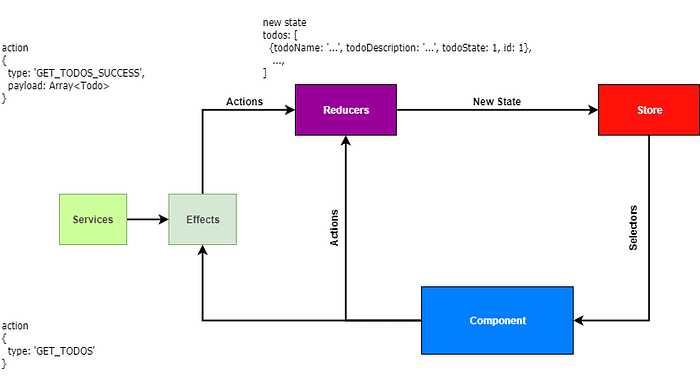
Your codebase's organization, predictability, and scalability can be greatly improved by implementing state management in Angular applications with Redux and NgRx. Built on top of Redux, an Angular-specific library, is NgRx, a popular state management library that offers a unidirectional data flow architecture.
Redux and NgRx Principles:
- Single Source of Truth: The entire application state is kept in a single store, ensuring consistency and avoiding data duplication.
- State Changes through Actions: State changes are initiated by dispatching actions, which are plain JavaScript objects representing events or data updates.
- Reducers Handle State Mutations: Reducers are pure functions that receive the current state and an action and return a new state, ensuring predictable state updates.
- Components Subscribe to State Changes: Components subscribe to state changes using selectors, which are pure functions that extract specific parts of the state relevant to the component.
Implementing Redux and NgRx in Angular:
Install Dependencies: Install the Redux and NgRx packages using npm or yarn:
npm install redux @ngrx/store @ngrx/effects- Create Store Module: Create a store module to hold the store configuration and provide access to the store throughout the application.
- Define Actions: Define actions for each state change event or data update. These actions will be dispatched to trigger state mutations.
- Create Reducers: Create reducers for each part of the state. Each reducer takes the current state and an action and returns a new state, ensuring immutability.
- Integrate NgRx Effects (Optional): If using NgRx Effects, create effects to handle asynchronous operations and side effects, such as making HTTP requests or interacting with APIs.
- Subscribe to State Changes: In components, subscribe to relevant state changes using NgRx selectors. These selectors will provide access to the specific parts of the state needed by the component.
here is an example of implementing state management in Angular applications with Redux and NgRx:
Scenario:
Consider an e-commerce application where users can add items to their cart.
Actions:
ADD_ITEM_TO_CART: Action dispatched when an item is added to the cart.REMOVE_ITEM_FROM_CART: Action dispatched when an item is removed from the cart.
Reducers:
cartReducer: Handles state changes related to the cart items, such as adding or removing items.
Store Configuration:
import { NgModule } from '@angular/core';
import { StoreModule } from '@ngrx/store';
import { cartReducer } from './cart/cart.reducer';

@NgModule({
  imports: [
    StoreModule.forRoot({ cart: cartReducer })
  ],
  providers: [],
})
export class AppStoreModule {}
Component Integration:
CartComponent: Displays the current cart items and provides buttons to add or remove items
<div *ngIf="cartItems">
  <h3>Cart</h3>

  <ul>
    <li *ngFor="let item of cartItems">
      {{ item.name }} - {{ item.quantity }}
      <button (click)="removeItem(item)">Remove</button>
    </li>
  </ul>
</div>CartItemComponent: Displays the details of a single cart item.
<li *ngFor="let item of cartItems">
  {{ item.name }} - {{ item.quantity }}
  <button (click)="removeItem(item)">Remove</button>
</li>
State Management Flow:
- User clicks "Add to Cart" button for an item.
- Dispatch
ADD_ITEM_TO_CARTaction with the item information. cartReducerupdates the cart state by adding the item.CartComponentsubscribes to cart state changes and updates the UI accordingly.- User clicks "Remove" button for an item.
- Dispatch
REMOVE_ITEM_FROM_CARTaction with the item information. cartReducerupdates the cart state by removing the item.CartComponentsubscribes to cart state changes and updates the UI accordingly.
This example demonstrates the basic implementation of state management in Angular using Redux and NgRx. The unidirectional data flow pattern ensures that state changes are initiated through actions, handled by reducers, and reflected in components that subscribe to state updates. This approach promotes code organization, predictability, and maintainability, especially in complex applications with evolving state management needs.
I hope you enjoyed exploring the insights and information shared in this article. Your engagement and feedback are invaluable, and I encourage you to share this work with your peers and colleagues who may find it interesting or helpful.
If you have any questions, suggestions, or if there's a specific topic you'd like me to cover in future articles, please feel free to reach out. I'm here to foster a community of learners and enthusiasts, and your input is crucial in shaping the content to meet your needs.