

If you've been following me for a while, you might know I've worked in the SEO field for the past five years.
I've worked as an SEO specialist at B2B and SaaS companies in Ukraine, Hungary, and the UK before launching my website and becoming an entrepreneur.
Nowadays, I work on my own projects and help businesses grow their websites in organic search results.
Can you guess the most frequently asked question I get from my clients? — "Why isn't my website growing?"
My clients come from different backgrounds and industries, but the issue is often the same — their actions don't help them rank their websites on Google.
Researching the issue and developing a custom strategy helps to revive their websites. However, they could significantly improve their websites' performance on Google if they knew how to find keywords their websites could realistically rank for.
In this article, I'll share what you can do to find low-competition keywords with decent search traffic potential.
This strategy will be helpful if you own a website and want to grow its organic traffic.
How to find keywords your website can realistically rank for
Choosing random topics and creating content without analyzing search intent is a no-go strategy. It won't help you rank your content on Google.
A high-ranking web page results from keyword research, optimization, and quality content writing. It may seem pretty simple. Nevertheless, site owners often forget the first essential step in the process — keyword research.
Choose the right keywords, and your website will consistently attract your target audience from Google.
Choose the wrong keywords, and nobody will ever learn about your website.
That's why keywords are so crucial for any website!
You should know that keywords can be categorized into several groups:
Based on the competition:
- Low competition keywords
- Medium competition keywords
- High competition keywords
Based on keyword length:
- Long-tail (like "vintage furniture for bedrooms")
- Short tail (like "furniture")
Based on search intent:
- Informational
- Navigational
- Transactional
As a website owner, your task is to choose the most suitable keywords for your website to rank on Google. I'm referring to the following keywords:
- low and medium competition keywords
- long tail keywords
- keywords with transactional and informational search intent (for local businesses — navigational)
Besides the keyword type, you should also critically analyze your target keyword metrics.
If your website is brand new and you choose a highly competitive keyword, your content won't rank. It's not realistic!
I explained how to rank a new website on Google in this article.
Instead, you should choose easy-to-rank keywords your website can realistically rank for.
Below, I'll share my keyword metrics estimates. Since it's highly subjective information, you won't find anything like this in official SEO resources.
I'm sharing these estimates because I've used them for years to grow my website and client websites.
- Keyword difficulty: < 30
- Global search volume: 100+
- Search traffic in your target country: 100+
- Traffic potential: 100+
- Search intent: informational or transactional
You can choose any SEO tool for keyword research. However, my personal favorite is Semrush.
I use Semrush's free version for keyword research, site audit, and optimization ideas. Even though the free plan limits your daily usage, it's often enough to analyze a few keywords.
Semrush's paid version, Semrush Pro, is rather advanced and suitable for startups, agencies, or freelancers managing multiple client projects.
Here's one of the keywords from my website content writing plan.
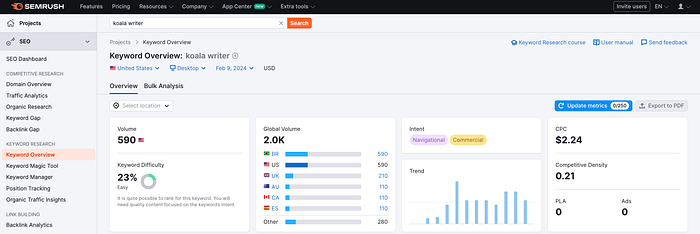
I picked this keyword for a few reasons:
- This is an easy-to-rank keyword with 23/100 keyword difficulty.
- The global volume is 2,000 a month.
- The search volume is 590 monthly in the US.
- The search intent is a mix of navigational and commercial.
I often used Koala Writer AI to generate content and have hands-on experience to share with my audience.
Considering my website domain authority 31, I know it can realistically rank for this low-competition keyword.
So, I've created a 2,746-word article targeting the "Koala Writer Review" keyword.
If interested, you can check the article here.
That's just one example of an excellent keyword selection.
Even though it takes time to research promising keywords, you'll be surprised how fast your website can rank on Google.
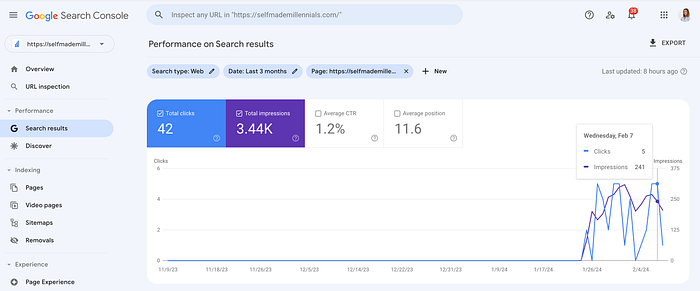
Here's how my article performs in organic search results a few weeks after the publication.
I replicate this strategy over and over again to create content that can passively generate affiliate commissions, SEO ebook sales, leads, and more!
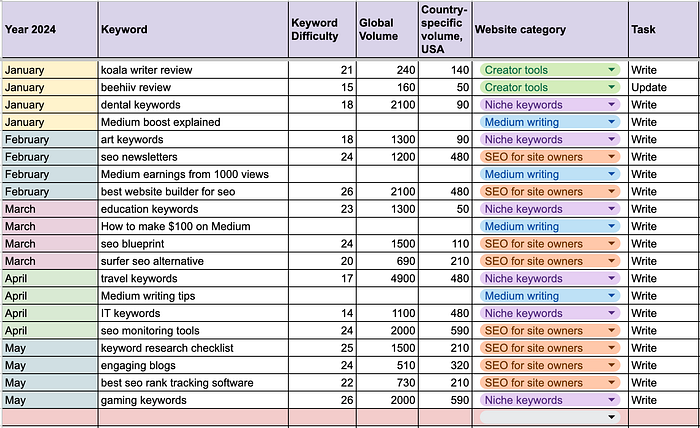
Below, you can see my content writing plan with keywords split month-by-month.
I've conducted keyword research and prioritized keywords based on their business potential. All that's left is creating optimized content and seeing how my website grows.
Feel free to steal these keyword ideas if they are relevant to your website, too.
In conclusion
This article briefly overviews keyword research essentials you should know to grow your website on Google.
Even though there are many details I could not cover in the article because it would have been too long, I wish I had known these insights when I started.
I spent months learning keyword research from other SEO experts and testing their strategies. Eventually, I developed my own keyword research process that helps me handpick juicy keywords and grow my website.
You can learn more about my keyword research and optimization processes in my SEO ebook "How to Hit the Google Front Page (Updated for 2024)."
Growing a website is usually a task for an entire marketing team, while I manage content creation, SEO, link building, and everything else alone. This will likely be your case at the beginning.
It's not a sprint; it's a marathon.
Therefore, be patient and keep working on your website no matter what others say.
📈 Want to grow and monetize your website?
Grab my free case study on "How I Turned My Website into a Profitable Side Hustle in 3 Years."
Want more marketing tips and tricks? Subscribe to the Better Marketing newsletter The Marketing Memo here.