

When you wake from a dream, you come back to reality, right? The physical world is what's real, and the dream world is, well, just a dream. Or so we have been taught all our lives. It's easy to buy into this faulty conditioning and become a modernized, jaded adult who dismisses the dream world as unreal. After all, you can't rely on your dreams for mental stability. In comparison to the "real world," the dream world is shifty, blurry, and vague.
Or is it?
To reinforce our modern jadedness, experts who study sleep describe dreams as little things. As mere memory traces and weak approximations of physical life. Or as the mind's feeble attempt to escape from reality into fantasy. Or the mind's attempt to make peace with an unresolved trauma. This is only partially true.
Our supposed experts still have the whole thing upside-down and backwards. The dream world does function, in part, the way they describe it, but it verges far beyond our personal lives. It is not a little thing. Compared to our Earthbound lives, the dream world is infinitely vast, and in one sense, it is more real than anything in the so-called waking world. Moreover, it is not the dream world that is shifty, blurry, and vague but rather humankind's ability to perceive it that has become corrupted.
How could I possibly know this? I practice astral projection. I'm familiar with the astral plane. In this article (part 1) we explore the astral world both in terms of its true nature and in terms of the maps that some explorers have attempted to make of it. In the articles that follow (parts 2 and 3), we will see some techniques for achieving lucidity in the dream world, as well as for entering and exploring the astral plane for ourselves.
"The Tao envelopes the sky, covers the earth, and extends beyond the four directions. Its height cannot be measured, and its depth cannot be fathomed. It embraces the universe and gives birth to all things. Like water gushing from a spring, it flows everywhere and penetrates everything."* — Eva Wong
We could refer to astral projection by its more acceptable label, "lucid dreaming," but that term has come about largely from an attempt to get scientists to take it seriously. Most scientists won't study the dream world unless we conclude for them, in advance, that it's "just a dream." That dreams are small, inconsequential, and "merely subjective." In other words, most scientists will not study the dream world unless they have already made up their minds about it. And they will almost certainly balk at calling it the "astral plane."
Furthermore, the scientific community approaches reality as though it is a kind of cosmic democracy. That is, they tend to believe what the consensus of their colleagues believes. And the consensus belief system of orthodox science, of course, still subscribes to materialism, defining the physical world as the foundation upon which the mind depends for its existence. As previous Forbidden Realms articles have demonstrated, this upside-down take on reality is essentially a form of insanity.
The Insanity of Materialism
When we pronounce someone insane, we tend to use words like "disturbed" and "mentally unstable." In other words, stability is what we consider sane, and instability is what we consider insane. But this ends up becoming a trap because most people don't know where true stability can be found.
Where can you find true stability? In the material world? We tend to assume that the physical world is stable, but all we have to do is pay attention and we can see that it is anything but. The only thing about the physical world that holds steady for us is the fact that it's constantly changing. When we look for our mental stability in the realm of materialism, we are looking in the wrong place.
But what about the dream world? That's far more wishy-washy than the physical, right? Or is it? What I am proposing is that we turn the world right-side-up again and cease to rely on the physical world as our ultimate foundation. True stability can be found in the realm of dreams.
This may sound absurd, and in a conventional sense, it is. Everyone knows that dreams are ephemeral things, and that a life lost in imagination can lead to idleness, addiction, and seemingly endless wastes of time. However, it's important to pay attention to the exact words I've just used: "True stability can be found in the realm of dreams." The word "realm" provides a key insight that can keep us from getting lost in a blur when we're dreaming. To discover true stability, it's helpful to distinguish between two things: the dream and the dream world itself. Let's do a little thought experiment.
To discover true stability, it's helpful to distinguish between two things: the dream and the dream world itself.
The Silver Screen Analogy
Imagine you're in a movie theater — only this is a theater in which you suddenly find yourself waking up to the fact that you're watching a film.
For a while, you've been worried about whether your onscreen hero is going to win his fight. But then all of the sudden, something odd happens. Your chair squeaks — and you abruptly notice that you're in a darkened auditorium. You are sitting still, on a stale-smelling cushion, and there are people all around, lined up shoulder to shoulder as though someone has riveted them to their seats. They are all staring straight ahead and haven't noticed you looking around.
You have begun to see something other than the movie: the auditorium — the walls, the ceiling, and the fine motes of dust dancing in the wavering beam of light overhead.
In particular, you have begun to notice the movie screen. It is flat. It never moves. Images play across it, and everyone around you is captivated by the parade of phantoms washing over it, as though the insubstantial drama of the movie were the basis of their reality. The apparent solidity of the cars in the car-chase scene, the sensual caresses in the love scene, and the spaciousness of the sky in the movie's cinematography — all of these are two-dimensional illusions. How obvious! And yet how strange…
You might walk up to the front of the room and touch the screen, verifying for yourself that it's really there, flat and cool to the touch. The moving pictures dancing across it are so distracting that we fail to notice what's right there in front of us. But only now, you have noticed it, and it's not possible to "unsee" it anymore. You have awakened.
Naturally, I'm inviting you to think analogously. The movie screen in the above scenario is the mind, and the images that play across it are dream images that arise within the mind. In this sense, it is not your dreams that provide stability. Dreams, by there very nature, can often be shifty, blurry, or vague. Rather, it is the dream world — the imagination itself — that is the truly stable aspect of who and what you really are.
Those who dismiss dreams as unreal tend to unwittingly dismiss the dream world along with them. In dismissing the movie, they inadvertently dismiss the movie screen. They end up ignoring the very thing that provides true stability and sanity. In your mind, the utter stillness of your "viewscreen" is always present whether you are awake, daydreaming, or dreaming at night. And as demonstrated in the previous article, this viewscreen is even present when you are immersed in dreamless sleep. It is even present when you are dead.
Once we are fully aware of the distinction between the dream and the dream world, everything changes. The universe turns right-side-up again. The so-called physical world is no longer considered solid and real. It's just a very large and captivating aspect of the movie we find ourselves watching, and it's distracting us from the true stability of who and what we really are.
Could enlightenment be that simple? Simply a matter of learning to see the difference between image and imagination? Between foreground and background? Watch everything you experience from moment to moment. The imagery in your mind moves through the medium of imagination, but the medium of imagination itself does not move. Images arise, play themselves out, and dissipate, but the imagination remains steady and ever present. The mind doesn't even need to become still for us so that we can experience inner peace. At its foundation, it already is stable and peaceful. And it has always been so. Imagination is the absolute foundation of reality.
The principle here is so simple that it's hard to take it seriously: turn your attention away from the movie and train yourself to be aware of the movie screen. That's it. Whatever you happen to be doing, wherever you seem to be going, you are always in the same place, confronted by your screen. Will you continue to get caught up in the drama of "the movie"? Or will you learn to let it go, settle down, and stabilize within your true nature?
The Sphere of Sensation
One of the coolest things about the silver screen analogy is that it is possible to "zoom out." If the physical world is merely the large sensory phantom that happens to be filling up your entire view screen at the moment, then you can back away from it. You can zoom out and imagine a universe that is bigger than the phantom of the physical world. When you do this, you become aware that you are living inside a "sphere of sensation," as some occultists have referred to it.
As long as you have a reasonably well-developed literary mindset — that is, as long as you have the ability to think in analogies, symbols, and metaphors — the concept of the sphere of sensation is not really so difficult to understand. All you have to do is imagine that the silver screen in the movie theater has reached out to you, embraced you, and enveloped you in a sphere. It's sort of like a planetarium, except the dome overhead also extends beneath you and you are floating in the center. In this capsule-like existence, your biology and imagination have teamed up to project a movie all around you, visible to you on the inside of your own personal, experiential sphere. You are surrounded by a phantom image of the universe. In a manner of speaking, you live inside a highly convincing bubble of illusion. We all do.
Let's push this analogy further. To get the full gist of the sphere of sensation, you must now imagine that the projected image around you is being generated in three dimensions. That is, the imagery of the material world is not only projected upon the curved wall of your sphere. It is also being projected upon the very air that fills up the space within your sphere. Your are completely immersed in a three-dimensional hologram. And this hologram involves more than just sight and sound. It also includes touch, taste, smell, and a plethora of other senses.
The ultimate realization here is that the "external" world is not really so external after all. The external world is merely a small cinematic drama that's playing itself out inside a much larger theater complex embedded in a bigger universe that's beyond the senses. If this is so, then the physical world can be shrunk down and regarded as a little thing. As an insubstantial movie that's playing itself out in your own little auditorium. There's a lot more going on beyond your personal sphere, beyond your own little theater. And it's all "out there" waiting to be explored. Somehow…
"There is only one mistake you are making: you take the inner for the outer and the outer for the inner. What is in you, you take to be outside you and what is outside, you take to be in you. The mind and feelings are external, but you take them to be intimate. You believe the world to be objective, while it is entirely a projection of your psyche." — Nisargadatta Maharaj
"I can no longer be sure whether the psyche is in me or whether I'm in the psyche…" — James Hillman
It's important to avoid a solipsistic interpretation of the sphere of sensation. Waking up to the illusory nature of the universe doesn't necessarily mean that you're the only person living in it. It doesn't mean that the rest of the people and the creatures around you are merely figments of your imagination. What it can mean is that everyone seems to be immersed in the same imaginal medium and we each occupy our own sphere. And we each experience each other as sensory phantoms. What the people and the creatures around you actually are, what you actually are, who can say? You experience them — as well as yourself — the way your sphere of sensation portrays them, as characters in the movie of a life. As avatars in a simulated universe. The most misleading thing about them is that they present themselves as solid, limited, and "real."
It's also important to avoid a dualistic interpretation of the sphere of sensation. By "dualistic," I mean our tendency to believe that "I am over here and the universe is over there." To believe that the sphere of sensation is somehow "out there," "surrounding me," "separate from me." You must remember that you, too, are part of the movie. You, too, are a projected image. Not only is your body part of the hologram, but so are the images in your imagination, the feelings roiling through your guts, and the concepts constellating in your thoughts. There's a clear reason why it's so hard for us to accept that the material world is insubstantial. To an insubstantial image such as yourself, the insubstantial world all around you will naturally seem solid and real. Make-believe solidity and realness are essential aspects of the movie's drama.
You might want to read the above paragraph more than once.
Here There Be Dragons
There's also something frightening about this movie screen analogy. Darkness. If the physical world exists within the mind and we can zoom out from it, then what exists outside of that world? All around it and beyond it? What's out there on the other side of your movie screen?
Imagine you are working on a computer with a slow internet connection. You are looking at the Google Earth website. When you first access the site, you see a satellite view of your neighborhood. You then rapidly zoom out to see the whole state or the whole country in which you live. The area around your home rapidly shrinks from view, but now it is only a small square space surrounded by…darkness. Slowly, your computer accesses the information on Google's server, and the squares all around your hometown begin to materialize.
This is what it's like when we Zoom out from the material world. We are left with nothing but darkness all around it, and there is a vast amount of surrounding "space" to map out. But now there's a problem. Our physical senses are no longer adequate to gather the data for our expanded map. We must access deeper aspects of the mind beyond the physical, and gradually we can "download" data that creates a new map. A map of the astral world. This new map becomes an interface through which we can explore the universe beyond the physical plane.
What Is the Astral Plane Really Like?
Let's let go of our complicated theater analogy for a moment and simply describe the astral plane. How does the world of dreams appear to us when our ability to perceive it has been restored?
About a decade ago, I found myself walking through a busy shopping mall. This struck me as odd because I hadn't been to a mall in years. "Do people still do this?" I wondered. The hardness of the floor and the metallic sheen of the escalator were absolutely real. A little too real, in fact. Too clean. I could single out individual chunks of pale green and pink in the terrazzo floor. I could hear that characteristic patter of footfalls echoing through a public space. I could smell the leather from the luggage store nearby. The smell seemed to convey the very texture of the leather itself. "How odd! What am I doing here? What's going on?"
I suddenly got an inkling that I might be dreaming. It seemed unlikely. My body certainly seemed physical. I could even feel a slight gurgling in my stomach. I was hungry. To test whether I was dreaming, I gazed into a store window, looking for my reflection. I didn't have one! I looked down at the floor and noticed that I didn't have a shadow. One final test: I hopped up into the air. Sure enough, I was floating above the floor. "I can fly!"
I began drifting through the mall corridors. I flew up under the domed ceiling of the food court. The level of detail was unbelievable, and I was privy to views of mall architecture that only the ants crawling up there on the rafters could appreciate.
I allowed myself to drift back down to the floor. A little too fast, it seemed, but that was no matter. My dream body was indestructible. The impact of a three-story plunge would be easy to absorb.
Strolling out through the main entrance, I was startled to note that I didn't know what neighborhood this was. It seemed a typical urban-sprawl setting, but one I had never explored in the waking world. Apparently, one can visit places in the dream world that are configured differently than the locations we've visited in the physical. What was generating all of this — this seemingly solid landscape, this elaborate grid of streets, buildings, and powerlines. This endless, crystal-clear detail? Just me? My brain? That seemed doubtful.
And there was something massive up there in the sky! There were unbelievably tall columns of stone, a mile high. They supported a series of massive arches, as though the sky itself were being held up by graceful gothic architecture. The surfaces of these columns seemed to glitter, but the detail was somewhat veiled by the haze of the atmosphere.
I rose up into the air to investigate, carefully dodging the powerlines. Higher and higher I flew. A flock of pigeons passed far beneath me. Getting closer to the giant arches, I could see that their surfaces were covered with tiny tiles that flashed and glinted with colors I had never seen in the waking world. Mesmerizing! A warm wind bustled in my ears, and I suddenly had the urge to fly higher. I zipped up into the blue vault of the heavens, and wisps of clouds passed beneath me. As I rose, I closed my eyes and basked in the warm expanse of an endless sky.
That was a mistake. As I settled into myself and disengaged from the spectacle around me, I became aware of the sensations of my body lying on a mattress. I heard the rasp of air blowing through an air-conditioner vent overhead. Once these sensory details arose, the astral trip ended. I woke to find myself nestled in bed with a light tingling sensation passing over my body.
This trip happened years after my first experience of astral projection, and this time the clarity was startling. The world of dreams seemed more real even than the physical sensation of the bed beneath me. Since then, I have found that the dream world has a much clearer ladder of abstraction in it than that of the waking world. It verges from the mightiest and most nebulous atmospheric "moods" to the finest, tightest granules of sensory detail that we can possibly imagine. In part 2 of this article, we will explore mystical techniques for restoring the clarity of the astral world.

In addition, the things we can experience in the dream world verge far beyond anything produced by the physical senses: colors our eyes have never seen and sounds our ears have never heard. Levels of magnification that are impossible in the waking world. Space sometimes has texture. Emotions sometimes have fragrances. Faith allows you to walk on water. Hours can pass in minutes, and minutes can pass in hours. And in the midst of it all, if you're aware of the backdrop of the imagination itself, there's a wide-open dimensional gateway to the formless realms and to the very mind of the universe itself.
"Peng Yi was one with the forces of nature. He could walk on the snow and leave no footprints. Even the sun could cast no shadow on him. Moving like a spiral on a ram's horn, he rose with the wind and floated over the grasslands, lakes, and mountains. When he descended to the ground, the earth embraced him, and when he ascended to the sky, the stars received him." — Eva Wong*
What Is the Material World Made Of?
If the astral world can, at times, become sharper and clearer than the material world, then what is the physical world made of? This is a difficult question to address.
The apparent forms that we encounter in the material world are not really there. You are superimposing them upon it. If this sounds absurd, then you have some reading to do. See the Forbidden Realms article entitled "The Insanity of Geometry." There you will find an exploration of the physical world as an infinitely porous place in which lines and surfaces do not exist. The lines and surfaces we see are actually creations of the mind, and when you can behold the physical world without superimposing an imaginary world of surfaces upon it, you will be startled to see that there is "no thing" actually there. Just one big, immediately upfront display of phantasmagoria.
The apparent forms we encounter in the physical world are not really there. You are superimposing them upon it.
Even so, we cannot deny that the physical world has some kind of imposed reality to it. Something is generating it from beyond our immediate sphere of sensation. The human mind is being immersed in some kind of "other" imaginal realm, the principles behind which appear to be none of our business (at least for the time being). The main point here is that the physical world isn't really physical. Its physicality is, in itself, a fantasy. The physical world is actually just another level of the astral world, a level of a much larger cosmic dream that is currently beyond our ability to dream for ourselves. This means, of course, that when you wake up in the morning, you haven't really awakened yet! You have simply entered a tighter, more constrained level of dreaming.
If your own little sphere of sensation and the greater "sphere" of the entire universe are both made up of the same imaginal substance, then how much influence might you have over the projection of the physical world all around you? Can you manifest your dreams?
Some of us are more constrained in our awareness than others. For example, to the average human being, the physical world often seems like an enemy. A harsh and bitter place. It can be like a nightmare or a prison. Because of the "hard" lessons we've learned deep in humanity's evolutionary past, we can end up intimidated by the apparent hardness of the material world. We can end up feeling trapped and powerless within it, and as a result, we feel imposed upon, bullied, and kicked around by life.
For others, those whose sphere of sensation has grown larger, the physical world has become more of a friend. These people tend to be leaders, innovators, and artists. The world serves as their proving ground for personal displays of beauty, integrity, and power. Such people feel like they have control over their own fates, and life becomes more of a creative adventure than an ordeal. They are governed by the ancient maxim: "Find and fulfill your destiny."
For those who awaken completely, the world is simply another layer of a much larger cosmic dream, and it is just as insubstantial as any other construct that might arise in imagination. These people are the realized mystics and spiritual masters, and they function in the world as though they have magical powers. They seem to live a charmed life, "favored by the gods," because the physical world seems to present almost everything they need without requiring any struggle.
How can we become realized mystics? How can life become a magical experience? The less constrained our awareness is, the more freedom and power we enjoy — and the more influence we appear to have over the material world.
The word "influence" can be a bit misleading, however. Let's restate that. The less constrained your awareness, the more your personal dream gets "in sync" with the overall cosmic dream. When this happens, power flows through you effortlessly, and you appear to be creating your own reality. In truth, you have always been participating in the creation of the world, but now you've simply learned to recognize it as it happens. This is what some New Age enthusiasts refer to as "co-creating with the divine."
"Wherever you go, there you are." — Jon Kabat-Zinn
The Sea Bubble Analogy
Let's push our theater analogy even further. You might also view your sphere of sensation as though it were a bubble on the surface of a vast ocean. Each bubble in the ocean's foam is an individual soul with the potential to expand and awaken. Each bubble is like a miniature universe housing one sentient being. Each sentient being has emerged inside its own miniature projection of the universe. Within it's own minutum mundum. Many such bubbles exist, of course. Some of them are very small and tightly constrained. Others are larger, more open, and more free.
Minutum mundum is a fancy Latin term used by occultists. It means "lesser world." The term magnus mundi means "greater world" — the world beyond your little bubble. In occult terminology, the vast ocean of being — upon which your bubble floats — is the magnus mundi, and your little bubble is a minutum mundum.
In standard English, the greater world can also be called the macrocosm, and the lesser world can be called the microcosm. Each microcosmic bubble on the surface of the macrocosmic ocean is like a theater playing its own movie version of the universe — albeit the movie can often end up distorted, misleading, and misunderstood. Some dreams are, of course, nightmares. Some lives are too.
Just as a bubble of sea foam is made of the same substance as the ocean, so is your own microcosm made of the same substance as the macrocosm. Because of our material conditioning, however, it doesn't usually feel that way. We have come to believe that the sensory phantoms in our little movies are solid, separate, and distinct from everyone else's. We end up duped by appearances, and we lose sight of the true substance of the universal mind. The more you buy into the movie, the smaller your bubble world seems and the more delusional you become. And the more delusional you become, the weaker your mind.
The smaller bubbles are the Earthbound dreams. The larger ones can include experiences beyond the Earth plane. Not to worry though. A smaller bubble is always capable of merging with a larger one. And a larger bubble can merge with still larger ones. In this way, our inner movie screen is capable of expanding and taking in more and more of reality. We can zoom out and experience a deeper universe. We can "expand our horizons," as the saying goes. But in the end, all bubbles burst and return to the universal dream ocean from which they have arisen.
Be Wary of the "Egregore"
It's important to avoid interpreting what I just said in a sociological way. Merging a smaller bubble with a larger bubble is not the same thing as you merging your mind with the "group mind" of a club or organization. It's not about joining a cult or becoming a loyal patriot. The larger bubbles you merge with can instead be regarded as larger versions of your own potentiality. Being initiated into a social group is not the same as being initiated into deeper levels of who and what you really are.
This is an important point. I've noticed that many occultists refer to something called the "egregore," the collective mind of a group of people. While there does appear to be such a thing as a group mind or a "mob mentality," it's important not to mistake your connection to an egregore for an initiation to deeper aspects of reality. There's a startling difference between a group that emphasizes conformity and a group that emphasizes each member's individual process of awakening. A difference as stark as the contrast between night and day.
Reification
The most startling thing about all this is that the material world isn't really what we think it is. It's an astral experience that is being condensed down and compressed into a particularly small, constrained kind of movie drama. As a result, many things in the material world seem solid and real to us, mainly because some of them seem to hold their shapes steady for us for a long time. This illusion of "realness" is what Buddhists sometimes refer to as reification. The mind, when it regards its own sensory phantoms as solid and real, is engaging in the process of reification. And when this reification process happens automatically, you end up believing that you are trapped in a tightly constrained illusion of materiality and suffering. Life becomes "hard."
The imagery projected within your own little bubble world — with its impressions of solidity and realness — can be so convincing that you are tempted to rely on the physical world as the foundation for your sanity. The room in which you sleep each night seems solid enough, right? So you settle for that kind of temporary solidity, and you don't bother to explore any further. And of course, since the physical world, in the long run, is neither solid nor steady nor real, you suffer. The things you cling to crumble before your eyes and slip through your fingers. Like everything else in a dream, matter morphs and transforms endlessly. The only thing that never changes is the backdrop upon which your dream of the shifting universe is arising. The movie screen itself. Or rather, the ocean of pure consciousness. Choose whichever metaphor works best for you at the moment.
This can all be quite startling to you as you wake up to the fact that you've been watching an insubstantial movie all your life. And it can be equally perplexing when you notice how other people around you are still caught up in the onscreen drama. What will you do for them? What can you do?
"Toss aside your map of the world, All your beliefs and constructs. Dare the wild unknown.
"Here in this terrifying freedom, Naked before the universe, Commune with the One Who knows everything from the inside: Invisible power pervading everywhere. Divine presence permeating everything.
"Breathe tenderly as The lover of all beings."
— The Radiance Sutras*
What about death? What happens when we die? Our reliance on the physical world as a foundation is what creates our experience of mortality. The fact that "everything dies" — or rather that every phantom image in our movie appears to die — causes us almost constant anxiety when we believe that the onscreen production in front of us is real. Most humans pretend that it's possible to establish stability in their little bubble worlds — even though they know that all bubbles eventually burst. Bubble worlds are captivating and interesting, for sure, but only the ocean itself can provide the lasting stability we truly seek. As bubbles, we are fleeting and mortal. As the deep ocean, we can never truly die.
The Vibration Analogy
Let's turn our attention away from our movie (the physical world). And also, let's turn our focus away from dream images that parade endlessly before us. Instead, look at the backdrop, the movie screen itself. What is it made of? Or rather, what is the substance of the astral plane made of? Never mind the forms and images that arise. What is this universal substance of the mind that gives these phantoms their semblances of reality?
Another way of defining the universe is in terms of vibration. Whether you are plodding along through the waking world during the day or wandering through the dream world at night, you are immersed in a sea of vibration. You are part of an energy field crisscrossed with many different, overlapping frequencies . These overlapping frequencies create images. Some of the imagery arises as the "material world." Some of it arises as the dream world. Some patterns of vibration appear to be under your control, and some do not.
This vibrating substance of the dream world is what occultists refer to as the astral light. The curious thing about this substance is that we cannot perceive it directly. Since it is the medium through which all appearances arise, all that you can see are those appearances. If it were to hold still — that is, stop vibrating — it would disappear. However, you can still discern the screen indirectly. Just as you are able to reach out and touch a movie screen that's "hiding" behind the movie, you can also infer the existence of the astral light. And you can begin playing with it.
It might be useful to see the astral light as though it were a lens that focuses consciousness. This lens, however, is made of a fluid substance, and it flows, oscillates, and vibrates. The various vibrational patterns within it create patterns that cause our experience of various phenomena to arise.
Other Planes of Existence
The astral light vibrates on different frequencies, giving rise to various levels of reality or distinct "planes of existence." In our case, as unenlightened beings, at least two of these planes have gotten intermixed, or tangled up within each other. The dream world has gotten tangled up with the physical world. Or rather, a finer level of imagination has become confused with — and conditioned by — a grosser level. This mix-up is what leads to our ignorance and suffering — or to what alchemists refer to as the massa confusa.
Massa confusa is a fancy Latin term for "mass of confusion." Two different levels of vibration have become intermixed, causing us to misunderstand everything about our lives. If this is so, then the task before us becomes clear: disentangle the dream world from the material world. Smooth out the dream world until all of its vibrations function separately and harmoniously from physical perception. When we succeed in doing this, we realize that the higher and lower worlds are not really separate. Once they have become separated, it's as though a knot in a string has been untied, revealing not two different strands but one. The realization of this oneness, once we stabilize within it and reside there permanently, is what the alchemists called the philosophers' stone. The philosophers' stone is not really a stone but a state of mind that is absolutely clear and firm. It is so firmly rooted in reality that it is indestructible. This legendary "stone of the wise" is sometimes referred to as the "wish-fulfilling jewel" in Eastern traditions, and it is none other than the universe itself.
This is exactly what the medieval alchemists attempted to do. In the literature of alchemy, the reader is exhorted to "separate the subtle from the gross." To separate and recombine. In other words, you must learn to zoom out and perceive the different levels of that astral light as they operate on their own levels of existence. And notice how they function harmoniously. Only then can you open your eyes and see the physical world as something other than a tangled up mass of confusion. You can stop projecting your hopes and fears upon it, and you can free your mind from outward appearances.
"Separate the earth from the fire, the subtle from the gross, acting prudently and with judgment.
"Ascend with the greatest sagacity from the earth to heaven, and then again, descend to the earth, and unite together the powers of things superior and things inferior. Thus will you obtain the glory of the whole world, and obscurity will fly far away from you.
"This has more fortitude than fortitude itself; because it conquers every subtle thing and can penetrate every solid.
"Thus the world was formed."
— The Emerald Tablet of Hermes (200 C.E.)
When the imagination has been set free from the physical world, it no longer superimposes itself upon it. We can see the physical world as it actually is — which can be quite startling, once you find yourself embedded in a sensory medium that has no true lines, boundaries, or surfaces anywhere in it. At the same time, our nighttime dream life is free of the convoluted, granulated nature of the material world. It is free to form itself into surfaces that are pure: absolutely flat, or absolutely smooth and firm. Perfectly crisp and clear. It's textures can become infinitely hard, much harder than anything in the physical world. Or they can become absolutely soft and gooey. Colors are free to present themselves as 100 percent themselves — with a depth, clarity, and radiance free of the typical interference patterns that characterize the physical world. When you establish this kind of clarity, the astral world can, at times, seem much more real than anything we encounter in physical life.
As you develop astral projection, another great discovery awaits you, but it is really more of a re-discovery than a discovery: the astral world is under our control. The astral world, when it is separated out from the physical world, responds to our thoughts and wishes.
Realizing that we can control this substance is usually a challenge because of our ingrained habit of reification. We've been tangled up in physical conditioning for so long that we no longer believe that the landscapes in the dream world are malleable. In other words, our experience of the astral world has been corrupted by our conditioning in the material world. We have fallen into the misconception that the dream world is just as harsh and external a reality as our physical life has been. This conditioning convinces us that what's happening in our dreams is beyond our control. And this is what leads to nightmares. We end up chased by monsters that we could easily make friends with. We fall from great heights, not realizing that we can fly. And we struggle to stay afloat in dark, scary water when we could easily conjure up a flashlight and go exploring beneath the surface.
Once mystics become aware of the astral world and its "levels" of vibration, they begin to formulate their own conceptions of it. They begin to map it out. In ages past, there have been numerous attempts to do this.
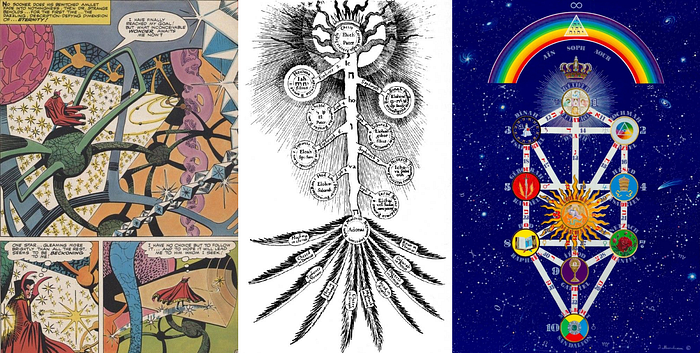
Mapping the astral plane for ourselves can be quite a task because we are continuously presented with a challenge: to distinguish between a dream image and the actual substance of the dream world itself. This mapping is a task worth doing — mainly because our ability to discern the difference between various levels can help us simultaneously remove all entanglements. As you create your own map of the astral world, you simultaneously learn how to see through it. Not only through all of its imagery but also through all of its apparent levels of activity — to the very heart of the universe itself. As the mapping process evolves, the map you have created eventually falls by the wayside, along with all other training techniques you no longer need. You learn to exist fully embodied on all planes of existence. Some spiritual traditions suggest that this level of spiritual mastery allows you to incarnate on the physical plane at will. Or you can simply remain discarnate, absorbed utterly in oneness and peace, existing as pure potentiality untroubled by forms.
There are a couple of maps I believe to be the most accurate, and these can serve as a base template for anyone who is developing the ability to explore the astral realms. One of them comes from the tradition of Vedanta, and the other comes from Kabbalah. Vedanta is a spiritual discipline that arose in India, from ancient texts known as the Upanishads. Kabballah comes to us from the Jews and Christians of medieval and Renaissance Europe. What I present here is overly simplistic, but it shows how both schools of thought present an astral world that exists on (at least) four different levels. I think you will find this four-fold system highly relatable to your daily life.
Level 1: The Physical Plane
The base level of reality in Kabbalah is known as Assiah, or the World of Action. This is what Vedanta — as well as you and I — would think of as the waking world. The world you are confronted with when you get out of bed in the morning. In Kabbalah, this level of reality, though it is the lowest, is not a foundational level. The World of Action is actually a projection — a projected image upon your sphere of sensation, as we have explored above. You might consider that your experience of the waking world is actually quite superficial. All you are presented with here are the tips of icebergs. The depth and foundation of our lives in the physical world is much bigger, and it is invisible, hidden in the deeper depths of the astral world.
Another way to think about Assiah is as a puppet show in which characters of the waking world are merely extensions, dangling down from on high, dancing about on a theatrical stage. The vast sky of the imagination looms above them, but the audience cannot see that higher realm. All they can see are the stage and the puppets. (And if they're lucky, they might catch glimpses of the "strings" that connect those puppets to the realm from which they are dangling).
Level 2: The Subtle Plane
Once you enter the dream world, you have entered level 2. Even though this is the second level, you have touched upon the ultimate ground of being: imagination. In Kabbalah, this is called Yetzirah, the World of Formation. Not surprisingly, Vedantics refer to this level of reality as dream-filled sleep, but it is more than that. It's the realm of imagination in which visible forms arise, play out their dramas, and dissipate. Though the entire universe is really all only one astral plane, level 2 by itself is usually what most occultists think of as the astral plane.
Level 3: The Causal Plane
In level 3, we have entered the Kabbalistic realm of Briah, the World of Creation. This level of reality is difficult to describe because most of us black out when we enter it. Briah is really the same plane as Yetzirah, except for the fact that it has no forms — or rather, no images — within it. Briah is that ultimate ground of the imagination from which all forms emerge. Briah is the mother of all form, but there are no forms within or above it. All that most people tend to experience on this plane is darkness. Briah is known to contain "the Abyss," a terrifying void that supposedly separates everything in creation from the divine realm above, in level 4. In Vedanta, level 3 is the realm of dreamless sleep. In the last article, I went to greater lengths to describe this plane.
Level 4: The Spiritual Plane
If you are capable of crossing the Abyss — or rather, of negating the illusion of the Abyss — the highest level of the Kabbalistic universe bursts upon you. Atziluth is the World of Emanation. It is a world of pure, transparent radiance. On this level, there are no levels, and there never were any levels. The concept of levels was just something we used to reach this plane of pure light. This level is in fact, the state of enlightenment itself. Once we are there, our distinctive sense of self is completely wiped out — and yet it still exists in some mysterious way. It has simply been absorbed back into pure potentiality. It is both one with the divine and ready to re-emerge back into manifestation. In the Vedantic tradition, this level of reality is called Turiya. Deathlessness.

As you can guess, it's mainly levels 1 and 2 in the above schematic that we explore as we learn how to project our Astral bodies. But what you might begin to notice is that the concepts of the third and fourth levels put the whole business of astral projection into clearer perspective. Comparing this four-fold schematic to our experience of sleep and dreams can be really helpful.
In the next article, you'll find methods of training that can help you free yourself from the habit of reification, and in the article following that, we'll explore methods for entering and exploring the astral world while fully conscious.
Stay tuned!