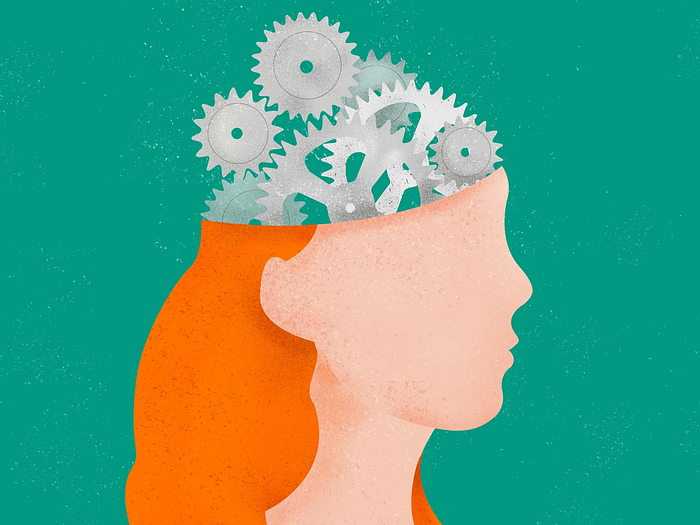

Executive functioning challenges and time blindness contribute to poor financial management
Basically, Executive function refers to the mental skills that enable people to manage their lives. Think of it as the "command center" of the brain. ADHDers are wired differently and our command center has a hard time with some tasks.
ADHDers struggle with transitions. Initiating or ending a task. Which makes us feel stuck.
We struggle doing something that needs to be done, not due to laziness or even procrastination, but executive dysfunction. To me, laziness or procrastination, is delaying something because you don't feel like it, you are tired, or the task isn't too important.
As with executive dysfunction you WANT to do the task, but can't, or you want stop doing it, but can't. We often use adrenaline to push through, doing things at the last possible minute. Running against the clock and fueling our anxiety to get stuff done.

Time blindness
Time blindness is kind of like being colorblind, but with time. Just as someone who's colorblind might struggle to differentiate between certain colors, someone with time blindness has a tricky time gauging the passing of time. It's like our internal clock took a lunch break… without telling us.
For neurodivergent people, especially those with ADHD, our perception of time can get a bit wonky. We might feel like something took just a moment when, in reality, it ate up half our afternoon. Or we'll think we've got a solid few hours to prep for something, only to realize it's due in 20 minutes.
Picture this: you want to pay a bill, and think you've got plenty of time before it's due. The days seem to stretch out ahead of you. But then, in what feels like a blink, you're slapped with a late fee. Why? Because you genuinely thought you had more time than you did.
Having to rush to buy something because you lost track of time, last-minute plane tickets, a rush shipping fee for a late gift, grabbing takeout because you didn't do groceries, or can't get unstuck to cook. Failing to file your tax return on time, or an application for school. Often, doing things last minute means paying a higher price, either financial or emotional – when there is no fee, just a lost opportunity.
For most people it happens every once in a while, for us, it's all the time.
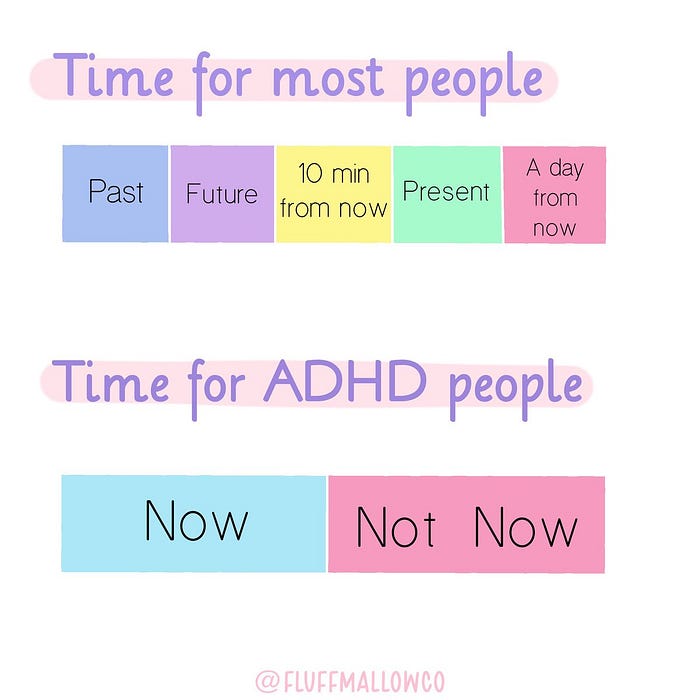
There is term that summarizes this, ADHD Tax. The unexpected financial hiccups and burdens, like late fees, forgotten subscriptions, impulse buys (that we later fail to return), and having a hard time with financial and time management overall. Also, the additional emotional tolls we might face because of how we are.
Money paradox
A lot of neurodivergent folks aren't as motivated by money as our neurotypical peers. It's not that we don't understand its value; it's just that our motivations often lie elsewhere.
We are unlikely to stick around if we feel like a job has run it's course, i.e not intellectually stimulating, overwhelming, underwhelming or too much structure. We tend change jobs more frequently or have longer periods of unemployment. ADHDers usually don't have linear carreers.
That may seem like a generational thing. It's true people now tend to change jobs or roles more often, and are valuing well-being over a corporate career. However, for people with ADHD, I think it's a more complicated issue.
Studies indicate that people with ADHD have higher levels of debt and more often have unpaid debts. This study found that young adults with ADHD are less likely to have regular, full-time employment and more likely to have financial problems and public assistance. ADHD group participants could expect to earn $543,000-$616,000 less over their lifetimes than comparisons.
Beyond debt, ADHD folks might have lower credit scores, fewer savings, and might be less likely to own a home.
Interest-hopping and motivation
And then there's the constant shift in interests. We are constantly seeking novelty and things that will increase dopamine levels (as we're short on that). One month, it's pottery, then painting or resin casting. The next, it's the learning to play guitar or photography. Buying courses or joining classes.
Before you know it, you've accumulated an impressive collection of very cool, yet barely-used items, and a variety of skills.
Now, there is a misconception that we need thrill or lots of things happening at the same time. Although we do like those, there is more to it. At least in my experience, intellectually stimulating and dynamic environments are different from fast paced or thrilling.
Dynamic, to me, means there's wide range of topics and activities within a role or field. It means having some or total flexibility to execute tasks (no micromanaging). Too many deadlines or interruptions are the worst thing for me, I actually prefer calm environments.

I think for us, money can't be the sole motivator for doing something. Our jobs don't need to be our passion or our favorite interest. But it must allow us to flow and be our true selves.
There's an interesting study that observed that when people were paid to do an activity they enjoyed doing for free, their motivation for the activity decreased. This effect is known as the "overjustification effect." The idea is that introducing external rewards can shift the person's perception of why they're doing the activity. They begin to see the external reward as the primary reason for engaging in it, which diminishes their original motivation.
That stuck with me. Because many of neurodivergents (specially adhd), find that the moment we start monetizing our interests, the spark vanishes.
I think everyone would rather do the things they like and not worry about money. But for neurotypicals, their executive function allows them to power through it more easily, to focus — even when they aren't necessarily motivated or interested.
We need structures and spaces that cater to diverse needs.
Our society is obsessed with productivity, financial milestones, and 'making the most of time'. I fell into the trap o reading *several* productivity books (that don't work for ADHD brains), just trying to fix myself.
Our brains dance to a different tune, that's a fact. Finding our rhythm, understanding our relationship with time/money, and seeking supportive spaces are key.
I feel like the world could use a bit more variety, and could learn a bit from neurodivergent folks. Changing our approach to how education and work are structured would benefit everyone.
There are a lot of facets to having ADHD. We often feel exhausted, frustrated and inadequate. But we can also be creative, adaptable, dynamic, and have a variety of knowledge that can be useful.
So if you are neurospicy, be kind to yourself. If you have someone in your life that has ADHD be patient, maybe try to understand how they operate.
You can find more resources on this link: