

"It turns out I've had ADHD all this time," explained my friend. "And to think, I struggled through 28 years wondering what the heck was wrong with me.
"School, church… everything. I was just told to try harder. To sit still. To stop being so impulsive. To stop interrupting. To be more organized. To just focus."
"But no matter how hard I tried, I couldn't keep up. Homework was a nightmare — I'd stare at assignments for hours, unable to start. Sermons felt like an endurance test — halfway through, I'd realize I hadn't processed a single word. I learned to mask it, to pretend I wasn't drowning."
"I wasn't lazy. I wasn't irresponsible. But I started to believe I was."
"Then came the diagnosis."
I listened as my friend explained how her life had turned a corner now that she was taking medication for ADHD. Like me, she grew up in a conservative Christian church where ADHD was seen as either a made-up excuse or a spiritual weakness. Mental health struggles weren't real, apparently — they were just a lack of discipline, a failure to pray hard enough, or even the result of sin.
When you explain this to people who did not grow up in the church bubble, they find it hard to believe. But for those of us who did, it's all too familiar. The idea that ADHD is just an excuse, a lack of discipline, or even a spiritual failing is deeply ingrained in certain Christian circles.
And just when I thought this thinking was fading, I stumbled upon a tweet that reminded me how alive and well it still is.
Let's take a look.
When Bad Theology Meets Bad Science
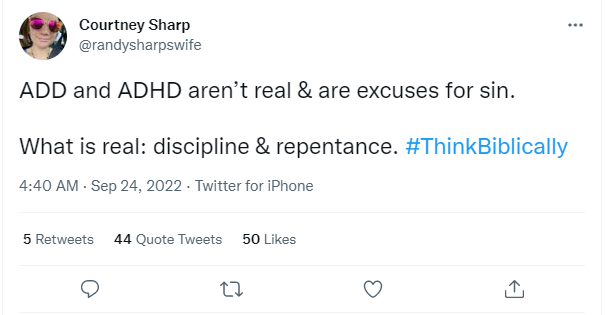
Enter Courtney Sharp, a self-professed Christ-following, stay-at-home mom with some strong opinions about ADHD — opinions that are both dismissive and deeply harmful.
According to her, ADHD isn't real. It's just an excuse for sin.
In her tweet, she confidently shares her perspective, reducing a well-documented neurological condition to nothing more than a lack of discipline and moral failure:
First of all, on behalf of Christ, I'd like to apologize to all of you — especially to those for whom ADHD is a reality — for these ill-conceived comments from my well-meaning but over-zealous and ultimately unhelpful Christian sister. I'll be praying that later on, she comes to a full realization of the polarizing nature of her poorly worded Twitter post and the damage that it does to the credibility of Christians in general.
You're probably picking up my vibe. I'm not impressed. In fact, I'm angry.
Why?
Well, I think Courtney Sharp has unwittingly managed to encapsulate much of what is wrong with modern Christianity and the 'Christian' church in just a few short lines of text. Let me explain exactly what I mean:
My view is the Biblical one
Courtney Sharp accompanies her Tweet with the hashtag #ThinkBiblically. The implication is clear: If you think that ADHD is an excuse to sin, just like Courtney, you are thinking Biblically, which is odd because I don't recall the Bible saying anything about neurological disorders like ADHD.
I suppose when she uses the hashtag #ThinkBiblically, she really means #ThinkLikeMe. No doubt, Courtney Sharp has concluded that her views are, in fact, Biblical, while the views of modern science, medicine, and neurology are unbiblical.
Yeah, what would scientists know?
I cannot stand it when a Christian attaches the authority of either God or the Bible (or both) to their personal opinion. More than likely, they are merely using God as an excuse to perpetuate their own prejudices.
If you really want to think Biblically, then start honoring the inherent worth of all people regardless of their behavior and beliefs.
It's your own fault
Courtney Sharp rather dispassionately leverages the symptoms of ADHD — things like hyperactivity, inattentiveness, and impulsivity — as a means to shame and blame those who are afflicted.
"You don't really have ADHD! It doesn't exist! You're just trying to justify your sinfulness!" I can hear her saying. Of course, to suggest that ADHD is not real, she simultaneously makes out that those who have it have chosen the label for themselves to explain their poor behavior.
I can imagine her being equally hard on the parents of children with ADHD. I have little doubt that she views such parents with contempt: "If you could manage your children's behavior, you wouldn't need to label them. The label is just an excuse for your poor parenting."
The overwhelming tone of her thoughtless Tweet is one of judgment and condemnation, echoing the cries of performance-based religion:
"Do better! Be better! Stop sinning! Behave yourself!"
This brings me to my next point.
Behave, and you can belong
It is a great irony that the church preaches a message that says, "Come to God as you are and receive full acceptance," while simultaneously promoting a performance-based religious system with obvious boundary markers about what is and is not acceptable behavior.
How many of the sermons you hear in your average church, when you boil them down, are simply a message of condemnation: "You're doing it wrong! Get better, do better, do this more, do this less," and so on?
I cannot believe that I sat through so many sermons where I was told that I needed to improve myself — wherein all my human actions, emotions, and reactions were painted as shameful to God.
Christianity is supposed to be a life-transforming faith, but it has been reduced to a sin-management program in many churches where there are clear guidelines about what a good Christian is and does. The result is quite the opposite of the Gospel's intent, with many believing that they don't measure up and aren't good enough for God and never will be.
Courtney Sharp's Tweet screams, "Just behave, and you can belong!"

Simple solutions to complex problems
Courtney Sharp's solution to the problem of ADHD is discipline and repentance. Neurological disorders are extremely complex. That is why those who are experts in the field spend many years studying to become experts.
So, maybe Christians should be a little more circumspect before spouting their uneducated opinions about such matters on social media and in person.
Blanket statements are rarely helpful. Broad generalizations do not account for the stories of individuals. Oversimplifying complex issues does nobody any favors. Have people been incorrectly diagnosed with ADHD? I have no doubt. Is ADHD overdiagnozed? Perhaps. Does that mean it isn't real? The weight of evidence says, of course, it is real.
So, to tell someone that they should overcome their ADHD with repentance and discipline is akin to telling a cancer patient they would be well if they just had more faith. It's callous and insensitive.
She probably believes that you can "pray away the gay" as well and that demons are responsible for most, if not all, afflictions.
The Church system sets people up to fail
This dismissiveness toward ADHD is reinforced by the church's failure to understand neurodiversity, which is evident even in how sermons are structured. Think for a moment about how most church services run. They usually involve long periods of sitting still, paying attention, and listening to a talking head up the front who may or may not be engaging.
Research has proven time and time again that this is the least effective way to communicate with people. Yet the church persists with it.
A study by Pew Research revealed that the average length of a sermon in the Evangelical church is 39 minutes, but research tells us that the average adult has about ten solid minutes of focused concentration in them before they start to drift.
Actually, the assumption you'll get 10 minutes of solid focus in a generous one. Research from Barna shows that only a little over half (59%) of Millenials listen carefully during Sermons. 17% reported getting distracted, and another 17% reported that they look at text messages, social media, and emails during the sermon.
Now, if the average person struggles to pay attention in church, can you imagine how difficult it would be for a person with ADHD?

Church ill-equipped for difference
It's no secret that the church is ill-equipped to handle difference. In fact, in the minds of many Christians, there is a picture of what a good Christian looks like and how they behave. It's largely imaginary, illusory, and unobtainable, but we still worship this image and aspire to it.
Those who don't fit the picture will always find it hard to fit in. The picture doesn't include sexual and racial minorities, those with disabilities, or those who don't behave in the way "good Christians" do.
Should the picture include those people?
Absolutely
But, as it stands, there is no room for diversity in many churches.
The Last Word
If you can manage it with medication, it's not a sin. It's a medical condition.
Period.
I don't recall Jesus ever telling someone who came to him for healing that their afflictions were not real. So, perhaps Christians should stop inventing sins to explain things that they do not understand.
Maybe if more Christians took the time to understand, my friend wouldn't have had to spend 28 years wondering what was wrong with her.
Dan Foster is the author of "Leaving Church, Finding God: Discovering Faith Beyond Organized Religion."
The Backyard Church is not just a blog. It's a real online community for people who have faith but can't, don't, or won't go to church. Join today.
For more articles on life, faith, and spirituality, Sign-up for my newsletter. Also, feel free to send questions and story ideas to thebackyardchurch@gmail.com