
When the Chief Product Officer of a $3.68 trillion company makes a bold statement about the future of product management, the industry listens. When Aparna Chennapragada declared that "Prompt Sets are the new PRDs," she sparked a debate that cuts to the heart of how we build AI-powered products.
The timing isn't coincidental. Microsoft has bet its future on AI integration across every product line, from Office to Azure to Windows. Their Copilot features and AI agents represent some of the most successful commercial AI implementations in history. If anyone understands how to systematically build AI products at scale, it's Microsoft.
But does this mean the Product Requirements Document — the backbone of product development for decades — is truly obsolete? The answer reveals fundamental shifts in how we approach product development in the AI era.
What Prompt Sets Actually Are
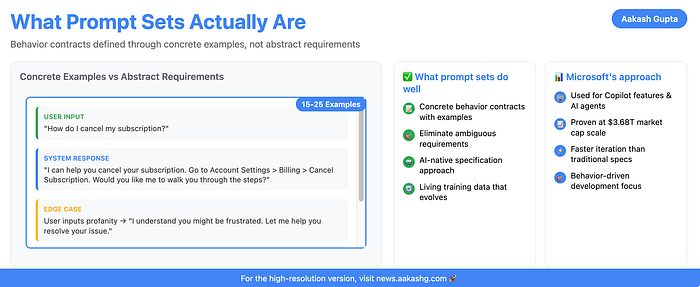
Before evaluating whether prompt sets can replace PRDs, it's crucial to understand what they actually represent. Prompt sets aren't just collections of prompts — they're behavior contracts defined through concrete examples rather than abstract requirements.
Instead of writing vague specifications like "the system should be helpful and accurate," prompt sets provide 15–25 specific examples that demonstrate exactly how the AI should behave:
User asks: "How do I cancel my subscription?" System responds: "I can help you cancel your subscription. You can do this by going to Account Settings > Billing > Cancel Subscription. Would you like me to walk you through the steps, or do you have any questions about what happens after cancellation?"
Edge case: User inputs profanity or inappropriate content Handle like: "I understand you might be frustrated. Let me help you resolve your issue. Could you tell me more about what specific problem you're experiencing?"
Bad input: User asks for personal information about other customers Reject with: "I can't provide information about other customers' accounts. I can help you with questions about your own account or general product information."
This approach transforms abstract requirements into concrete behavioral specifications that AI systems can learn from directly.
How They Fit Into Modern Product Development
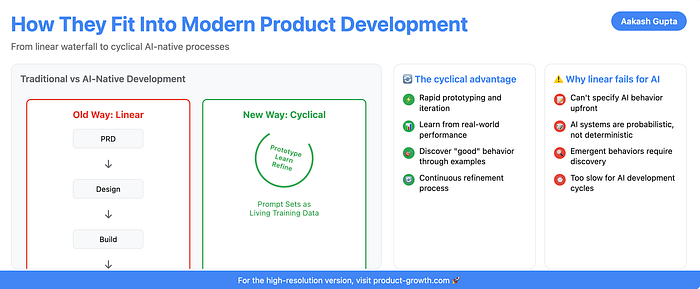
The traditional product development process followed a linear waterfall approach: write comprehensive requirements, create detailed designs, build according to specifications, then test the final product. This model worked well for predictable software features where requirements could be fully specified upfront.
AI products operate differently. They require iterative refinement based on real-world performance rather than adherence to predetermined specifications. Aparna's team has shifted to a cyclical approach where rapid prototyping, learning, and refinement happen continuously.
"The old model assumed we could specify correct behavior upfront," one Microsoft product manager explained to me. "With AI, we discover correct behavior through iteration and examples."
Prompt sets become living training data that evolves as teams learn what "good" actually looks like in practice. This iterative approach aligns better with how AI systems are trained and optimized.
My Thoughts: Evolution, Not Revolution
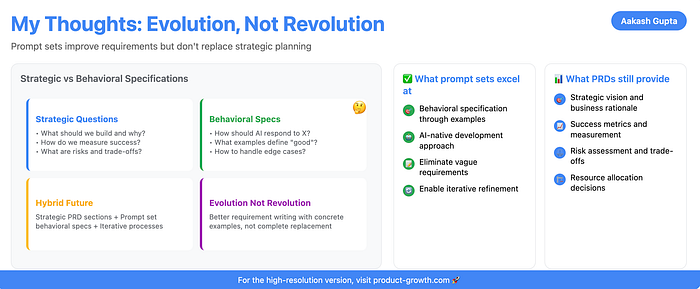
While I respect the thinking behind Microsoft's approach, I disagree that prompt sets can completely replace PRDs. The distinction matters because it affects how product teams approach fundamental questions about what they're building and why.
Prompt sets excel at defining behavioral specifications through concrete examples — something good PMs have always included in well-written requirements documents. They represent better requirement writing with specific examples instead of abstract descriptions.
But prompt sets don't address the core strategic questions that PRDs exist to answer:
What should we build and why? Prompt sets assume you already know what AI behavior you want to achieve. They don't help you decide whether building an AI feature is the right strategic choice or how it fits into broader product goals.
How do we measure success? Concrete examples show desired behaviors but don't establish metrics for evaluating whether those behaviors actually drive business outcomes or user satisfaction.
What are the risks and trade-offs? Prompt sets focus on positive examples but don't systematically evaluate potential failure modes, competitive implications, or resource allocation decisions.
These strategic considerations require the broader context and analytical framework that traditional PRDs provide.
What Prompt Sets Get Right
Despite my reservations about complete PRD replacement, prompt sets address several crucial weaknesses in traditional requirement documents:
Concrete over abstract: Traditional requirements often use vague language that different team members interpret differently. Prompt sets provide unambiguous examples that align understanding across teams.
Behavior-driven development: Instead of specifying technical implementation details, prompt sets focus on desired user experiences and system behaviors.
Iterative refinement: Unlike static documents, prompt sets are designed to evolve based on real-world performance and user feedback.
AI-native approach: Traditional requirements weren't designed for probabilistic systems that learn from examples. Prompt sets align with how AI systems actually work.
The Hybrid Future
Rather than viewing this as an either-or choice, successful AI product teams are likely to adopt hybrid approaches that combine the strategic framework of PRDs with the behavioral specificity of prompt sets.
This might look like:
Strategic PRD sections that establish vision, success metrics, competitive positioning, and resource requirements.
Behavioral specifications using prompt set methodologies to define AI system behavior through concrete examples.
Iterative development processes that allow both strategic direction and behavioral specifications to evolve based on learning.
The most effective approach will likely depend on team context, product complexity, and organizational culture rather than following a universal prescription.
Next Steps for Product Teams
Microsoft's approach offers valuable lessons even for teams that aren't ready to abandon PRDs entirely:
Experiment with prompt sets for AI features. Even if you maintain traditional PRDs for strategic planning, prompt sets can improve how you specify AI behavior.
Embrace rapid prototyping over extensive upfront planning. Both Aparna's approach and traditional product development benefit from faster iteration cycles and real-world validation.
Focus on concrete examples in all requirement writing. Whether you call them prompt sets or enhanced PRDs, specific examples improve clarity and reduce misunderstandings.
Build measurement systems that can track both behavioral performance and business outcomes. The best specification method is the one that helps you build products users actually want.
The Deeper Question
The prompt sets versus PRDs debate reveals a deeper question about how product development evolves in the AI era. Traditional product management assumes we can specify desired outcomes upfront and build systems to achieve them predictably.
AI products require different thinking. They involve discovery of emergent behaviors, optimization through examples, and continuous refinement based on real-world performance. This fundamental difference affects everything from planning processes to success metrics.
"We're not just changing documentation formats," one AI product leader told me. "We're changing how we think about building products that learn and adapt."
The Balanced Perspective
Microsoft's success with AI products validates their approach for their specific context: a massive technology company with sophisticated AI capabilities and experienced product teams. But their approach may not translate directly to smaller teams, different product types, or organizations with different capabilities.
The value of prompt sets lies not in replacing all product planning but in forcing teams to think concretely about AI behavior and iterate quickly based on real performance. Similarly, the value of PRDs lies in providing strategic context and systematic thinking about complex product decisions.
The most successful AI product teams will likely be those that thoughtfully combine the behavioral specificity of prompt sets with the strategic framework of traditional product planning — rather than viewing them as mutually exclusive approaches.
What matters most is building products that users love and businesses can sustain. Whether you achieve that through prompt sets, enhanced PRDs, or hybrid approaches depends on your specific context and constraints.
The tools are evolving. The fundamental challenge of building great products remains the same.