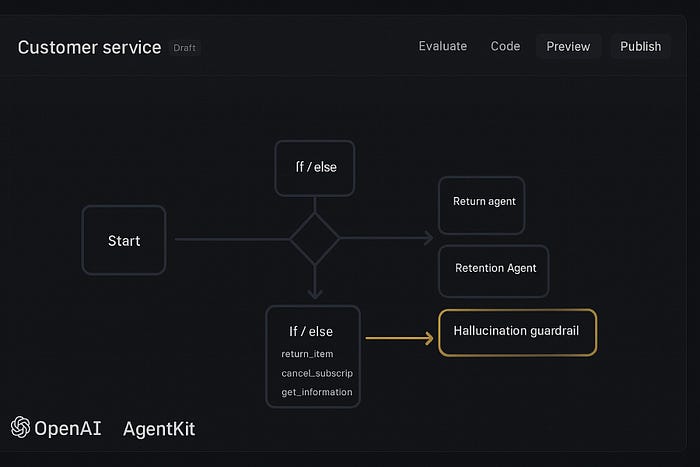

From OpenAI's announcement:
A unified toolkit for building, deploying, and optimizing "agents" (i.e. AI workflows that act, not just respond).
Key components:
- Agent Builder – visual canvas for designing multi-agent workflows, with versioning, guardrails, logic branching.
- Connector Registry – central place to manage integrations / data connectors across systems (Google Drive, Dropbox, SharePoint, etc.).
- ChatKit – embeddable chat UI layer for agents (streaming, threads, theming) to inject "agentic" chat into apps / web interfaces.
- Evaluation / Evals upgrades – datasets, trace grading, auto prompt optimization, third-party model support.
- Reinforcement fine tuning (RFT) – customize model behavior, tool calling, evaluator criteria.
Agent Builder is in beta, Connector Registry is rolling out. ChatKit + Evals features generally available.
They also hint at forthcoming "Workflows API" and deployment options in ChatGPT.
Values / Benefits (for CMO / CRO audience)
From a marketing & revenue lens, here's why AgentKit matters (and how to pitch it to executives). Also what are the benefits and value/benefits:
How to communicate to CMO / CRO
Speed to market & iteration Because AgentKit provides visual orchestration + versioning + built in evals, you reduce development friction and iteration cycles.
OpenAI claims "agent live in two sprints rather than two quarters."
"Less dev overhead, faster rollouts of AI-driven engagement features (sales bots, support agents). You iterate faster, test quickly, respond to feedback."
Lower engineering burden / risk Instead of building orchestration, fallback logic, connector plumbing, embedding chat UI, evaluation frameworks from scratch, much of that is packaged.
"You don't need to spin up a bespoke framework; the core plumbing is handled. Your teams can focus on domain logic / user flows."
Governance, compliance, safety
Guardrails are built in (PII masking, jailbreak detection, etc.). Connector registry gives control over what systems agents touch.
"You keep oversight, you reduce exposure to privacy / brand risk from rogue agent behavior."
Scalability & control
Versioning, centralized connector control means you can manage many agents, and govern them at scale. "When you roll agent features across markets, channels, teams, you'll want a single control plane."
Performance optimization & measurement
The enhanced Evals framework lets you trace agent failures, optimize prompts automatically, grade outcomes end-to-end.
"You can instrument these agents like conversion funnels – see where they fail, improve them continuously."
Custom behavior / domain fit
With RFT and custom tool calls, you can push the agents toward your vertical/industry logic rather than being generic bots."These agents don't stay generic – they learn your domain, process, playbook so they act more like your team."
Embed native conversational UX ChatKit lets you embed the agent into your product or customer touchpoints in a branded, seamless UI. "Your customer sees your brand, not a third-party chat overlay."
Differentiated customer experiences & revenue uplift
The end result: you can build smart assistants for sales, retention, support, onboarding – enabling upsell, faster resolution, proactive outreach.
How to frame it to CMOs and CROs
When speaking to CMOs / CROs, frame AgentKit not as a dev product, but as a platform lever to drive:
- Customer experience transformation (bots, guides, assistants)
- Revenue efficiency (faster conversions, reduced friction)
- Cost avoidance (lower support / dev maintenance burden)
- Competitive differentiation via smart automation at scale
Also emphasize the operational leverage: once built, these agents can run 24/7, be reused, be extended into new use cases, and evolve via measurement and improvement.
One danger: if you treat these as black boxes, the model's failure / hallucination risk could backfire. So guardrails, evaluation, human oversight remain critical.
Incumbents, competitors, partnerships, and risks
If you're a CMO / CRO vetting AgentKit, you should know who else is playing in this "agent / workflow automation" space, where overlaps/conflict might occur, and who is a potential ally.
n8n
Low-code workflow automation, connectors, event triggers.
Overlap in orchestration and connectors; n8n is strong in "if this then that" style pipelines.
Potential partner: for non-AI logic steps, n8n can feed into or out of agents; OpenAI might integrate n8n connectors.
Clay
Data workflow / automation in sales / ops.
Overlap where Clay builds "agents" or automations; OpenAI itself cites Clay using agents for growth.
Clay may use AgentKit under the hood or act as a front end / vertical layer over it.
Zapier / Make / Workato / Tray.io
Mature ecosystem for connectors, automation, cross-app workflows.
A lot of overlap in connectors, orchestration, triggers; they are entrenched in many orgs.
They could integrate AI / agent steps via AgentKit; OpenAI might embed Zapier actions as connectors.
Microsoft Power Automate / Logic Apps / UiPath
Enterprise automation, robotic process automation (RPA).
In large enterprises these are incumbent automation layers; for legacy systems, these are stronger.
Could integrate agents as "next step" inside their flows; possible partnerships.
Coda / Retool / internal tool frameworks
Internal tool development + logic embedding.
They often build "agentic" modules in internal dashboards / tools.
Could embed AgentKit via ChatKit inside their UIs.
Specialist AI agent platforms / agent orchestration startups
Some startups focus solely on orchestration, agent marketplaces, prompting optimisation.
They're more direct competitors; they may have domain specialization (e.g. legal, finance).
Some might complement (you use their domain models inside AgentKit workflows).
Incumbent threats / challenges
- Entrenched automation stacks: Enterprises already have heavy investment in Zapier, Workato, RPA tools – switching costs are high.
- Open source orchestration solutions: There will be clones or lighter open source alternatives that replicate Agent Builder or connectors.
- Vertically focused AI vendors: Domain specialized agent platforms (e.g. in healthcare, finance, legal) might bypass generic toolkits and build directly.
- Internal engineering efforts: Large tech firms or digital natives may build their own agent orchestration layers, bypassing OpenAI's tools.
Partnership or collab potential
Connector / automation platforms: n8n, Zapier, Make, Workato as connectors inside AgentKit's Connector Registry.
- CRM / marketing suites: Integrate AgentKit agents directly into Salesforce, HubSpot, Marketo workflows.
- Vertical SaaS vendors: Embedding chat agents into specific tools (e.g. legal tech, sales tools) using ChatKit.
- Model providers: Through third-party model support in Evals, you could let other model vendors plug into AgentKit (so other LLMs can be evaluated inside this framework)
- Systems integrators / digital agencies: They build agent experiences for clients using AgentKit as the backbone.
Risks, open questions, and cautions (from a GTM lens)
- Lock-in risk: If you build deep workflows using AgentKit, migration to alternative stacks might be hard.
- Performance / failure modes: Agents will make mistakes. If one misroutes a customer, your brand takes the hit.
- Guardrail trust / safety: The built-in safety tools must be robust and auditable. The accountability chain (who fixes bad agents) must be clear.
- Integration completeness: The value of AgentKit heavily depends on the depth and quality of connectors (CRM, databases, custom APIs). Missing connectors will force rebuilding.
- Complexity creep: Multi-agent workflows can get complex. Without good tooling, debugging can be painful.
- Adoption & internal change: Teams (marketing, operations, engineering) must shift mindset toward agentic ops. Change management needed.
- Regulation / compliance: Especially if agents manipulate data, take actions, or use personal data. Need to ensure legal signoff and data governance.
How to position (for CMO / CRO adoption)
If you're pitching this to CMO / CRO, your narrative should emphasize:
- AgentKit as a force multiplier – it scales your human expertise across many more customer interactions, making each rep / marketer more effective.
- Built for control – you get guardrails, versioning, oversight, not a black box.
- Test fast, fail safe – you can run experiments with bots, measure outcomes, pivot quickly without full releases.
- Plug into existing stack – it's not a replacement for CRM or automation – it complements, extending them.
- Focus on ROI use cases first – start with high-leverage use cases (e.g. lead qualification, support triage, onboarding guidance) to prove value quickly.
- Ensure feedback loops – metrics, traceability, human handoff points are part of the design from day one.
- Risk mitigation plan – define review process, safe mode, rollback, responsible owners.
You'd want in your roadmap: pilot in a high volumes, low risk domain (like support / FAQ), then expand to commerce, sales assist, retention bots.
Want to learn more? Speak with GTM and marketing specialist, Reggie James at Digital Clarity.