

In the world of web development, the idea of "microfrontends" has become increasingly popular as a method to manage large-scale projects. The approach involves breaking down a complex frontend application into smaller, more manageable parts, each responsible for a specific feature or functionality. This breakdown allows different teams to work independently on different parts of the application, using different technologies and frameworks as needed. Here's a closer look at what this approach entails and how you can implement it in your React projects, along with practical examples.
What Are the Advantages of the Microfrontend Approach?
- Enhanced Modularity and Scalability: Breaking down the application into smaller parts enables teams to work independently, making it easier to scale the project as it grows.
- Technology Flexibility: With the microfrontend approach, teams can choose the best tools for specific tasks, even if they involve different technologies or frameworks.
- Isolation and Independence: An error in one part of the application does not necessarily affect the entire system, as each microfrontend functions independently.
- Simplified Maintenance: Dealing with smaller, isolated codebases makes maintenance more straightforward, allowing teams to update specific parts without impacting the entire application.
- Boosted Development Speed: Teams can work concurrently on different microfrontends, leading to faster development and better overall productivity.
How to Implement Microfrontends in React Projects
To implement the microfrontend approach in React, you can leverage various techniques, such as Web Components, Module Federation, or custom-built solutions.
Let's focus on using Web Components to integrate microfrontends into your React application.
Step 1: Setting Up the Microfrontend Components
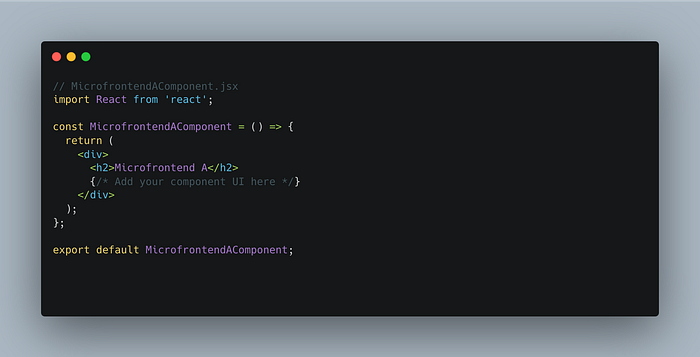
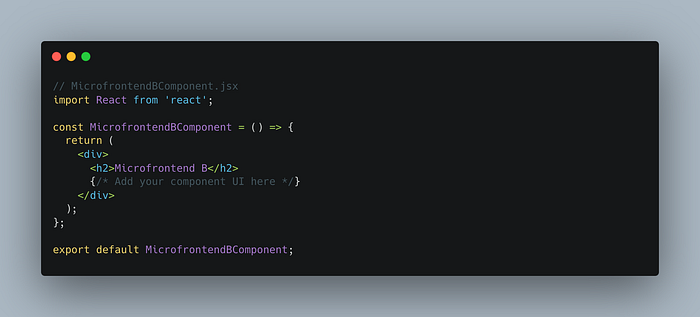
First, let's create two independent React projects, each representing a microfrontend. Here are simplified examples:
Microfrontend A
Microfrontend B
Step 2: Integrating Microfrontends into the Main Application
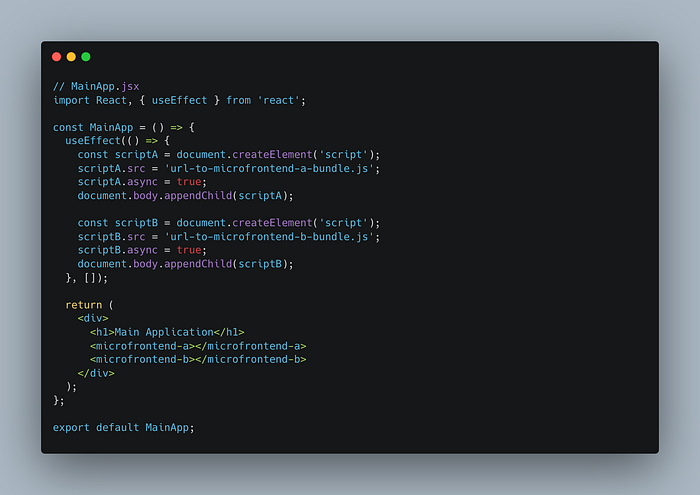
In your main application, import the microfrontends as Web Components and use them within the React application. This integration can be achieved by dynamically adding the necessary scripts for each microfrontend into the main application.
Here's a simplified illustration:
Step 3: Building and Running the Microfrontends
Each microfrontend project needs to be built and served independently, ensuring that they expose their components as Web Components. This process involves creating bundles that include the required scripts and styles for the microfrontends.
Conclusion
The microfrontend approach presents an effective strategy for managing complex frontend applications, enabling teams to work more efficiently and independently. By adopting this approach in your React projects, you can take advantage of its benefits, including enhanced modularity, simplified maintenance, and improved scalability. Implementing microfrontends using Web Components in React is a popular and practical solution that allows for seamless integration of independently developed and deployed components. By following the outlined steps, you can successfully implement the microfrontend approach and create scalable, maintainable, and robust applications in React.