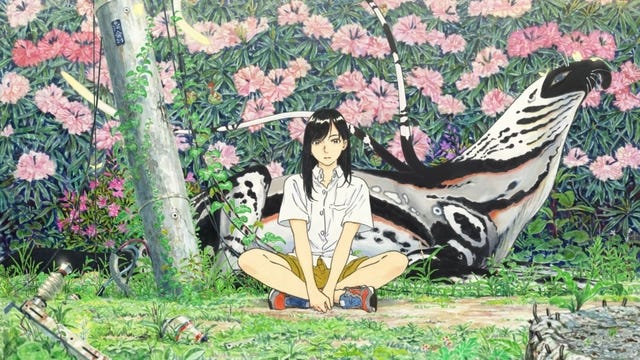
If you have a little time, watch Puparia (linked right below). In three quick minutes, you will be taken through a palette of intense and subtle colors, lines that ebb and flow effortlessly that are juxtaposed with confronting transitions, the eerily familiar yet also creepily alienating, and emotions that are comforting and unsettling all the same time. This all occurs in three minutes and without saying a single word.
So, what did you think? Intense, right? One of the features that stand out to me are the eyes… the individual humans and humanlike characters, the non-human animals/insects, and the mass of the crowd. Everyone is watching, and everyone is being watched. It reminds me of a quote from George Berkeley, "Esse est percipi" (to be, is to be perceived).
How do we go about understanding the work? Fortunately, the creator, Shingo Tamagawa, provides some insight in a short documentary that goes over the creation of the work (I linked the video below).
So, the big question is, what does Puparia mean? This is not so simple of a question, given that the film makes you ask, are you the one watching or is the film watching you? It is obvious that Tamagawa is trying to produce an artistic work in a way that he feels that has been neglected. However, Puparia is more than just a style, more than just a vibe.
Puparia speaks of the shifts within society and the ebb and flow of society as a living being. However, the shifts may seem like a flow of hair in the wind, but these shifts speak more to changes in values. Also, these shifts are ontological in nature; changes creates a transformation, or a transformation creates a change in being.
The film doesn't end so much in a call to action, but rather, a call to be. Whatever is to come cannot be met by another external object. Rather, the eyes of perception must point inward to the self. Puparia probes the societal crisis as a common societal existential crisis. It is the existential crisis of being for all of us collectively, but without the anime screaming and yelling.