Introduction
"Herding cats" is the phrase most people use when I tell them I teach middle school. Cats would be easier.
When it comes to practicing patience, spending a year or two in a middle school could do wonders for most of us. While some people think patience is a trait, you're born with or not, patience is a constant practice.
Incoming sports analogy: We don't learn how to make a free throw in basketball. We might learn some tactics, tips, and tricks to become a better free-throw shooter. In the end, what we're really doing is practicing those tactics over and over, so it increases our chances of making the shot when we're in the game.
What You'll Learn
Patience is a skill. And as a skill, it can be practiced and improved.
However, being a more patient person will not only help you feel better but will also help you become a more efficient communicator.
When we're frustrated, the only thing that gets through to the other person is the frustration. Articulating calmly and clearly is the absolute key to communicating and planning ideas.
Remember that your frustration will always betray you.
Why Me
So what makes me an expert on patience?
I teach middle school… on purpose. I've taught 12- and 13-year-olds in Camden (New Jersey) and Harlem (New York). Now I teach 13- and 14-year-olds in the suburbs of Philadelphia.
In all those years, I've learned a ton about patience. I was not always a patient person. However, these tactics helped me learn how to manage my frustration and emotion through years of practice.
These quick tips, if consistently practiced, can make a major difference in the way you interact with others and the way they interact with you.
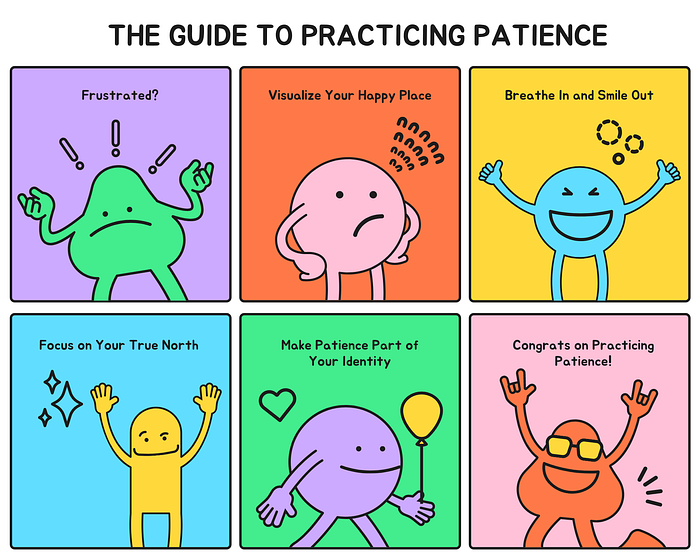
- Happy Place
- Breathe In & Smile Out
- True North
- Identity
1. Your Happy Place

Step one, visualize your happy place. Pick a place that relaxes you to your core. Think about that location right now.
For me, it's my family's lake house (pictured above). While there, I get up every morning and sit on the beach and read. That's some serious inner peace.
Your happy place might be a beach, a hammock, or even your own bed. Heck, it can be a place you want to visit.
Have you decided on your happy place? Okay, good. Now, here's the part that makes this work. Print out the picture and put it in your line of sight in the places you're most frustrated with.
Are kids driving you crazy? Put that picture on the fridge. Frustrating desk job? Put the picture on your desk.
If you're a teacher like me, put the picture in the back of the room. Then, when you're standing in front of your class and they're just not getting it. Or they're not listening or aren't doing what you ask them to, you can eye the picture.
You might even use it as the background of your phone or computer.
Look at the picture often. So often you can imagine being there any time you need to. Practice recalling the place in your mind. Do your best to transport yourself there. What does it sound like? Feel like? Smell like?
When you get good at this, you'll be able to find that inner peace any time.
2. Breathe In & Smile Out
Okay, so breathing is probably one that already relieves stress and frustration. However, stick with me because I'm going to add a wrinkle in this one that's really important.
Everything constricts when you get angry. When you breathe slowly, you'll naturally release the tension in your neck, drop your shoulders, and feel the frustration leave your body.
Here's that wrinkle I was talking about: as you breathe out, smile.
This sounds crazy, but science confirms you can trick your body into releasing endorphins and dopamine by smiling. So when you're most frustrated, pile on that wide grin.
"… when you smile, your brain releases dopamine, endorphins and serotonin. These neurotransmitters are associated with lowering your anxiety and increasing feelings of happiness." — Aultman.org
Try it now. Breathe in deeply and on the release, smile.
This one will take practice. But if you can nail it, it will drastically decrease your frustration time. Plus, it will refocus whoever you're talking to away from your frustration and toward your message.
Or they'll think you've gone completely insane and will back away slowly. Success either way!
3. Articulate Your True North
You should be able to explain, at any moment, why you're completing the task you're completing. Do it now. What is your True North? Say it out loud.
Even if you're stuck at some crappy job that you hate, you have a True North. There's a reason you go to that job.
Maybe it's paying for housing or for your child's food. Maybe it's because you're saving for a new car. Or a new house. You might need to survive for a few years until you get that sweet promotion.
Focus on your True North. If you do, frustration plays no part in that end goal.
When you clearly articulate your True North, you're zooming out from that particularly frustrating moment. As frustrating as the moment can feel, this is just one moment, in one day, in one week, in one month, in one year.
If you can consistently zoom out from any moment, you gain perspective, both in time and space. These can be difficult mental hurdles to accomplish at the moment. They require the practice we've been talking about.
4. Identity
Last, but certainly not least, start modifying your identity to include patience. Tell yourself daily: I am a patient person.

Say it out loud or write it down again and again.
By repeating this over and over, you'll ultimately build it into your identity.
There's a fair amount of research done around the positive outcomes based on identification with a particular trait. If you want to know more, read Atomic Habits by James Clear. Or at least this article from his website.
"To change your behavior for good, you need to start believing new things about yourself. You need to build identity-based habits." — James Clear
Conclusion
Patience isn't a light switch. But it is possible to improve your patience with practice.
When we become more patient, we also become more empathetic, caring, and better communicators.