
The release of Gemini 3 Pro marks a distinct shift in how we talk about AI development. For a long time, the conversation was dominated by benchmarks — MMLU scores, context window sizes, and reasoning capabilities. While those metrics still matter, Google's latest flagship model has brought a different concept to the forefront: the ability to build software based on "vibe" rather than just syntax.
This isn't just about a smarter chatbot. It is about a fundamental change in the developer experience. When you pair a model like Gemini 3 Pro with an agentic platform like MetaGPT, you stop acting as a syntax corrector and start acting as a product architect. The friction between having an idea and seeing it run in a browser is disappearing.
In this deep dive, we will look at what Gemini 3 Pro actually brings to the table, how it powers the emerging trend of Vibe Coding, and — most importantly — what it looks like when you use these tools to build real, interactive applications.
The Shift to Natural Language Programming
"Vibe Coding" might sound like a buzzword, but it describes a very real phenomenon. It refers to a workflow where the developer describes the feeling, behavior, and aesthetic of an application in natural language, and the AI handles the implementation details.
Andrejh Karpathy famously tweeted about how "English is the hottest new programming language." Gemini 3 Pro is the engine that makes that statement true. Unlike previous models that often required precise, pseudo-code prompts to get a working result, Gemini 3 Pro demonstrates a surprising ability to infer intent.
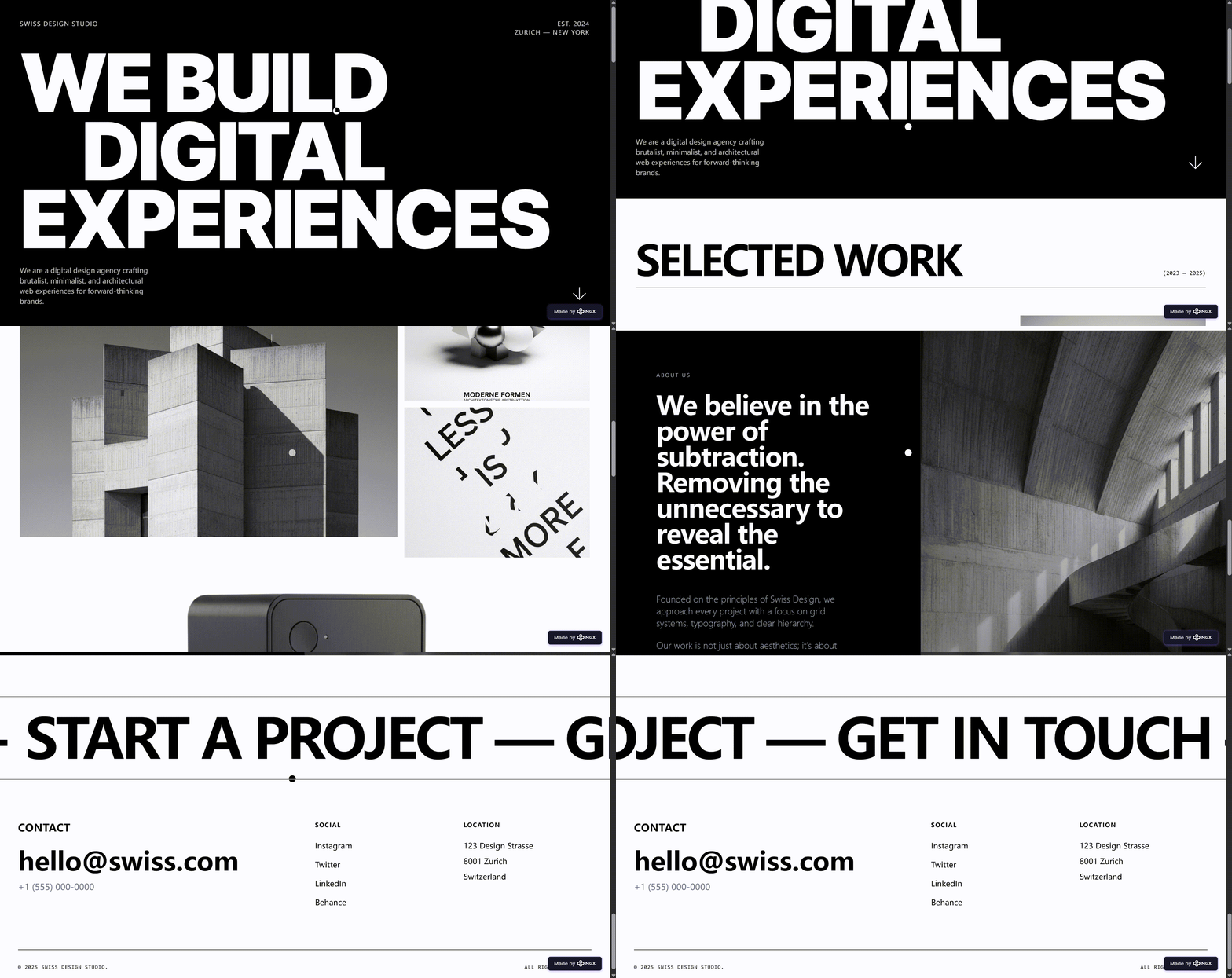
It understands context. It understands design systems. It understands that when you ask for a "minimalist, Swiss-style portfolio," you aren't just asking for a white background — you are asking for specific typographic hierarchies, grid alignments, and spacing rules.
This capability is amplified when the model is hosted in an environment designed for it. On platforms like MetaGPT, the model isn't just generating text snippets; it is orchestrating a full development environment. It writes the code, installs dependencies, renders the preview, and iterates based on your feedback. This is the "Vibe Coding" loop: describe, preview, refine.
Under the Hood: Why Gemini 3 Pro is Different
To understand why this works now, we have to look at the technical leap Gemini 3 Pro represents. Google has optimized this model specifically for complex reasoning and long-context understanding.
1. The 1 Million Token Context Window
The most immediate game-changer is the context window. With a 1-million-token capacity, Gemini 3 Pro can hold an entire project's structure in its "working memory."
In the past, if you wanted an AI to refactor a complex app, you had to feed it file by file, often losing context in the process. Now, the model can see the HTML, the CSS, the JavaScript logic, and the asset references simultaneously. This holistic view allows it to make changes that are consistent across the entire application, reducing the "whack-a-mole" bug fixing that plagued earlier AI coding tools.
2. Native Multimodality
Gemini 3 Pro doesn't just read text; it sees. Its native multimodal capabilities mean you can upload a sketch of a UI, a screenshot of a bug, or a video of an interaction you like, and say, "Make it work like this."
This visual understanding is crucial for frontend development. It bridges the gap between a designer's visual intent and the developer's code. Instead of translating a visual idea into CSS properties manually, you let the model interpret the visual data directly.
3. Enhanced Reasoning for Logic
While "vibe" handles the aesthetic, you still need rock-solid logic for an app to work. Gemini 3 Pro scores exceptionally well on reasoning benchmarks (like GPQA and SWE-bench). This means it is less likely to hallucinate non-existent libraries or write logic that creates infinite loops. It can plan out the state management of a React app or the physics calculations of a game with a level of competence that rivals a junior developer.
Real-World Examples: Building with Gemini 3 Pro
Theory is fine, but the real test of any tool is what you can build with it. To see Vibe Coding in action, we can look at several applications generated using Gemini 3 Pro on the MetaGPT X platform. These aren't cherry-picked code snippets; they are fully functional, interactive web applications generated from high-level prompts.
The Physics of Fun: A Fruit Merge Game
One of the best ways to test an AI's coding ability is through games. Games require a tight loop of logic, graphics, and user interaction. If the physics engine is slightly off, the whole experience falls apart.
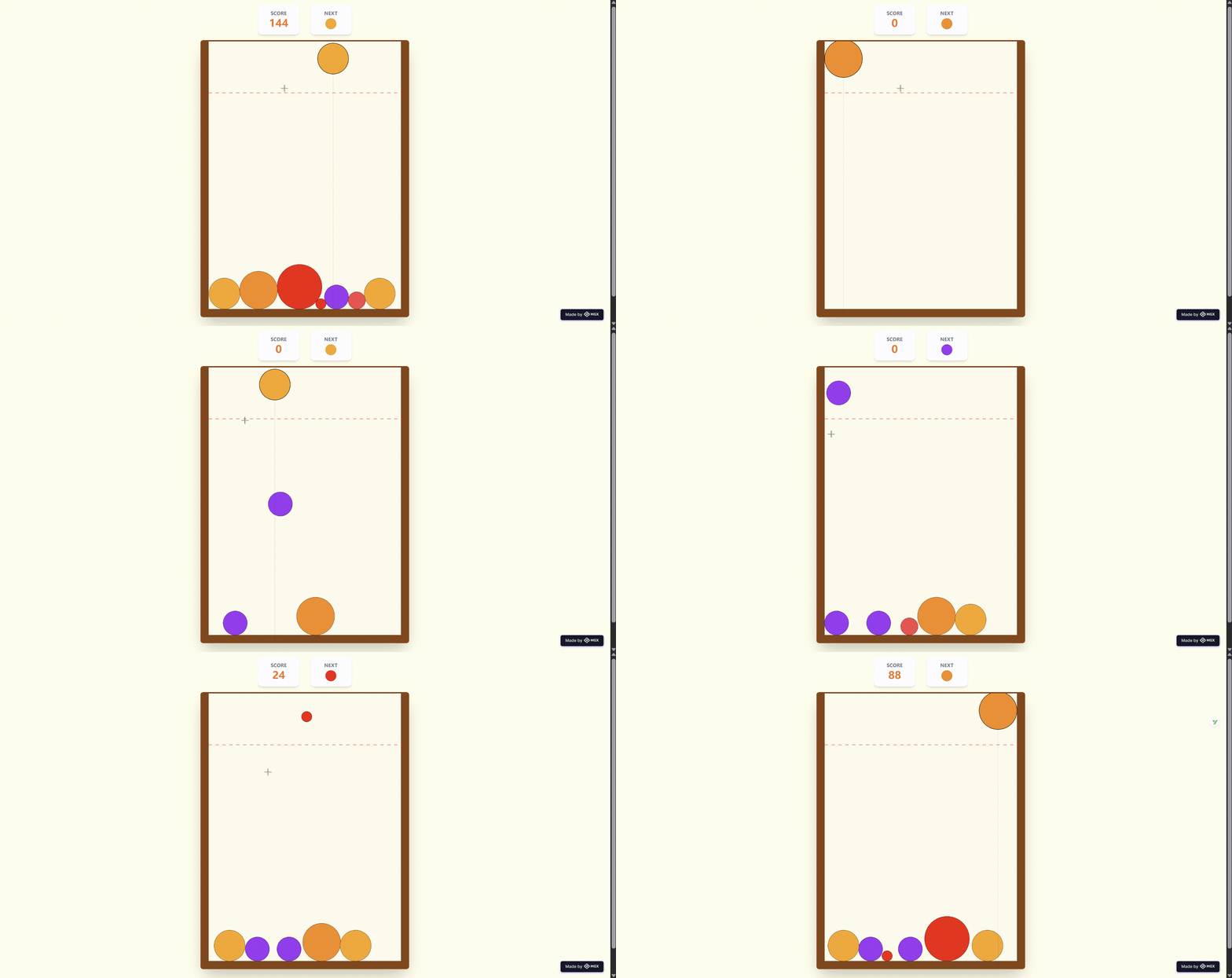
Consider this Fruit Merge Game. It's a physics-based puzzle game where players drop fruits that merge upon collision.
Building this traditionally involves:
- Setting up a physics world (using Matter.js or similar).
- Handling collision events.
- Managing the game state (score, "game over" conditions).
- Rendering the graphics loop.
With Gemini 3 Pro, the prompt focuses on the mechanics: "Create a game where fruits drop and merge into bigger fruits. Don't let them cross the top line." The model infers the need for a physics engine, selects an appropriate library, and wires up the collision logic correctly on the first or second pass. It handles the complexity of the "merge" logic — calculating the new size and type of fruit — without needing explicit step-by-step algorithmic instructions.
Aesthetic Precision: The Cosmic Countdown
Launch pages are all about "vibe." They need to look cool, feel modern, and build anticipation.
This Cosmic Countdown example demonstrates Gemini 3 Pro's ability to handle visual flair. The application features a particle-driven nebula effect, dynamic lighting, and a cinematic reveal animation.
Creating this requires knowledge of WebGL or advanced Canvas API manipulation. A developer might spend hours tweaking particle velocity and color gradients to get the look right. Here, the "vibe" prompt drives the technical implementation. The model understands that "cosmic" implies dark backgrounds, glowing particles, and smooth, floating motion, and it generates the shader code to match.
Functional Utility: The Glassmorphism Kanban Board
Productivity tools require a different kind of discipline. They need to be clean, responsive, and usable.
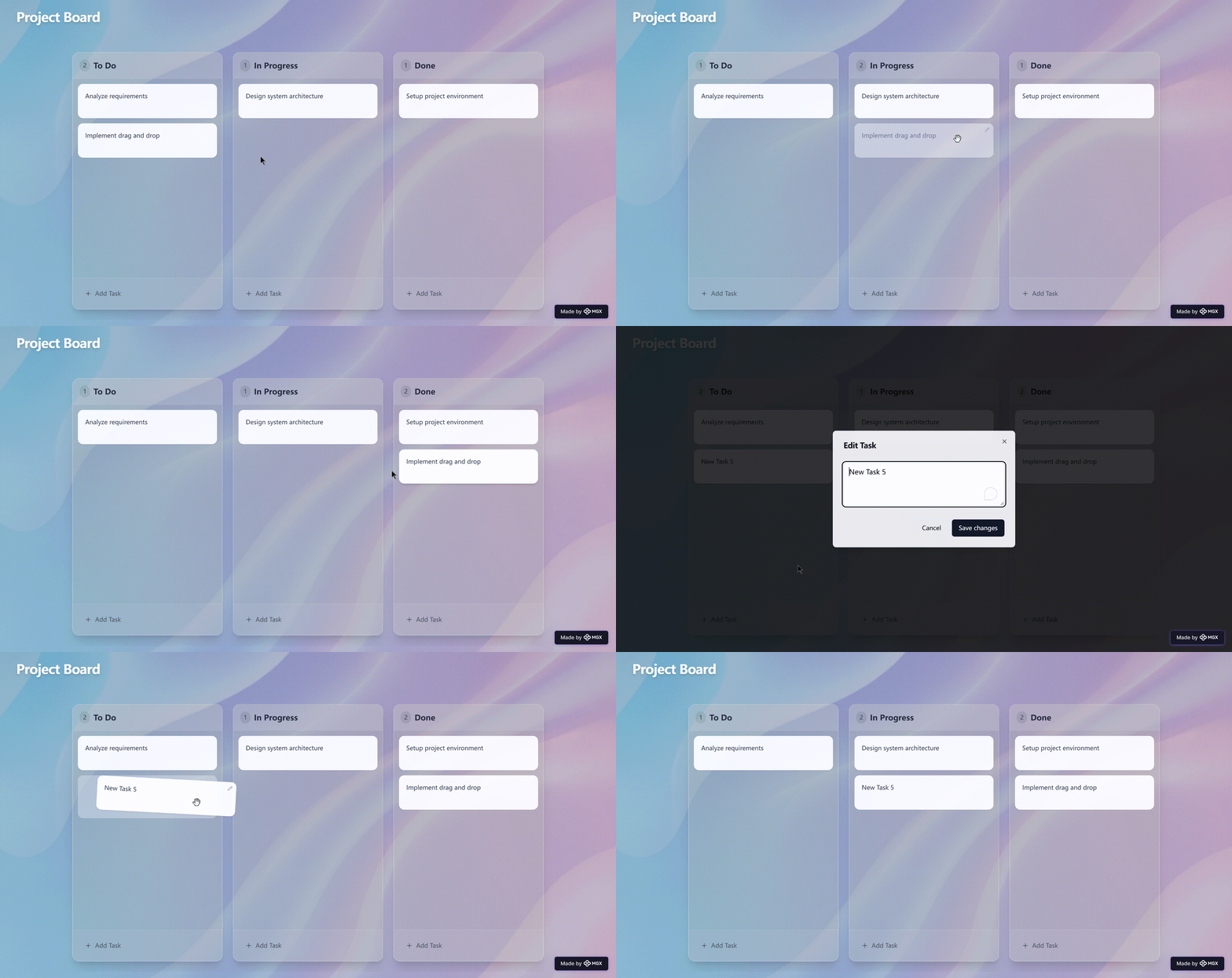
The Glassmorphism Kanban Board showcases how Gemini 3 Pro handles modern UI trends and complex state management. "Glassmorphism" is a specific design style involving background blur, transparency, and subtle borders.
Implementing this in CSS can be tricky to get right across different browsers. Furthermore, a Kanban board needs drag-and-drop functionality that updates the underlying data model. Gemini 3 Pro successfully marries the visual style (the frosted glass look) with the functional requirement (moving cards between columns), resulting in a tool that feels like a polished SaaS product rather than a rough prototype.
Interactive 3D Environments: The Zero-Gravity Playground
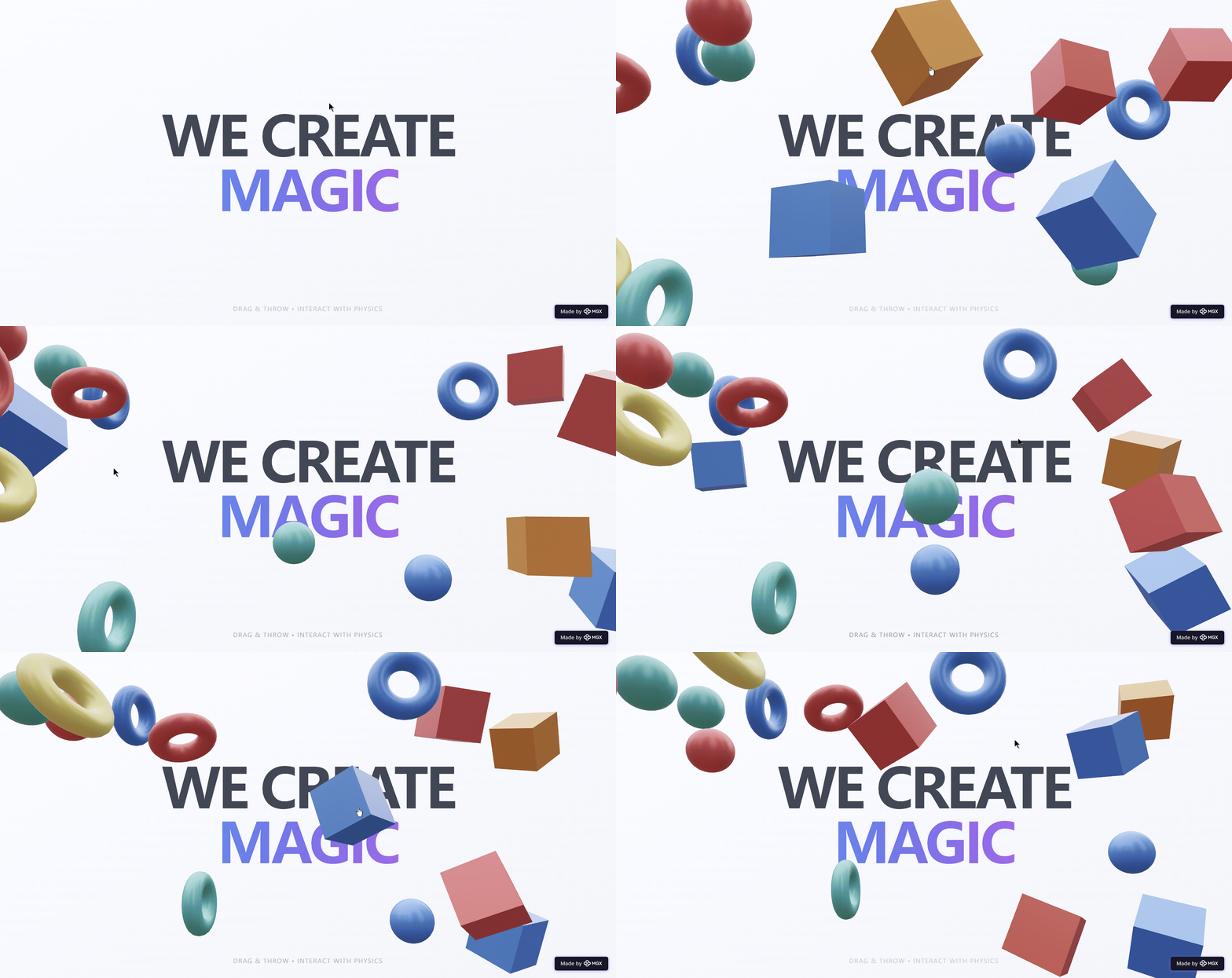
Finally, we have the 3D Physics Playground. This is perhaps the most impressive demonstration of "Vibe Coding" capabilities.
3D web development is notoriously difficult. You have to manage a scene graph, lighting, camera perspective, and user controls. This application creates a digital, zero-gravity environment where objects float and interact.
The fact that a language model can generate a working 3D scene from a text description is a testament to its training data and reasoning. It understands the relationship between the 3D coordinate system and the user's mouse inputs, creating an immersive experience that would typically require a specialized 3D developer to build.
The Role of MetaGPT in the Ecosystem
While Gemini 3 Pro provides the raw intelligence, the environment matters. MetaGPT acts as the IDE for this new era of development. It wraps the model in a framework that understands software engineering.
When you use Gemini 3 Pro inside MetaGPT, you aren't just getting a text response. You are getting:
- Project Structure: The system knows how to organize files, separate CSS from logic, and manage assets.
- Iterative Refinement: You can look at the preview, say "make the gravity stronger" or "change the font to something more modern," and the system applies those changes contextually.
- Deployment: The ability to instantly host and share the application (as seen in the links above) closes the loop between creation and distribution.
This combination is what makes Vibe Coding a viable workflow for professionals, not just a novelty. It allows product managers, designers, and founders to prototype at the speed of thought.
Conclusion: The Future is "Vibe" Driven
Gemini 3 Pro is a significant milestone. It proves that AI models have reached a threshold where they can handle the nuance of creative intent alongside the rigidity of code syntax.
We are moving away from a world where you need to know the specific syntax for a CSS grid to build a layout. Instead, we are entering a world where you need to know what you want to build and how it should feel. The skill set is shifting from memorization to curation and direction.
Whether you are building a physics game, a cinematic launch page, or a complex productivity tool, tools like Gemini 3 Pro and MetaGPT are making the barrier to entry lower than ever before.
The code is still there, running under the hood. But for the first time, you can focus entirely on the vibe.