
I don't think there's a more quintessentially American board game than Monopoly. Literally everyone I've known throughout my life has played it, and everyone has their own theories about which properties are the best. I mean, we all know Boardwalk is amazing, right? Or as the Mr. Beast video person said, "Get Park Place!" But, in reality, there are limits to our assumptions. There are very clear statistical and mathematical reasons behind which spaces are most-landed on in Monopoly, so let's analyze that.
Now, before we get into the messy coding-aspect of this, let's do some math. Monopoly moves primarily rely on the sum of two dice. These sums range from 2 to 12, with the most common sum being 7, since you can create it 6 ways: 1+6, 2+5, 3+4, 4+3, 5+2, 6+1. Hence, it's reasonable to assume that traversing the board once, you're really likely to land on the spaces 6–8, 13–15, 20–22, 22–24, since they have the highest probability. However, you obviously don't just traverse the board once in Monopoly. Most games go through the board multiple times. In addition, the 7 rule is not the only reason not every location is favored equally. You could get doubles, which means you roll again. You could roll doubles 3 times, sending you straight to jail. You could get a chance or community chest card, which could transport you to a whole other position on the board. It's these nuances that end up favoring certain locations much more than others, and that's what we'll analyze now.
To simulate this, I coded a program in python (link below) with the game logic from Monopoly that recorded the frequency of landing on each space. The code does get fairly complex, but it allows us to clearly track the actions on each move. Then, I applied the Chi-Squared Goodness of Fit test to the frequency data to see if the frequencies are about the same or not (I encourage you to research this). Here were some key assumptions within the program.
- I used the standard American version of Monopoly.
- All money related manners are ignored. They don't affect the location of the player, hence they're unnecessary
- Only one player is simulated. Another player cannot affect the location of another player, hence they're irrelevant.
- Our alpha value for all Chi-Squared tests is set at 0.05, df=39, Chi-squared critical value=54.57.
- Our expected number of landings on each place is the mean of the observed frequencies.
- Our null hypothesis is always that the observed frequencies are roughly equal to each other.
Now, let's look at multiple cases.
Case 1: No jail logic and No Community Chest/Chance Cards.
I know, I know. No (sane) game of Monopoly has these rules. Let's still look at it. Running the game for 1,000,000 turns, we get a p-value of 0.90 (Our test statistic is 28.27), meaning our frequencies are roughly the same, which is pretty much reflected in the data below. Hence, even though the rule of 7 seems it would matter, over many trials the data is roughly random. The graph below has # of times landed on the y-axis, and position on the x-axis.
Case 2: Jail logic and No Community Chest/Chance Cards.
Relax, I'll get to the case we're all waiting for. Running the game for 1,000,000 turns, our p-value is basically 0 (Our test statistic is 68,398). The reason is pretty clear when you look at the data.
See that huge spike at 10 (or jail)? That's because of the dice jail rule and going to jail. It clearly makes a HUGE difference over many turns, and ends up favoring that position a lot. But, regardless of that, the rest of the positions are still roughly similar.
Case 3: Jail logic and Community Chest/Chance Cards (basically the actual game)
Finally, sighs the reader. Running the game for 1,000,000 turns, we see very clear distinctions in the data. Our p-value is again essentially 0 (Test-statistic at 66971), and it's very obvious why.
Clearly, a lot of the spaces are favored more than others. Let's summarize those spots.
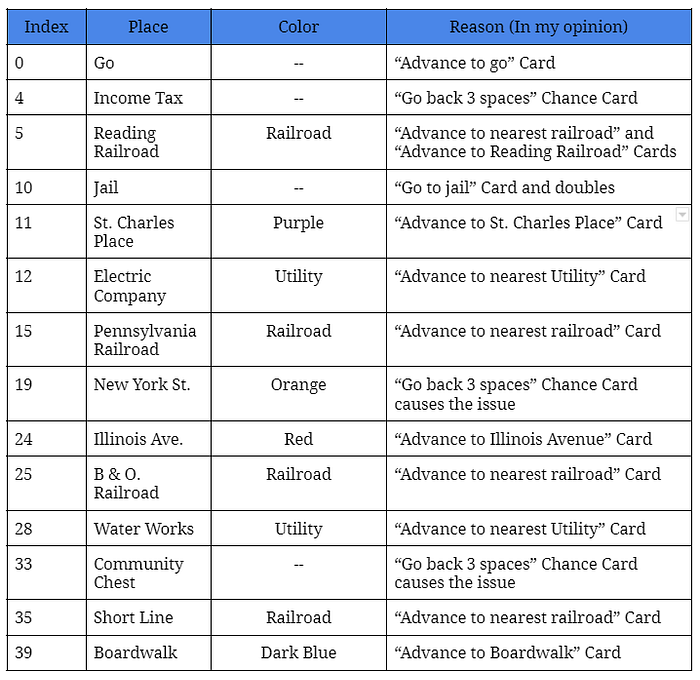
As you can see, there are reasons behind why each space is favored more than each other. The biggest influencers, at least in my perspective, are the chance/community chest cards. They cause certain properties to be favored much more than others, and completely mess with the seemingly random nature of the game. While the advance to property cards are an example (Illinois St., Boardwalk, Railroads, Utilities), the rather shocking card is "Go Back Three Spaces" in Chance. This card causes New York St. and Income Tax to be landed on much more often than other properties, reflected in the data.

So, what can we conclude? Buying the Orange properties might be an equally good option as Dark blues or Reds. Why? Well, first of all, New York St. is clearly highly landed upon because of the "Go Back 3 Spaces" Card. But, alongside that, Electric Company is very highly landed upon, which is exactly 7 spaces before New York St. We know that the most common dice sum is 7, so it's extremely likely someone lands on the Oranges after landing on Electric Company. In addition, Jail is the most landed upon space, and it's really likely to land on the Oranges from there. Hence, those who possess the Oranges have a strong chance of getting rent. Now, the Reds are still equally good — especially given their higher rent. Boardwalk remains a good option as well. But, one thing to highlight is the value of the railroads, especially Reading Railroad. They get landed on a lot, and if you have all 4, that can be a very good source of revenue. Thus, in summary:
- Buy the Oranges.
- Buy the Railroads.
- Don't blame yourself if you land on Income Tax a lot.
Hopefully this helps with your next Monopoly game! This simulation code is at the link below — I'll refine it more over time.