

Not a Medium member yet? Read this story for free here.
There are some sports disciplines I simply don't "get." I'm not talking about crazy stuff like base jumping or fringe sports like camel racing or made-up events like Ultimate Frisbee or eSports tournaments. I'm talking about recognized sports, ones in the Olympic Games, ones represented by serious federations. Ones that even get occasional television coverage.
Look, this is coming from a totally omnivorous sports fan. I'll watch almost anything: pretty much 90% of what is shown in the Summer Olympics, the same for the Winter Olympics, international and premier club football, American football, rugby, boxing, basketball, volleyball, tennis… hell, even televised sumo on a slow sports weekend.
So maybe I need to narrow down what I mean by my "not getting" the following sports. It's not that they don't require skill or strength. For some of them, it's not even that they're not fun to watch. It's that they don't make sense from a purely athletic/physical/dynamic standpoint. If we can think of Pierre de Coubertin's Olympics motto of "Citius, Altius, Fortius" (Latin for "Faster, Higher, Stronger") as a convenient litmus test of what makes for an actual sport, the disciplines on this list would carry, at the very least, a question mark.
First and surely the most controversial on the list is a trifecta of three of the four recognized competitive swimming styles: the backstroke, the breaststroke, and the butterfly. Yes, I know: these are major events followed by millions during the Summer Games and World Swimming Championships, and produce demi-gods like Mark Spitz and Michael Phelps.
But think about these swimming styles from a practical point of view. What is the point of diluting what is essentially a contest about moving through water as quickly as possible, i.e. freestyle swimming or what used to be known as "the crawl," by formalizing three additional and manifestly sub-optimal ways of doing so?
If we were to apply the same logic to track events, we'd have to add to the usual running events the running-backwards 200 meters as the equivalent of the backstroke; the only-hopping-with-feet-joined 400 meters as the equivalent of the breaststroke, and the 110 meters hurdles, except with the hurdles placed every two meters, as the equivalent of the butterfly. Madness.
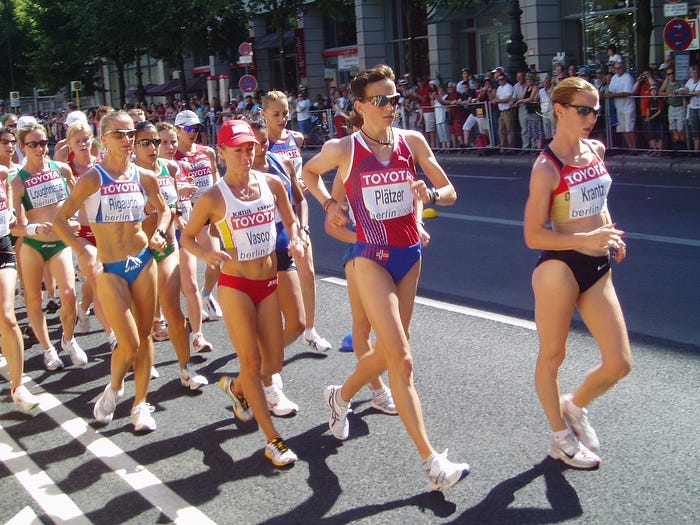
Proper track & field has a couple of illogical disciplines all of its own. The one that comes most easily to mind, and is jeered at enough already, is racewalking — or, as it's more commonly known, "the silly walk race." I mean, aside from the ridiculous gait that the sport mandates, what is the point? To cover a given distance less quickly than by running, while looking like something out of a Monty Python routine?
And what deep-seated masochism leads a young track & field-oriented person who — given the option of training in the various sprints, the distance runs, the javelin throw, the pole vault or the high jump — decides instead on the 50-kilometer race walk as their path to athletic glory?
Far less mocked, but equally inane in my opinion, is the triple jump. This used to be known as the "hop, skip, and jump" event before the PR folk at the various track & field federations decided that it sounded too playground-ish.
But playgroundish it is. Run, then hop, then skip, then jump? Seriously? Why not events in hopscotch in that case, and separate singles and doubles categories in Double Dutch jump roping?
Staying with the playground analogy for a second, but time-travelling it back to circa 1830: rhythmic gymnastics. Admittedly, the gals twirling around the mat with their quaint accessories have impressive levels of coordination, accuracy and flexibility. That said, it's still essentially about watching skinny young girls playing with bouncy balls, hoops, bowling pins and streamers. A little too weird — borderline creepy, in fact — for comfort.
On to the racetrack, and harness horse sulky racing.
Huh?
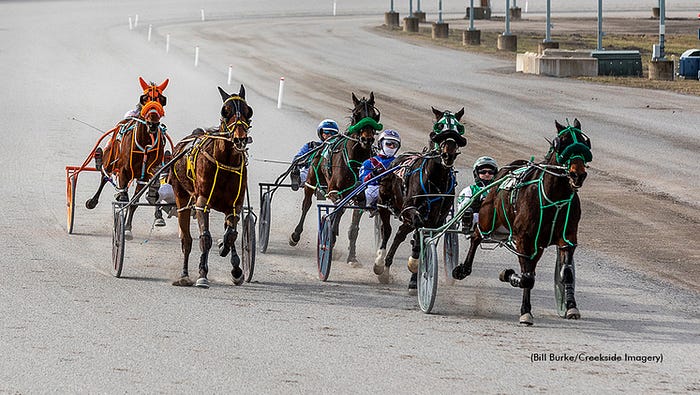
OK, sorry. For the non-initiated, this is that horse race where horses pull a light two-wheeled single-man cart, called a sulky, to determine which horse-and-cart combo can go fastest. But only if they don't gallop.
HUH?
Yes, that's the rule: they can only trot, not go as fast as a horse can actually go. And heaven forfend that, in the hope of extra oats going to the winner, the horse interrupts the dictated pace and breaks out, however briefly, into a run. Like the distracted or perhaps sneaky racewalker having two feet momentarily airborne, it too will be immediately disqualified. Assuming that this sport is a descendant of hell-for-leather chariot racing, it seems to have lost the spirit of the exercise somewhere between 2500 BCE and now.
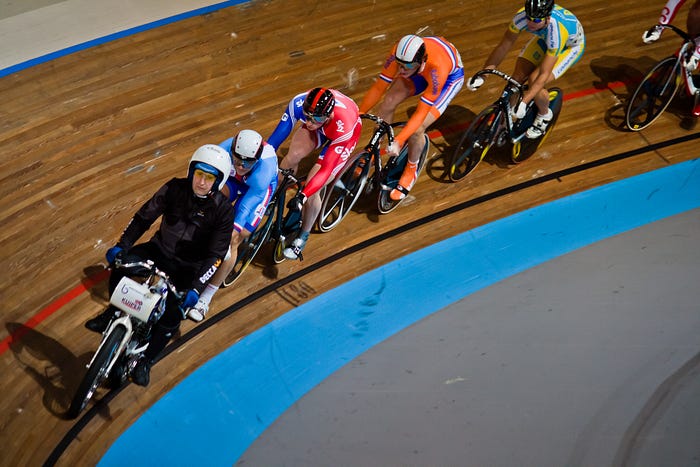
Still on the track, but this time in the form of the indoor cycling oval, we come upon that strangest of spectacles: a platoon of lycra-clad cyclists tailgating a very upright fellow puttering around the track on a motorcycle. Formally called Keirin racing, and a fully fledged Olympic track cycling event, this odd discipline involves the motorcycle rider fading away after a few laps, leaving the cyclists, suddenly draftless, to sprint to the finish. So again: what is the point? We might as well have gymnasts on the beam do a few somersaults safely suspended from the ceiling via harness before finishing their routine with an untethered backflip dismount.
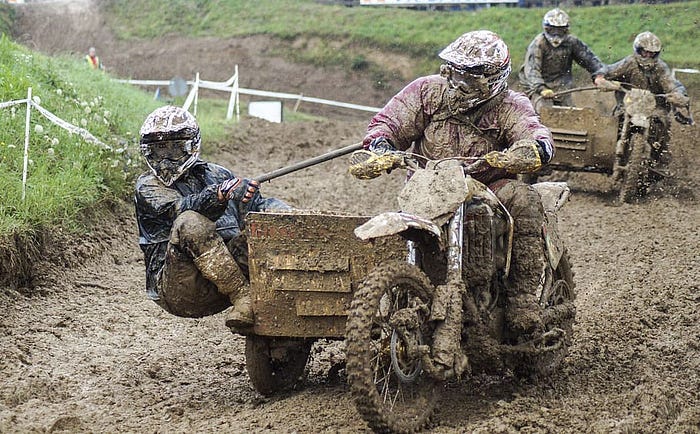
Also involving motorcycles, albeit in a configuration you don't see anymore except in quirky travel shows, is the redheaded stepchild of all motorsports: sidecar racing. A two-man discipline practiced in both track and motocross racing, in which the passenger's contribution consists entirely of leaning this way and that to counterbalance the centrifugal force experienced in taking curves at speed, sidecar racing gets very little respect even from motorcycle racing fanatics: barely tolerated as a warm-up act to the proper races to follow. Ask any motorcycle racing fan to name a single one of these riders of three-wheeled oddities, past or present. A blank stare is guaranteed.
Olympic breakdancing. Here, nothing more needs to be said on the matter, for which we shall be forever grateful to the tragicomic Rachael "Raygun" Gunn of Australia.
Back to aquatics, and I submit to you stand-up paddleboarding. Blending awkwardness and inefficiency, this worst-ever use of a board upon water involves such ungainly motion and discomfort (for the practitioner as well as any observer) that it should be banned on both humane and aesthetic grounds. Yes, it supposedly works your "core." So does holding a "plank" position for over a minute. Neither is fun to do, nor fun to watch. Pacific islanders must laugh their heads off when they see earnest white folk slowly wobbling their way across the lagoon on these things.
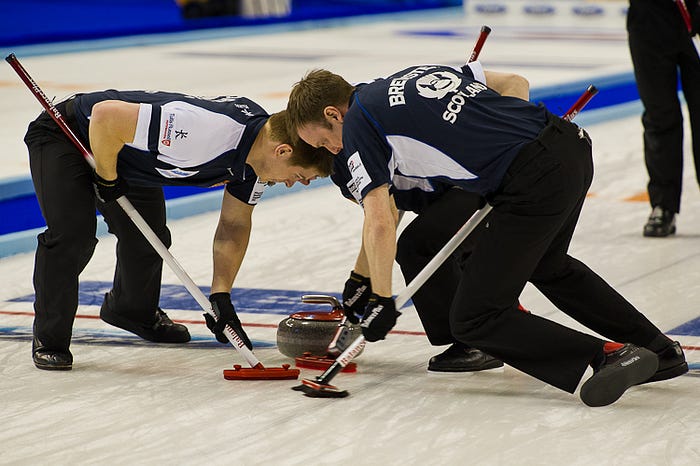
Last but not least, over to winter sports, and — you guessed it — curling. This one you literally could not make up. Involving the strangest approach run in sports, you push a big round stone with a handle bolted on to it over the ice up to a certain line, whereupon you let go of it and your teammates get busy with stiff little brooms, fine-tuning the stone's momentum so that it stops as near as possible to the center of a dartboard-like circle etched in the ice.
Borrowing from lawn croquet, your team can also try guiding your stone to bump that of your opponents out of said bulls-eye. It's as if a bunch of Canadian housewives living near the Arctic Circle got really drunk one night and invented a sport requiring only what they had lying around the house. To its credit, it's worth watching once, for the sheer absurdity of it.
So there we have it, ladies and gentlemen. Ten sporting disciplines you have to see to believe. And, far from wishing to denigrate the efforts of the brave men and women involved in these competitions, I salute their resoluteness in pursuing their chosen sporting passions, defying the derision with which their sports are, on occasion — including here — considered.
They might not be the best examples of Citius, Altius, Fortius, but these sportsmen and sportswomen certainly demonstrate Pilae Magnae.