

Ever since I joined Mastercard, I've become more attuned to how people pay, whether they dig for coins, swipe plastic, or just tap their phones. It's turned me into a bit of a payments nerd. But it's also opened my eyes to how different the experience is around the world.
Take China. I remember my first time back in a while, Hunan, a third-tier city, and how blissfully cashless life was. As a light-packing tourist, not needing a wallet was liberating. I could leave the house with just a phone, and come back with bao and boba in hand.
In contrast, Japan felt like a charming trip back in time. Coins jingled everywhere, even in restaurants. The payment counter sounded like a pachinko machine. I'd count out coins, the cashier will count them, we'd all pretend it wasn't painful.
Can I Cross the Border with Just a Phone?
Attempt 1: Taking the train
But the starkest contrast came this Golden Week. I was in Shenzhen, planning to cross into Hong Kong to meet some friends. Golden Week, China's national holiday from May 1st (Labour Day) to May 4th, is one of the biggest travel periods of the year. I thought I was being clever by going on the second day of the long weekend, skipping the early rush. I wasn't. High-speed train tickets were sold out. My only option: public transport.
That meant crowds. I was ready for that. But what I wasn't ready for was a full-blown regression into the Stone Age of payments, just meters from the border.
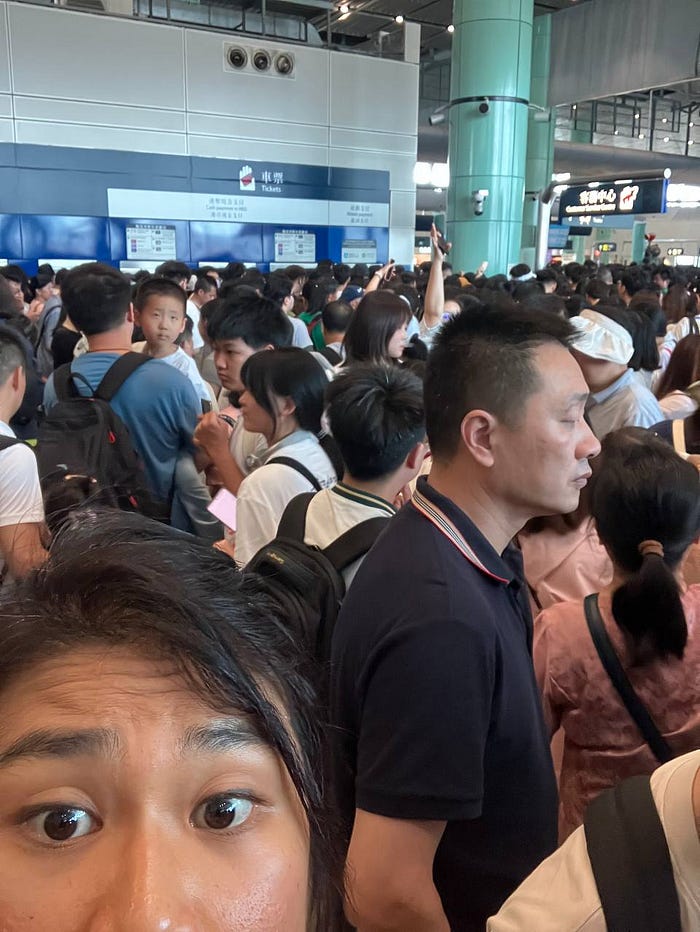
After three hours of inching through immigration, I made it to the train gantries on the Hong Kong side. I figured I was home free. Then I saw it: a human wall of stuck commuters, all holding their phones in the air like it was a Taylor Swift concert. But instead of swaying their torchlight in beat with the concert, thry were trying to catch a sliver of mobile signal.
You see, Alipay, one of the two apps making up the backbone of China's cashless system, relies on a live QR code that refreshes every few seconds. Problem is, the networks were overloaded. No signal, no QR code. No code, no gate access. People stood at the gantries frozen, desperately hoping for one last bar of 4G. And nobody behind them could move forward.
Being a proud Mastercard employee, I was smug. Surely my Mastercard would work here. I marched up to the terminal like a knight in shining NFC. Denied. The gantry didn't even blink. They didn't take Mastercard.
Sheepishly, I backed away and pivoted towards the Octopus card vending machines, the Hong Kong's equivalent of the Oyster card, and my ticket to salvation. Of the five machines, only one accepted card payments, and yes, the line was comically long. Still, I had an edge: my eSIM gave me better signal. I cut a few friendly deals with people in front of me. "Let me buy your card, pay me back on WeChat". I was this close to the front when the machine broke down. One person before me. The universe has jokes.
Next stop: the manual counter. But it only took Hong Kong dollars. I hadn't brought any. There were no ATMs in sight. I didn't even have Chinese RMB to exchange. I was fully digital, and utterly helpless.
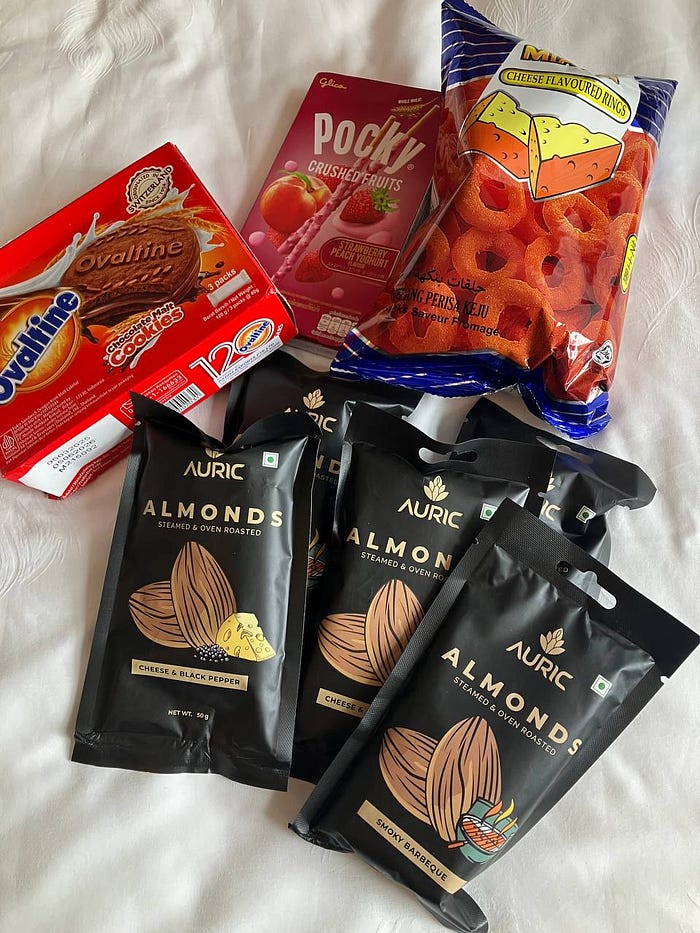
At this point, I gave up. My makeup was melting. I was disgusted by the ceaseless flesh to flesh contact with strangers' sweaty arms. Some uncle had left a sweaty imprint on my forearm that no amount of tissue could remove. My bag of biscuits, meant as gifts, was now a crumbled metaphor for my hopes. I wanted to go back to Shenzhen.
Attempt 2: Going back
But even that wasn't easy. The only way back was through a gated staircase near the bus terminal. The police were holding the crowd back to prevent a stampede. For another 30 minutes, we just stood there, cooked and confused, while everyone kept staring at dead phones, willing them to come back to life.
I pushed forward, hoping to ask the officer to make an exception for me since I was returning to Shenzhen instead of pushing through to Hong Kong. Speaking English helped. People let me through, assuming I was just another clueless foreigner. That worked, until I met a Hongkonger who wasn't having it.
"You still have to wait in line," he snapped. "Just because you speak English doesn't mean you get priority."
Fair point.
I smiled awkwardly. "Sorry, I didn't know. I'm not from here." I turned on the charm and struck up a conversation. "So what about you? Do you live in Shenzhen?"
He said he lived and worked in Hong Kong, and his house was ten minutes away. Yet he was stuck in the same snaking crowd as me. My guess? He'd taken a train within Hong Kong and had to use the same interchange to get to the bus.
We talked. We people-watched. At one point, there was almost a fight. I held my breath in morbid curiosity. A man shouted at the police officer in Cantonese, "阿Sir, 還要等多久呀? 都要等死人了!" (Officer, how much longer?! We'll die waiting!) I half-hoped it would escalate just for the drama. It didn't. The officer barked back, and the crowd cowed.
Finally, the gantries opened. I hesitated. I still had two hours until my meeting. Maybe I could call a cab. But my Uber barely loaded. I hovered on the edge of indecision.
And then, the same uncle from earlier came back. He'd stepped away from his own line just to check on me.
"You go back this way," he said gently, pointing up the stairs.
That was it. That sealed it for me. I couldn't pretend I had moral high ground if I bailed on all the people who helped me. So I turned, climbed the stairs, and walked back into Shenzhen.
I Missed the Meeting but Gained an Adventure
It wasn't the day I planned. I never made my meeting. I ate my crushed biscuits on the way home, broken, but still sweet.
But the experience made something crystal clear: China is fully cashless, and impressively so. Everything is digitized, from a street vendor to the city bus. Even public transport runs on green energy. No engine roar, no fuel smells. So quiet, some don't even use air-conditioning. And this was clear when juxtaposed against Hong Kong who still held on to cash.
So yes, the future is digital. And China is leading the way. But sometimes, just sometimes, it still pays to carry a little cash. Just in case.