
In the mid-20th century, as classical computers evolved from theoretical constructs into practical machines, computing was still in its infancy. The earliest programmable electronic computers, such as the ENIAC (1945) and the Manchester Baby (1948), demonstrated the potential of digital computation, yet they were slow, massive, and limited by rudimentary storage and processing power.
These early machines, built using vacuum tubes and later transistors, laid the groundwork for modern computing but struggled with scalability and efficiency. The limitations of classical hardware became apparent as researchers sought to tackle increasingly complex problems, such as cryptography, optimization, and simulations of physical systems.
Around the same time, another scientific revolution was unfolding — quantum mechanics, a field that had already reshaped our understanding of the microscopic world.
While classical physics explained macroscopic phenomena with great precision, it failed to describe behaviors at the atomic and subatomic levels. The discoveries of Max Planck, Albert Einstein, Niels Bohr, Werner Heisenberg, and Erwin Schrödinger in the early 20th century introduced a new, probabilistic framework where particles could exist in multiple states simultaneously (superposition) and exhibit nonlocal interactions (entanglement). These counterintuitive phenomena challenged classical intuition but offered a deeper understanding of reality.
It wasn't until the 1980s that physicists and computer scientists realized that quantum mechanics could revolutionize computation itself. Richard Feynman (1981) and David Deutsch (1985) proposed that a new type of computer — a quantum computer — could outperform classical machines by harnessing quantum principles. Unlike traditional bits, which exist in states of 0 or 1, qubits can exist in a superposition of both states, enabling vastly parallel computations.
This marked the birth of quantum computing, an entirely new paradigm with the potential to tackle problems that remain intractable for even the most powerful classical supercomputers today.

The First Glimpse of Quantum Phenomena
The origins of quantum mechanics can be traced back to Max Planck's groundbreaking work in 1900. While investigating black body radiation, he introduced the revolutionary idea that energy is quantized rather than continuous. Planck proposed that electromagnetic radiation is emitted or absorbed in discrete packets, later called quanta.
This discovery was deeply unsettling at the time, as it challenged classical physics, which assumed energy behaved like a continuous wave. Despite his own reluctance to accept the full implications of his findings, Planck's work laid the first stepping stone into the quantum world.
Just a few years later, in 1905, Albert Einstein took Planck's idea even further while explaining the photoelectric effect — a phenomenon where light ejects electrons from a metal surface. Instead of treating light as a continuous wave, Einstein proposed that light consists of discrete energy packets, which he called photons. This idea directly contradicted the classical wave theory of light and provided the first experimental validation of quantum principles. His work not only explained the photoelectric effect but also laid the foundation for quantum theory, earning him the Nobel Prize in Physics in 1921 (though he received it in 1922 due to procedural delays).
As quantum mechanics evolved, new discoveries deepened the mystery of the subatomic world. In 1913, Niels Bohr introduced his atomic model, proposing that electrons orbit the nucleus in discrete energy levels and that they jump between these levels by emitting or absorbing energy quanta.
Although Bohr's model was later refined, it pioneered the concept of quantized energy states, reinforcing the idea that nature itself operates in discrete units. By the 1920s, two competing mathematical frameworks emerged to describe quantum behavior: Erwin Schrödinger's wave mechanics and Werner Heisenberg's matrix mechanics.
These approaches, though mathematically different, converged into a unified theory — what we now call quantum mechanics.
By the late 1920s, a new generation of physicists sought to formalize the meaning of quantum theory. The Copenhagen interpretation, led by Bohr and Heisenberg, introduced the idea that quantum systems exist in a superposition of states until measured, at which point they "collapse" into a definite state. This interpretation sparked intense philosophical debates, especially with Einstein, who famously rejected the idea that "God plays dice with the universe." Meanwhile, Max Born and Wolfgang Pauli helped establish the probabilistic nature of quantum mechanics, emphasizing that particles do not have definite properties until they are observed.
The term "quantum mechanics" was formally adopted during this period to describe this rapidly growing field. The word "quantum" originates from the Latin "quantus," meaning "how much," symbolizing the discrete nature of energy and matter.
The implications of quantum mechanics went far beyond physics, influencing chemistry, cryptography, and later, the development of quantum computing. Despite its abstract nature, quantum mechanics has become one of the most experimentally verified theories in science, forming the foundation for modern technology, including semiconductors, lasers, and superconductors.
Einstein vs. Quantum Mechanics
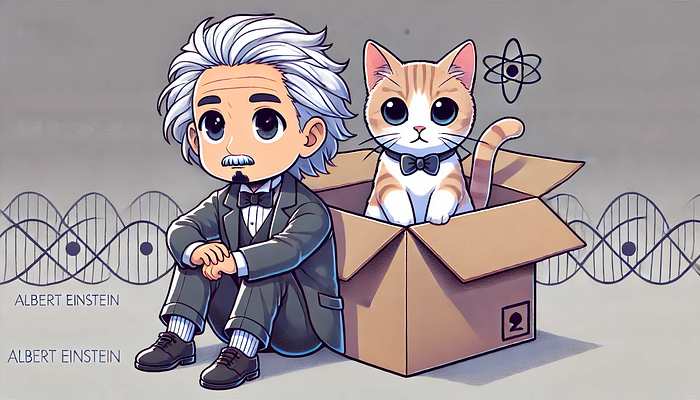
Albert Einstein, despite laying the groundwork for quantum mechanics, remained one of its fiercest critics. His discomfort stemmed from the intrinsically probabilistic nature of quantum theory, which contrasted with his deep-seated belief in a deterministic universe.
Unlike classical physics, where precise knowledge of initial conditions leads to predictable outcomes, quantum mechanics suggested that nature itself is governed by probability, not certainty. His skepticism was not mere philosophical resistance — he sought to prove that quantum mechanics was an incomplete theory, missing a deeper underlying reality.
One of Einstein's most significant challenges to quantum mechanics was the Einstein-Podolsky-Rosen (EPR) paradox, published in 1935. This thought experiment questioned the fundamental concept of quantum entanglement, where two distant particles could remain instantaneously correlated despite no apparent communication between them. Einstein argued that this "spooky action at a distance" violated the principle of locality, meaning that events occurring at one location should not have an immediate effect on another distant location.
He proposed that hidden variables — unknown factors within the particles — might explain these bizarre correlations, suggesting that quantum mechanics provided only a partial description of reality.
His doubts sparked some of the most crucial advancements in modern physics. In 1964, John Bell formulated Bell's theorem, which outlined a mathematical way to test whether quantum mechanics or hidden variable theories were correct. Experimental tests conducted decades later, particularly by John Clauser, Alain Aspect, and Anton Zeilinger, confirmed that quantum entanglement is real and cannot be explained by local hidden variables.
Today, entanglement has become a core principle in fields like quantum computing and cryptography, enabling groundbreaking developments in quantum networks, secure communication, and teleportation protocols. Ironically, Einstein's relentless skepticism pushed physicists to prove the very thing he doubted, solidifying quantum mechanics as one of the most experimentally validated theories in science.
Quantum Mechanics and the Atomic Bomb
While quantum mechanics revolutionized our understanding of the microscopic world, its impact extended beyond theory and into one of the most destructive inventions in history — the atomic bomb. Although quantum mechanics itself does not directly explain nuclear fission, the field played a crucial role in advancing nuclear physics, which ultimately led to the development of nuclear weapons.
In the early 20th century, the discoveries of quantized energy levels and nuclear interactions helped scientists understand the forces binding atomic nuclei together. These principles, combined with experimental breakthroughs, set the stage for exploring how atomic nuclei could be split to release vast amounts of energy.
The Manhattan Project, initiated during World War II, was a massive scientific and military effort to develop the first nuclear weapons. The project was driven by fears that Nazi Germany might succeed in building an atomic bomb first. While nuclear fission — the process of splitting atomic nuclei — was discovered by Otto Hahn and Fritz Strassmann in 1938, it was the theoretical insights of Lise Meitner and Otto Frisch that explained how fission releases immense energy.
Although quantum mechanics was not the direct mechanism behind nuclear fission, its principles were vital for understanding neutron behavior, reaction probabilities, and energy quantization in nuclear materials. Scientists like Enrico Fermi used quantum statistical mechanics to model neutron transport, while Richard Feynman applied quantum electrodynamics to optimize bomb efficiency.
The project brought together some of the greatest physicists of the era, including J. Robert Oppenheimer, Niels Bohr, and Edward Teller, culminating in the first successful nuclear detonation — the Trinity test — on July 16, 1945. The bombs dropped on Hiroshima and Nagasaki soon after changed the course of history, demonstrating the terrifying potential of harnessing atomic energy. While the project showcased the power of scientific collaboration, it also sparked ethical dilemmas that continue to be debated today.
Many of the scientists involved later regretted their contributions, with Oppenheimer himself famously quoting the Bhagavad Gita: "Now I am become Death, the destroyer of worlds."
Beyond warfare, the principles derived from quantum mechanics and nuclear physics led to peaceful applications, such as nuclear power generation, medical imaging (PET scans), and radiation therapy. The ability to control nuclear reactions with precision, predicted through quantum models, has enabled sustainable energy solutions and advancements in healthcare.
However, the dual-use nature of nuclear technology remains a concern, as the same knowledge that fuels power plants can also lead to devastating weapons. The atomic age, born from a fusion of quantum mechanics, nuclear physics, and wartime urgency, remains a testament to both scientific ingenuity and the moral responsibilities of technological progress.
The Quantum Revolution — A New Age of Computing

One of the most famous paradoxes in quantum mechanics, Schrödinger's cat experiment, was designed to highlight the bizarre implications of quantum theory. Proposed by Erwin Schrödinger in 1935, the thought experiment describes a cat placed inside a sealed box with a radioactive atom, a Geiger counter, and a vial of poison. If the atom decays, the Geiger counter detects it, triggering the release of the poison and killing the cat. If the atom does not decay, the cat remains alive.
According to quantum superposition, until the box is opened and observed, the cat is both alive and dead simultaneously — a concept that defies classical intuition. While Schrödinger intended this as a critique of the Copenhagen interpretation, the experiment has since become a symbol of quantum weirdness and a foundation for quantum computing, where qubits exist in multiple states until measured.
While quantum mechanics was laying the groundwork for a radical new form of computation, classical computers were also undergoing rapid advancements.
The 1980s saw a unique exchange of ideas between the world of classical and quantum computation, largely driven by Richard Feynman, one of the most badass physicists of his era. Feynman, known for his unconventional problem-solving skills and deep intuition, struck a deal with his friend, a computer scientist, where they would teach each other their respective fields. This cross-disciplinary collaboration became a pivotal moment in computing history. Feynman's curiosity about classical computation led to insights that helped optimize traditional computing models, while his expertise in quantum mechanics paved the way for quantum computing itself.
In 1981, he famously stated: "Nature isn't classical, dammit, and if you want to make a simulation of nature, you'd better make it quantum mechanical." This led to the realization that a classical computer could never efficiently simulate quantum systems, sparking the pursuit of quantum computation as a fundamentally different model of computing.
From this foundation emerged the modern quantum revolution, an era in which quantum computing is set to transform every aspect of science and technology.
Classical computers have already reshaped society, but they struggle with inherently complex problems like molecular simulations, combinatorial optimization, and breaking cryptographic codes.
Quantum computers, powered by qubits, leverage superposition and entanglement to process information in a fundamentally parallel manner, allowing them to solve problems exponentially faster than classical counterparts in certain domains. This shift is not merely an improvement — it represents a paradigm shift in how we approach computation.
Despite the promise, quantum computing is still in its infancy. Building stable, large-scale quantum computers remains an immense challenge due to issues like decoherence, noise, and error correction. Unlike classical computing, where transistor miniaturization fueled Moore's Law, quantum computing requires mastering coherence, quantum gates, and fault tolerance.
Scientists and engineers are racing to develop scalable quantum architectures, from superconducting qubits (used by companies like Google and IBM) to trapped ions and topological qubits, each with its own strengths and challenges. While small-scale quantum processors have been demonstrated, practical quantum advantage — where quantum computers significantly outperform classical ones in real-world applications — remains a goal for the coming decades.
The quantum revolution is not just about computation; it is about redefining the limits of what technology can achieve. Quantum cryptography promises unbreakable encryption, quantum sensors could enable unprecedented precision in measurements, and quantum networks may lead to the next-generation internet. Whether solving complex scientific problems, revolutionizing artificial intelligence, or securing data in an increasingly digital world, quantum technologies are poised to reshape the future.
What started as theoretical debates and paradoxes has now become one of the most ambitious technological pursuits in history — one that could redefine the way we compute, communicate, and understand reality itself.
Transitioning to Quantum Computing — Where to Start?
Quantum computing is an interdisciplinary field, meaning that anyone — whether from physics, mathematics, computer science, or even engineering — can transition into it with the right approach. Unlike classical computing, which relies on bits (0s and 1s), quantum computing introduces qubits, which leverage superposition and entanglement to perform complex computations exponentially faster in certain cases.
To build a strong foundation, a structured learning path is essential. The core subjects required for a smooth transition include:
- Linear Algebra — Crucial for understanding quantum state vectors, transformations, and matrix operations used in quantum algorithms.
- Quantum Mechanics — Necessary for grasping wave functions, quantum gates, superposition, entanglement, and measurement postulates.
- Classical Computing — Helps in understanding the fundamental differences between classical and quantum computational paradigms.
- Quantum Circuits & Algorithms — Essential for designing quantum logic gates, quantum error correction, and algorithm implementation.
- Quantum Hardware (optional) — Beneficial for those interested in quantum hardware architectures, superconducting qubits, and trapped ion systems.
Join TheQuantumNoob Journey
Quantum computing is no longer just theoretical — major tech companies like Google, IBM, and startups like Rigetti and Xanadu are actively developing quantum processors that are expected to outperform classical supercomputers in the coming years.
In this series, TheQuantumNoob, I will break down high school-level math to cutting-edge quantum research, making it accessible for absolute beginners and researchers alike.
Whether you're a student looking for an entry point, a programmer aiming to learn quantum algorithms, or a scientist exploring new frontiers, this journey will provide structured learning, insightful discussions, and real-world applications of quantum computing. The following resources will guide our exploration:
- Linear Algebra Demystified — David McMahon (Fundamental math required for quantum computing) - Quantum Computing Explained— David McMahon (Beginner-friendly introduction to quantum computation and logic gates) - Quantum Computation and Quantum Information — Isaac Chuang & Michael Nielsen (The definitive reference for quantum algorithms, cryptography, and hardware models)
The quantum revolution is here, and it's time to dive in.
Follow me as I build TheQuantumNoob, demystifying the world of qubits, quantum circuits, and the future of computing. 🚀
