


VACCINES AND EXPERTS
You're expecting this story to have something to do with vaccinations, and it actually does, but first I want to tell you a little about William Shakespeare …
My first encounter with Shakespeare's plays was as a senior in high school when I was cast as Antipholus of Epheseus in The Comedy of Errors. Since then, I've seen it several times, which has led me to conclude that I probably wasn't very good.
Since then, Shakespeare has been a significant part of my life. I've appeared in two more productions, King Lear and The Tempest. When you're cast in a play, you basically live it for several months: analyzing the text, memorizing the lines, thinking about the characters, etc. I usually take it a few steps further: I'll seek out various editions of the play and read the editor's introductory notes, which occasionally provide fun ideas for performance.
That's on top of actual rehearsal. Outside the theater building, I have likely spent hundreds of hours running lines Shakespeare wrote through my brain to commit them to memory so I could perform them inside the building. I've spent many more doing so on my own, just because it's wonderful to have his poetry in your head.
One of my fondest memories of my freshman year of college was listening to my theater coach and mentor marvel at Derek Jacobi's portrayal of Hamlet in the BBC production. This was when videotape was new and exciting, and he'd recorded Jacobi's performance. He was directing me in a children's show at the time, but for some reason he thought I might learn something from watching this extraordinary actor perform the scene with Hamlet and his father's ghost, so he let me sit in his office to watch it.
I have read most (not all) of Shakespeare's plays. I still haven't set foot in Henry VI, nor have I read The Merry Wives of Windsor or The Gentlemen from Verona. There are several I return to all the time: Hamlet, King Lear, The Tempest, Macbeth, Julius Caesar, Titus Andronicus and A Midsummer's Night's Dream.
I always read a play prior to seeing them on stage, and I've seen all but five. Some, like Hamlet and Macbeth, I've seen four or five times. My favorite theater is the Oregon Shakespeare Festival in Ashland, but I've also seen the Bard performed in Portland and in various outdoor locales.
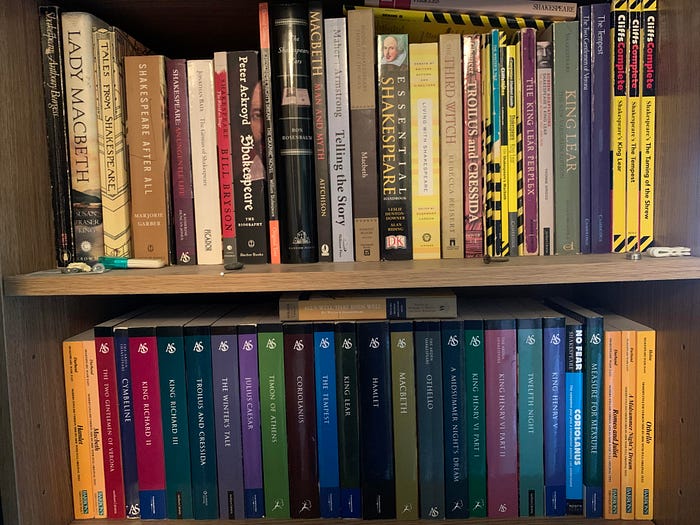
I have a bookshelf in my home office that is almost wholly given over to Shakespeare: Various editions of the plays (Arden, Pelican, Oxford, Folger's, etc.) along with supplementary material: Books about Shakespeare, the plays and sonnets. I even own (and consult) both volumes of Alexander Schmidt's Shakespeare Lexicon and Quotation Dictionary.
Last year I began reading the sonnets, which I'd neglected. A few I've memorized. Thanks to Sir Patrick Stewart for that. As the pandemic raged last year, he read virtually all the sonnets from his home in Los Angeles and posted them on social media so that anyone on Twitter or Instagram could listen, and I was there for it.
I also occasionally listen to the Folger Library's Shakespeare Unlimited podcasts, which affords an opportunity to hear actors, directors and scholars talk about their experiences and perspectives on Shakespeare and his work.
Oh, I almost forgot. The films. I've not seen them all, but I have seen those that I can find. I drove an hour across the Willamette Valley so I could see Julie Taymor's Titus Andronicus in a theater when it came out. Hamlet, of course, is a favorite. I like the Branagh version, because it's the entire play, and Jacobi is in there too, playing Claudius. But the best opening and Ghost scene may be found in the Olivier version, which is otherwise silly and pretentious.
So all this is basically a long way of saying that I know a thing or two about Shakespeare.
But I am not an expert on Shakespeare.
Nor am I an expert on any one of his plays — not even on those I've spent the most time with, Hamlet, Macbeth and King Lear.
There are plenty of roles I could play in Shakespeare (and many more I'd never presume to attempt) and hopefully I'll get to tackle a few more in my lifetime. But if I were to attend a conference of academic scholars on Shakespeare and tried to pass myself off as an expert — to basically play the part, drawing on many decades of work on my own with Shakespeare — I would fail. Real experts would see right through me. I'd fool no one. Unless I kept my mouth shut, I'd be outed before lunch on the first day.
And Sir Patrick Stewart? I might venture that it's safe to call him an expert on Shakespeare, but you note that I said he read "virtually" all the sonnets. That's because he skipped some. I remember one in particular, where he said he'd spent a lot of time working with the text and reading it aloud, but at the end of the day, he just didn't understand it.
So I suspect that if even the mighty Sir Patrick humbly acknowledged that he has some expertise on Shakespeare, he would surely deny that he is an expert on the sonnets — and those are not the same thing.
Which brings me to vaccines ….
Thousands of Americans have died from Covid-19 because they listened to self-described "experts" on vaccines who were, in fact, not. They took counsel from these "experts" (presumably over the advice of their own physicians) and paid for it with their lives.
There's one self-described expert (who, incredibly, is an osteopath) who made headlines recently. Anti-vax activist Sherri Tenpenny claimed, ludicrously, that pictures on the Internet showed people with utensils stuck to their bodies. The vaccine, she said, had magnetized them. (They don't).
Tenpenny claims to have done more than 40,000 hours of "research" on vaccines — none of which, I'd venture to guess, was done in a virology lab or faced the crucible of peer review. Forty-thousand hours amounts to about 14 years.
Here's some context for her supposedly vast reservoir of knowledge about viruses and vaccines. By around the time Tenpenny started her career as an osteopath, Dr. Anthony Fauci had already logged 14 years of professional work in virology, on top of his study in school. And he's been at it for several decades since.
Virology and epidemiology are fantastically complicated fields, expertise in which requires years of study and work drawing from equally complex fields such as biology, chemistry and medicine. You've either done the work, or you haven't. There are no kitchen table vaccine experts. Dr. Fauci is an expert on viruses and vaccines; Dr. Tenpenny is a dilettante who has been identified as one of the top "super-spreaders" of false information about vaccines. I spoke recently with a physician, and she seemed depressed, angry and exasperated all at once about the anti-vax movement. "They're killing people," she said.
I imagine one might object: But Sherri Tenpenny is also a doctor!
It is true that some doctors have staked out a position against vaccination. Putting aside the fact that there are people who have entirely legitimate medical reasons, in consultation with their doctor, to justify not getting the jab, I have to wonder about those who are acting as if vaccines are themselves a pestilence: 1) Why did they go into medicine in the first place? and 2) Do they derive some perverse joy from seeing patients with measles, chicken pox, whooping cough and tetanus infections?
But consider: Earth has between 15–20 million doctors. And guess what? Some of them are idiots. No field (including my own, journalism) is immune from this phenomenon.
Most doctors, however, are not idiots. And the vast majority of them are in agreement about the safety of vaccines.
So if you have questions, concerns or fears about vaccines (for Covid-19 or anything else) that's okay. Someone on my Facebook feed asked the other night if there was a causal relationship between vaccination boosters and virus variants. I've looked into that thorny issue just enough to know that it is enormously complex, so I suggested that she listen to the excellent podcast, This Week in Virology, one of the places real experts on viruses and vaccines congregate these days.
Better yet: Write your concerns down. Then get off your computer or device, make an appointment with your doctor and talk to him or her about it.
If your doctor is one of the very few who has come out against the vaccines, for whatever reason, and you decide that's good enough for you, I'd suggest that you hang on to that mask.
And I wish you the best of luck.
David Bates has written professionally for newspapers in the Pacific for more than a quarter century. He currently freelances online and writes about arts and culture for Oregon ArtsWatch and about ufology and skepticism on Medium.