

I recently read about humanity-centered design. It is a step in the design process to change humanity on a higher level than human-centered design. I found it an exciting topic, but after some thought, I wondered if it was a new thing, something we're not doing yet. What's the difference between human-centered design and humanity-centered design? Don't we make design human-centered to help a lot of people? These emerging practices help us craft better designs but can be confusing. Also, we tend to accept them without asking questions. Currently, there are enough design terminologies to fill the Library of Alexandria. It's an exaggeration (hopefully), but you get the point.
As time and people change, designers have to constantly redefine the meaning of design. You don't have to know all variations of design practices, as there are sure to be many. But it is necessary to truly understand some of these ideas and how we can apply them in our thought process to make better experiences.
Here I will focus on three design ideas: user-centered, human-centered, and humanity-centered UX.
User-centered design: This is an approach to focus on how a user or users interacts directly with the design. At this stage, the designer focuses on improving the user's experience of the product. In time, however, we recognized the importance of empathy in design, to make design that cares about people. So human-centered design stepped in.
Human-centered design: This considers the human behind the user. It encourages practitioners to truly empathize and understand the person as more than a product statistic. It helps to see the problem from this viewpoint because it's an invaluable insight into people's lives, showing the designer why people do things the way they do.
Humanity-centered design: This practice views humanity as a single system with deep-rooted problems. The main goal is to solve some of the biggest concerns that affect us as a species.
Note, that humanity-centered design is not a new concept. It's been around for a long time. Products with a global market become what they are because they seek to eliminate the problems we all have as a society.
How are they related? These three ideas are not directly side-by-side but stacked on top of each other. Together, they make a single process that seems to evolve as the scope becomes bigger. It starts with one person at the center of the process, then expands to two people, to a small group, to a community, to a large group, and so on.
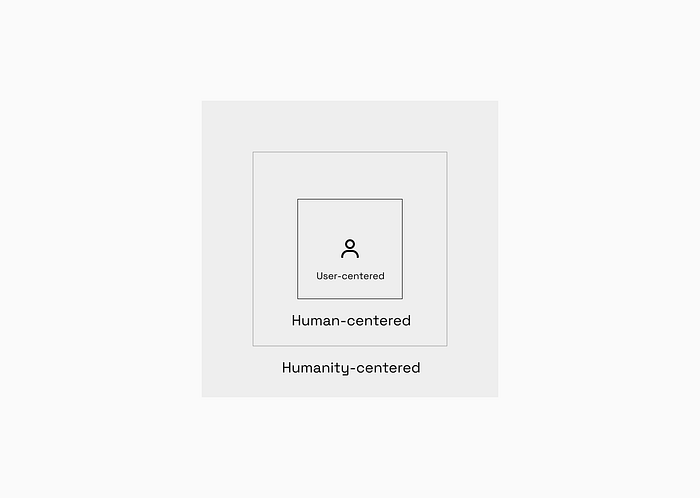
This idea is similar to how writers visualize worldbuilding. In worldbuilding, there are two ways to design a world:
- With the top-down approach, you start building by looking at the universe, solar systems, and planets and down to the details.
- The down-to-top approach, which, as you might have guessed, starts with the details and expands the scope. From physics to biology, to sociology, eventually to the planet, etc.
Humanity-centered design is high-scoped thinking and only concerned with people as an entity instead of their differences. It spreads out too wide to dig into the details concerning just one user, and if used alone or out of context, it creates a void.
Here's a similar example. In Isaac Asimov's Foundation, psychohistory is the study of the past and present of a group to predict possible future events. A great idea, but there is a downside. It can only anticipate the future if the population is big enough to be studied and there's enough history to examine past occurrences. Therefore it cannot predict the behavior of one individual. If one person did something completely different and sudden that contrasts with the bigger picture, it could change or even nullify Seldon's plan. This science does not consider individual differences. Still, it was an impressive gambling tactic, given how far he thought ahead and how well he executed the strategy.

Now, think of design in this way. Imagine if we solved the problems of a large group of people, but somehow we do not consider the differences of these people who will use it. People are different from each other in terms of culture, geography, language, ideologies, beliefs, and aspirations. To design a one-size-fits-all product and not prepare for each person using it is to ignore these differences. It won't do much, and that's not what we want to achieve. We want to help many people at once, but we must remember to go into the details because it's where you'll find the root problem.
There's not one way to solve a complex problem, only one suitable for the current context. Problems are dynamic and keep changing over time. It's why designers constantly update an existing design and why devs have to fix bugs. So, which one should you use? All of them. Spend time observing each user and gathering this data to design much bigger systems to help many. Remember, they're not separate practices, just different stages of the same process. Designers need to understand people from systematic and sub-systematic viewpoints to help organize the solutions in a way that will match their related scope.
The user-centered design creates the space to understand people as humans, which also paves the way to design and build more efficient systems for the benefit of humanity. Also, there's no standard way to go about it. You can use the bottom-up approach or start from the bigger picture; what matters is that you keep it focused on people.