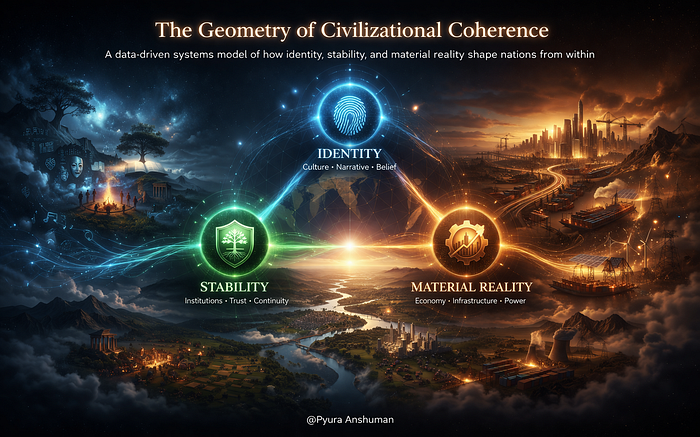


I've watched how people describe nations.
They talk about GDP. They talk about power. They talk about ideology.
But very rarely do they ask a more fundamental question:
What holds a civilization together from the inside?
You can feel the answer when you travel.
Some places feel grounded. Some feel fragmented. Some feel materially advanced but internally hollow. Others feel deeply rooted but structurally strained.
At some point, I stopped treating this as intuition.
I started treating it as a system.
Part I — From Intuition to Structure
I wasn't trying to measure wealth. Or happiness. Or religion in isolation.
I was trying to capture something above all of them.
Something I now call:
Civilizational Coherence
The ability of a society to sustain meaning, function, and stability simultaneously.
That definition immediately creates a constraint:
No single variable can explain it.
Because:
- Wealth without meaning leads to drift
- Faith without stability leads to fragility
- Identity without function leads to collapse
So the system had to be multi-dimensional.
The Four Forces
Over time, four variables kept showing up. Not politically. Structurally.
1. Identity (I) Does the society share a belief system or meaning structure?
2. Mental Stability (S) Do people feel secure and ordered in their lives?
3. Material Stability (M) Can the system sustain itself economically?
4. Cultural Continuity (P) Do people feel connected to their civilization?
Turning It Into Math
The simplest form:

And then:

Not perfect.
But transparent.
Why Simple First
I didn't start with neural networks or complex simulations.
Because if an idea fails in a simple model, it won't become true in a complicated one.
Clarity first. Complexity later.
Part II — From Ideas to Data
This is where most models quietly break.
Because none of these variables exist directly in reality.
There is no column called "civilizational coherence."
So the task becomes:
Find measurable proxies for invisible concepts
The Mapping
Each variable had to be grounded in real, global data.
Identity → Religious affiliation (%) Source: Pew Research, Our World in Data
Mental Stability → Life evaluation score Source: World Happiness Report
Material Stability → GDP per capita (PPP) Source: World Bank
Cultural Continuity → National pride (%) Source: World Values Survey
Why These Proxies Work
They are not perfect.
But they are:
- Comparable across countries
- Measured consistently
- Conceptually aligned
This is the best available approximation of something fundamentally abstract.
Normalization — Making Them Comparable
Each variable exists on a different scale.
So I converted everything to 0–100.
Mental stability:

Material:

Faith and pride remain percentage-based.
The Model

This reflects balance:
- Identity matters, but isn't everything
- Stability matters, but cannot dominate
- Wealth matters, but is insufficient alone
The Test Panel
To avoid bias, I selected 12 countries across systems:
Middle East, Asia, Europe, and the U.S.
This is not about cherry-picking.
It's about testing structural diversity.
Part III — The Results
Then I ran the model.
Here's what came out:
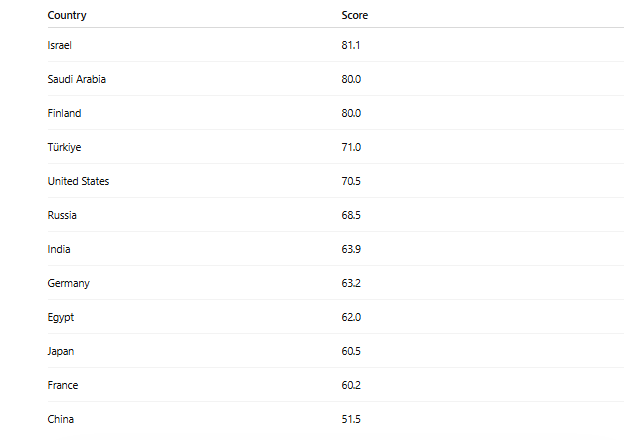
Identity-heavy systems often rank high.
What Actually Emerged
Not a ranking.
But patterns.
1. Balanced Systems (Rare)
Israel, Finland, Saudi Arabia
High across all variables. Internally aligned.
2. Identity-Heavy Systems
India, Egypt
Deep meaning. Lower structural stability.
3. Material-Stable Systems
U.S., Germany, France, Japan
Efficient. Less cohesive identity.
4. Structural Outlier
China
Low faith. High cultural cohesion. Different architecture entirely.
The Core Insight
My original idea pointed to something real.
But here is the refined version:

Where:
- Identity Density = Faith + Pride
- System Stability = Mental + Material
The Trade-Off Reality
No system maximizes everything.
Every civilization is solving:
An optimization problem under constraints
- Too much identity, not enough stability → fragility
- Too much stability, not enough identity → drift
- Too much wealth, no meaning → emptiness
Redefining the Idea
So I dropped the original framing.
And replaced it with something cleaner:
Civilizational Coherence
The alignment between belief, stability, material reality, and continuity.
Final Thought
Most people analyze nations through outputs:
GDP Military Technology
But those are consequences.
The deeper layer is structural:
What keeps the system internally aligned?
Because over time:
Internally coherent systems outlast externally dominant ones.
Where This Goes Next
This is still Version 2.
The next layer adds:
- Inequality (Gini)
- Institutional trust
- Social cohesion
- Historical continuity
That's where this becomes:
A true systems physics model of civilizations
Closing Line
We don't just build nations with infrastructure.
We build them with alignment.
And alignment is something you can feel.
But now, at least partially —