

BASKETBALL FROM A NEURODIVERSE VIEW
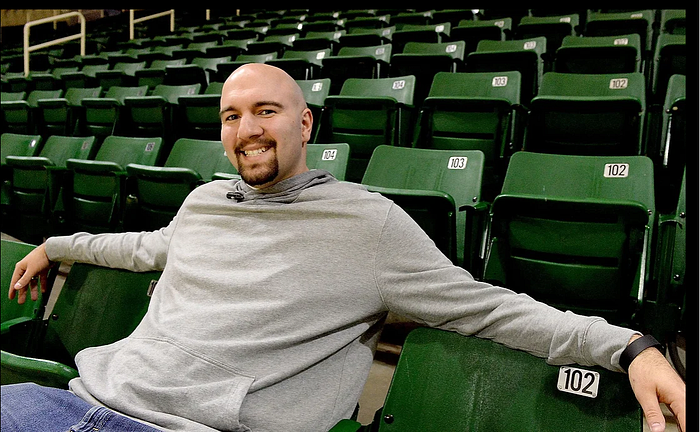
Despite being 6-foot-9, Anthony Ianni doesn't fit the standard profile for a basketball player.
As the first Division I college basketball player known to be on the autism spectrum, Ianni provides a unique view of playing basketball from a neurodiverse perspective in "Centered," his autobiography written with Rob Keast.
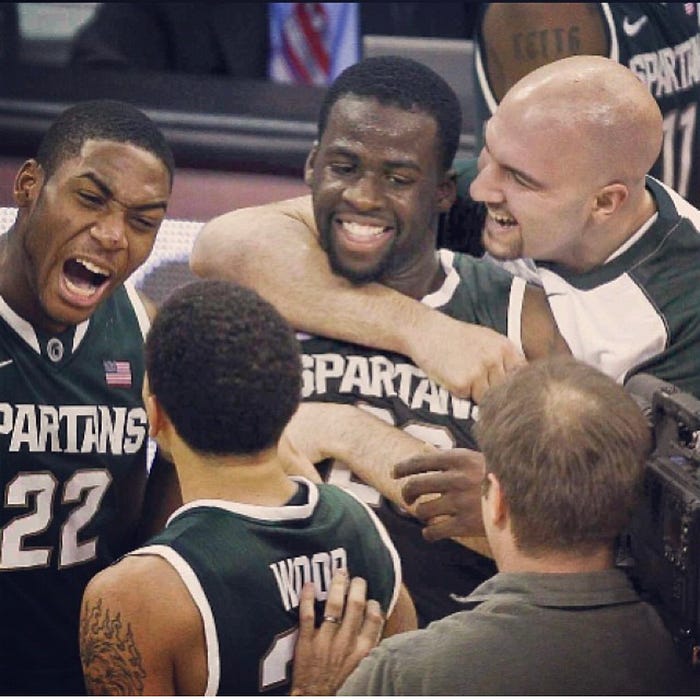
Ianni was a teammate of Golden State Warrior Draymond Green at Michigan State on its 2010 Final Four team and a reserve center for Tom Izzo's Spartans from 2009 to 2012.
But he doesn't just write of his basketball challenges. He talks about experiencing sensory overload going to basketball games as a child, getting bullied for being different, and enduring academic and social struggles.
His memoir is a ticket into the autism world and the challenges that neurodiverse people encounter in a primarily neurotypical society.
As the dad of a teenage son on the spectrum, one thing that I took away from his memoir is we shouldn't predict a child's limitations as an adult when they're only 4 or 5 years old.
When Ianni was diagnosed with autism at 4, doctors and specialists told Ianni's parents that he would "barely graduate" from high school.
They said he would never go to college and becoming an athlete was out of the question.
They also predicted he would likely grow up and live in a group home with autistic adults.
Ianni proved them wrong.
Besides becoming just one of the 3.5% of high school basketball players to play college basketball, Ianni also graduated from college, married, and has two young boys.
He has shared his story with over 400,000 K-12 students in schools, talking about the harmful effects of bullying he experienced growing up and helping to create a more inclusive world.
As a speaker for the Michigan Department of Civil Rights, Ianni seeks to make schools a safe environment where students can learn without being worried about being taunted by bullies.
One similarity I noticed between Ianni and my son is they both have some unusual behaviors which is normal for autistic people.
My son likes creating monologues and fictional stories in the bathroom, and he will often lose track of time engaging in this creative pursuit.
So I chuckled when I read Ianni had this same tendency as a teenager, and it was reassuring.
Ianni would create play-by-play commentary of imaginary games or postgame interviews with his high school teammates while in the shower.
"Iannia catches the ball. He makes a move. He puts up a hook. It's up and good! Two more points for Ianni. Was that Kevin McHale or Anthony Ianni?"
As the game intensified, his voice would rise dramatically or speed up with the action, and his mom would sometimes knock on the door.
"Ant, everything OK?"
"It's all good, Mom."
After a while, his mom — like my wife and me — accepted his talking in the bathroom as part of his identity and didn't see it as unusual.
One of my favorite parts of Ianni's memoir is when he shared his difficulty trash-talking with his teammates because he found it a struggle to come up with spontaneous replies on the spot.
His default retort to trash talk from his Okemos High School teammates:
"Yo Mamma!"
"A.I., you call that jumping? Your feet were one foot off the ground. Got rocks in your socks?"
"Yo Mamma!"
"A.I., you wear those shorts to school today?"
"Yo Mamma!"
This passage made me laugh because my son knows hundreds of "Yo Momma" jokes, and like Ianni, a scripted joke is an easier form of interaction than a back-and-forth conversation.
As a lover of comedy movies, my son often uses jokes and pranks to communicate with others because social communication is a challenge.
He enlisted three of his cousins in a prank on his grandmother to try to make her believe that one became a stripper, another shovels bear poop at the zoo, and he makes videos following people around with a tuba at Wal-Mark to support his oldest cousin going back to college.
It isn't right or wrong. Just different.
Autism is like visiting a foreign country with a different language. I wouldn't criticize people in another country for their different customs nor would I think they should change for me.
As a father, I've learned to embrace my son's autistic culture. My bridging this divide has encouraged him to step into my neurotypical world, chatting about subjects such as sports.
Draymond Green learned to understand Ianni's difficulties as an autistic teammate.
First, though, Green and Ianni had an incident during a workout. Green joked with Ianni that he had to take a grueling conditioning test solely for freshmen and transfer players.
Ianni had already taken the test a year before and didn't understand Green was only joking.
When Ianni took it seriously, Green spat at him, "You need to learn to take a joke. If you can't take a joke, you shouldn't be on the team."
A shoving match ensued. The team's strength and conditioning coach had to intervene and inadvertently let it slip that Ianni was autistic.
The coach told Green that being autistic makes it hard for Ianni to tell when someone is joking.
Following the incident, Green took Ianni under his wing by explaining the details of offensive plays ("set the pick at the top of the key") and the near fight cemented a long-lasting friendship.
The conflict between Green and Ianni reminded me of those between my son and his best friend when they went through a "frenemy" phase.
Autism specialists didn't tell my wife and me about our son's limitations as an adult when he was diagnosed with autism at 4.
I remember when he had trouble in a My Gym Class doing an egg roll: Grab your knees, pull your legs to your chest, roll forward, roll backward, roll side to side, fall back, and crack.
There were too many directions, shouted rapid fire by his teacher, for him to process at once.
The stinky feet exercise was next: Smell your feet, say "PEE-YOU," grab soap and water, grab baby powder, sprinkle your feet with baby powder, smell your feet again, sneeze, and fall backward.
The directions were again shouted too fast.
My son laughed as the other kids smelled their feet, and watching this tableau, I thought to myself, if my son's development is jagged in certain areas, I will remember all of the things that he does well.
Like learning to read at 4 and knowing the location of all 50 states and their capitals on a United States puzzle map.
Ianni's memoir reminded me that my son has something very important to offer to the world.
He has already taught me how autistic people see the world differently and how I can bridge this difference by viewing interactions with my son as a form of cross-cultural communication.
So I know that he can teach others and share gifts from his creative wheelhouse with others.
Thanks for reading my story.