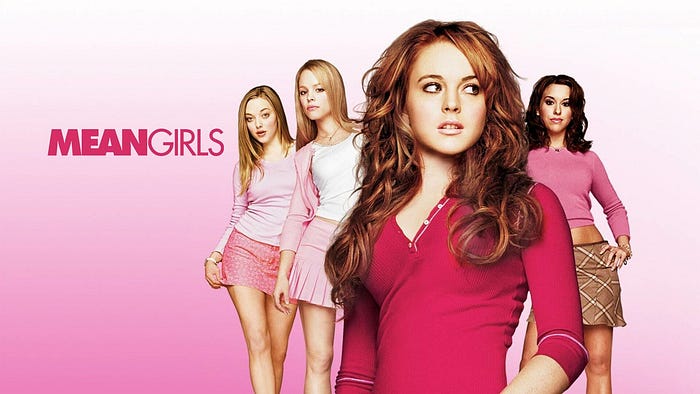


Lindsay Lohan stars in Mean Girls (2004), Tina Fey's razor-sharp high school satire inspired by Queen Bees and Wannabes. A funny, insightful teen movie that still hits hard.
Mean Girls (2004)
Directed by: Mark Waters
Written by: Tina Fey
Starring: Lindsay Lohan, Rachel McAdams, Tim Meadows, Amanda Seyfried, Lizzy Caplan, Daniel Franzese
Release Date: April 30, 2004
From Psychology to Pop Culture Phenomenon
Rosalind Wiseman's book Queen Bees and Wannabes is a nonfiction sociological guide to understanding teenage girls. Covering topics like cliques, fashion, peer pressure, sex, and drugs, it offers parents insight into the complicated social lives of their daughters. It's thoughtful and informative — but hardly the kind of book one expects to be adapted into a mainstream comedy.
Enter Tina Fey, then a rising star from Saturday Night Live, who took on the challenge of turning these observations into a cohesive story with compelling characters, humor, and resonance. Fey's script distills the book's big ideas into sharp dialogue, relatable conflict, and, crucially, a lot of laughs.
Lindsay Lohan Finds Herself in the High School Jungle
Lindsay Lohan plays Cady Heron, a teenager who has been homeschooled her entire life — in Africa, no less, where her zoologist parents worked in the field. When her family returns to the U.S., Cady enrolls in a traditional American high school for the first time and quickly learns that the social ecosystem there isn't all that different from the African savanna. Predators, prey, and elaborate hierarchies rule the day.
After a rough start, Cady befriends two eccentric outsiders — Janis (Lizzy Caplan) and Damian (Daniel Franzese) — who give her a crash course in the school's social structure. Chief among the groups to avoid are The Plastics, a trio of ultra-popular girls led by queen bee Regina George (Rachel McAdams), with loyal sidekicks Gretchen (Lacey Chabert) and Karen (Amanda Seyfried). When Regina surprisingly invites Cady into their inner circle, Janis encourages her to accept — so she can infiltrate and ultimately expose them.
But things spiral quickly. As Cady becomes more embedded in the Plastics' world, she begins to enjoy the power, popularity, and validation that come with it. Her mission to sabotage the clique turns into full-blown assimilation, and the consequences alienate her from her old friends, her values, and eventually herself. The emotional climax of this shift is embodied in the Burn Book, a journal filled with cruel secrets and gossip that tears the school apart.
Fey's Script Balances Sharp Humor with Real Insight
Mean Girls follows a familiar structure for teen comedies, but Fey's wit elevates it beyond formula. She peppers the film with observational humor, skewering stereotypes with just enough warmth to make the satire accessible. Fey herself appears in a supporting role as a math teacher, and SNL co-star Amy Poehler memorably plays Regina's misguided, try-too-hard mom who wants to be her daughter's BFF more than an actual parent.
The movie isn't afraid to brush against uncomfortable truths. One standout moment comes during the holiday talent show, where the Plastics perform a highly sexualized dance to "Jingle Bell Rock." The moment is played for laughs but also delivers a stinging critique of how teenage girls are often encouraged to perform adult sexuality for attention — and how adults enable that performance. Fey's handling of this topic is unsettling in the right way, and forces the audience to consider the culture these girls are reflecting.
More Thirteen Than You'd Think
Most comparisons link Mean Girls with Heathers, the 1989 cult classic that took a much darker approach to high school cruelty. That's fair — both films share a satirical edge and a jaundiced view of adolescent power structures. But Mean Girls also has thematic overlap with Thirteen (2003), a raw, emotionally intense drama about the transformation of a teenage girl under peer pressure.
Thirteen and Mean Girls depict how quickly identity can change under the influence of new friends and toxic environments. Where Thirteen dives into despair, Mean Girls reflects those same ideas through the warped glass of satire. The result is a more accessible, less harrowing way to explore important questions about adolescence, authenticity, and personal growth.
A Candy-Coated Comedy with Substance
As a comedy, Mean Girls never wallows in melodrama — but it never dismisses the emotional stakes, either. That's its quiet genius. Fey's script, paired with Mark Waters' lively direction and a stellar cast, turns the high school experience into a playground of pointed jokes and powerful metaphors.
For parents, Mean Girls might serve as a soft entry point into hard conversations. It makes its points without preaching, satirizes without cruelty, and leaves a surprisingly lasting impact. It's one of the smartest teen comedies of its era — and one of the most enduring.

Tags:
Mean Girls review, Lindsay Lohan, Tina Fey, teen comedy, high school movies, Rachel McAdams, best of Jamie Lee Curtis and Lindsay Lohan, 2000s teen movies, comedy films, Reelscope