
When we talk about human-like problem-solving these days, buzzwords like Artificial Neural Networks, Deep Learning, and Generative Artificial Intelligence tend to dominate the conversation. But there's more to problem-solving than just these flashy technologies. While they're powerful tools, they don't fully capture the broader concepts and processes that help us tackle new challenges.
One of these underlying concepts is Case-Based Reasoning (CBR), which mimics human intuition by applying solutions from similar past problems to current issues.
In this article, we'll explore the theory behind CBR, how it works, and its real-world applications.
Structure
- What is Case-Based Reasoning?
- CBR-Cycle
- Components of CBR
- Real-World Applications
- Conclusion
What is Case-Based Reasoning?
Case-based reasoning (CBR) is a problem-solving concept that mimics human intuition. It takes solutions from previous experiences and tries to apply them to current issues.
Let's make it more visually by looking at the example of a car mechanic.

When a car mechanic encounters a broken engine, his first step is to diagnose the issue. Once identified, he recalls previous similar engine problems he's dealt with, searching for the closest matches to the current situation. From there, he selects the most relevant case.
Rather than applying the past solutions precisely as they are, he adapts them to fit the specific nuances of the current issue. After each adaptation, he tests the engine, evaluating the solution's effectiveness. If it doesn't work, he revisits other past cases or refines the approach. Through his experience, he can fine-tune solutions, and when successful, this new case and its resolution become part of his knowledge base for future reference.
As you may have seen in the example scenario, a specific process is defined to solve an issue. You will find this process in your everyday environment.
CBR-Cycle
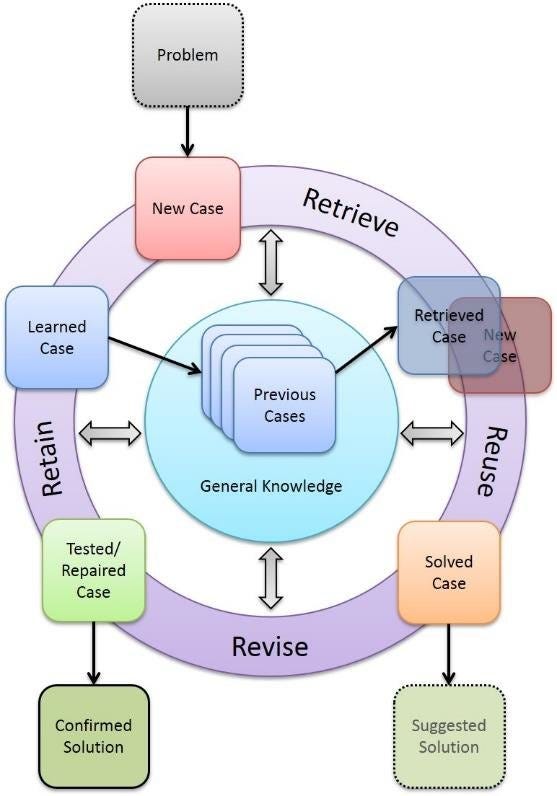
As seen in the car mechanic analogy, problem-solving through Case-Based Reasoning follows a specific process, much like a mechanic diagnosing and fixing an engine. This structured approach is known as the CBR cycle, which consists of four key phases: Retrieve, Reuse, Revise, and Retain. These phases mirror the way humans solve problems by recalling, adapting, and learning from past experiences.
Let's explore each phase in more detail.
Components of CBR
Retrieve
The retrieve phase is the first component in the CBR cycle. The system begins by receiving the current, unsolved case that needs to be addressed. Using this input, the system searches through the case base (or knowledge base) to retrieve k similar cases. Similarity measures are applied to find the most relevant cases, comparing the current issue with each case in the case base. Algorithms like k-nearest neighbors (KNN) and Euclidean distance are commonly used to determine similarity.
Reuse
Once the most similar cases are retrieved, the system enters the reuse phase. At this stage, the solutions from the selected past cases are adapted to the new problem. This step involves modifying the retrieved solutions to account for differences between the current and past issues. The adapted solution is then tested to see if it resolves the current problem. If the solution works, it proceeds to the next phase for further validation.
Revise
In the revise phase, the proposed solution is thoroughly tested to ensure it addresses the problem correctly. This phase may involve human intervention or additional intelligent systems to evaluate and refine the solution. If the solution is incomplete or flawed, adjustments can be made. This process of revision often leads to gaining new insights or experiences, which may influence future cases.
Retain
Finally, the retain phase involves deciding whether the new, successfully solved case should be added to the case base for future use. Cases that are sufficiently unique or provide novel solutions are typically retained, allowing the system to grow its knowledge base over time. By retaining such cases, the system improves its problem-solving capabilities for similar future issues.
However, you should be careful and thoughtful when adding a case to the case base because adding too many cases will slow down the retrieval process. So, you should have enough cases to solve future issues, but you should also have as few as possible.
Real-World Applications
Many real-world applications exist for case-based reasoning, from financial fraud detection to supported natural language processing. It can even be used for anomaly detection in images.
I am working with two study colleagues on one of these applications, financial fraud detection. I will report on the outcome and effectiveness of CBR in this field.
However, remember that CBR is just a concept, not a technology! This means that when choosing the right technologies, you will be able to solve many problem fields.
Conclusion
In conclusion, Case-Based Reasoning provides a transparent, human-like approach to solving problems by leveraging past experiences. Unlike black-box models like Artificial Neural Networks, CBR allows us to trace how cases are retrieved, how solutions are adapted, and how they are applied to new problems. This makes it a valuable method in fields where interpretability is essential, from medical diagnosis to financial fraud detection.
If you're interested in creating Machine Learning applications using CBR, you can check out the CBR Python library developed by two study colleagues and me. (Still under development)
Thank you for reading my article! Reading my articles means a lot to me, because I always invest a lot of time into them, and try to provide knowledge to others. I would love to hear some feedback from you on how I can improve or what you're missing in this article!