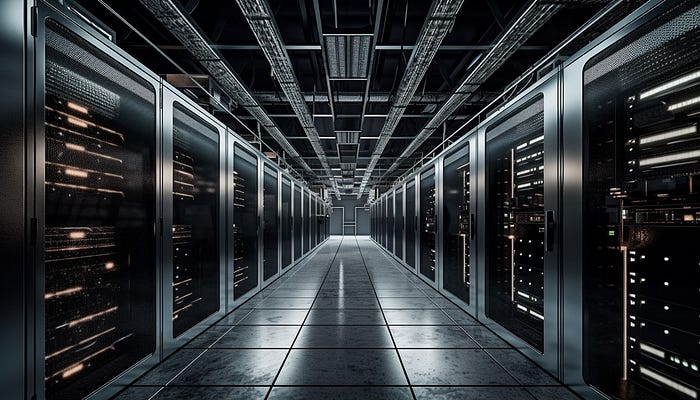
We all use the internet each and every single day without really thinking about what it takes to run all these applications. Well,behind all that is a system of super powerful computers called servers running the show. A server is a hardware or software system that delivers data, resources, services, applications, and other outputs to client devices over internal networks or the Internet. Servers can be hosted on premises, in large data centers containing rooms full of servers or in the cloud.
So what exactly is in these super machines that make them tick. Believe it or not,but servers are just computers with the tiny exception that they have to be running 24/7 and they have extremely powerful hardware. Some of these components include:
- CPUs (Central Processing Units)— One or more processing units (chips) that execute transactions and software instructions, perform calculations, manage data flow between motherboard components, and more.
- GPUs(Graphics Processing Units) — GPUs rapidly process requests requiring complex logical, visual, mathematical, and graphical rendering. They are used for gaming, video, design, and most importantly, processing workloads for AI and large language models (LLMs).
- RAM(Random Access Memory) — used for temporary storage during server processing.
- Storage — Storage, aka "secondary" or permanent storage, includes non-volatile media like SSDs(solid state drives), HDDs (Hard disk drives), and NVMe(Non-Volatile Memory Express) drives where data persists after power-off. This includes devices that store operating systems, data, and applications, such as hard drives, cloud storage, disk arrays, portable storage, and other media.
- Power supplies — Servers need one or more power supplies, including backup power as required.
- Motherboard — A circuit board that distributes electricity and connects and facilitates communication with all other server components.
- Network connection — All servers have one or more network interface cards (NICs) and internal network port(s). NICs allow communication between local and Internet-connected computers. Modern servers often use SFP+ or QSFP ports for fiber optic connections, not just standard RJ45 (Ethernet) ports.
All these critical components work together to handle data storage, processing, communications,and backups.
There are very many different types of servers which include: file servers, DBMS servers,print servers, application servers, Internet servers, virtual servers,virtual servers,AI servers and security servers. All these servers serve a distinct purpose and this is determined by server capacity, the operating system in use(Windows,Linux) and the servers' architecture(physical, virtual or cloud based).
Before an organisation selects what type of server to use,they need to consider the following:
- Server requirements. Select appropriate hardware and operating systems tailored to your applications. Plan for capacity and scalability to maintain performance and accommodate future growth.
- Physical type. Physical servers come in many formats, including tower, rack, and blade servers. Cloud servers and containers are Internet-based services that organizations lease or subscribe to.
- Location and maintenance. Will you run workloads on bare metal(a single-tenant physical machine where the operating system runs directly on hardware without a hypervisor layer), virtual machines, or within a containerized orchestration platform like Kubernetes? What maintenance will be required?
- Budget. How much can you spend on servers? Factor in operational upkeep costs when budgeting server expenses.
- Maintenance: Follow best practices for server maintenance, including regular patching, server monitoring, and backups.
With all that in mind, servers play an important role in the world now. We may not be able to see them,but their role is irreplaceable.