
Many of the ideas I am sharing in this "One Day Data Science Portfolio Ideas" series come from the book I wrote in 2021–2022 and then published in April of 2023. In a way, this series is a bit of a one year anniversary celebration of that book's publication.
In that book I wrote about open source projects:
Searching for a contribution you can make, and then implementing that contribution… makes for an impressive distributed portfolio entry.

Data Science Portfolio Inspiration
If you spend some time browsing the GitHub repository for one of data science's most used Python libraries, Pandas, you'll see the message:
"All contributions, bug reports, bug fixes, documentation improvements, enhancements, and ideas are welcome." (Pandas GitHub)
But that is not all! In late-night television-style Pandas also offers a contribution guide. If you plan to pursue this method of adding to or enhancing your data science professional portfolio — please-please-please make sure to read the contribution guide for the project you're working on.
Data Science Portfolio Example
As a "One Day Data Science Portfolio Idea" this topic is not new. I first wrote about this topic in early 2021.
A thrilling example of this approach comes from the prolific Stefanie Molin who also frequently writes here at Medium and is a software engineer in NYC and who is also the author of Hands-On Data Analysis with Pandas. In the fall of 2021 she writes about how she developed and contributed the ability to include a reference line in Seaborn visualizations.
From the summer of 2021, another exciting example of this is how Keith McNulty began a public discussion about how some of his work became available at CRAN. Via CRAN his work made data sets from his popular book Handbook of Regression Modeling in People Analytics easily available in R.
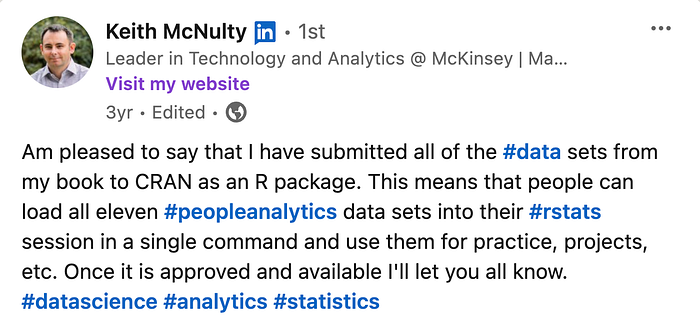
It was not long after Keith's announcement that an enthusiastic community member did the work to port the work to Python. Akshay Kotha's Python package is now available through PyPi's repository.
Data Science Portfolio Details
How to Contribute to Open Source Data Science Projects
The path for accomplishing a contribution to open source data science tools is clear.
- Visit the GitHub repository for a tool you care to work on. Not all packages use GitHub. The best managed packages will have a place to track existing issues.
- Browse the issue tracker. Filter the issues by tags that are of interest to you. Tags help organize and manage the issue tracking. Many of the tools have tags meant for new contributors such as "good first issue."
- Find an issue you are interested in solving. Be sure also to review the contributions guide.
- Use the issue tracker for discussion with maintainers and other contributors.
- Do the work. Then, submit your merge and pull request.
I also recommend you read Stefanie's related article:
Conclusion
At the time of writing this article Pandas listed 78 open "good first issue" issues in their issue tracker. The path to contributing to open source tools is pretty well paved.
If you take this idea as an approach to build your data science portfolio you can expect to experience a full range benefits. Some of which are difficult to fully anticipate.
Here are a two I often point towards.
- There is the altruistic outcome. You can make the world a better place for others. Importantly from a data science career perspective you can make the world a better place for other professionals in data science.
- You can't NOT learn from this kind of experience. Contributing to open source projects will help you learn. You will learn about new tools, you will learn about collaborating with others, you will learn about existing tools, you will learn about yourself, and you will learn about others.
If you have examples of your own contributions please let me know. Contact me on social or leave a comment with links here.
A final caveat, this idea is a bit of a deviation from the notion of completing an entire project in one day. Honestly, this kind of work may often require more than one day.
Contributing to open-source data science projects can be a recipe for success (it's also a ton of fun). Roll up your sleeves, dig into those "good first issues," and get your hands on some new coding experiences.

Thanks For Reading
Are you ready to learn more about careers in data science? I perform one-on-one career coaching and have a weekly email list that helps data professional job candidates. Click here to learn more.
Thanks for reading. Send me your thoughts and ideas. You can write just to say hey. Twitter: @adamrossnelson LinkedIn: Adam Ross Nelson.